 Bellingham Siding
 Board & Batten Siding for Birchwood Homes
Birchwood's mix of mid-century ramblers, updated bungalows, and newer infill homes has always suited a clean, vertical siding profile. Board and batten — wide flat panels with narrow strips covering the seams — gives these homes a look that reads as both classic Pacific Northwest and quietly modern, without the busy shadow lines of horizontal lap siding. It's a popular choice for accent walls, gable ends, dormers, and full elevations alike.
But board and batten isn't just a style decision. Done right, it's a moisture-management system. Done wrong, it's one of the faster ways to get water and rot behind a wall in a neighborhood like Birchwood, where the exterior takes a real beating for most of the year. This page covers what board and batten needs to hold up here, what a correct installation actually involves, and why we only install it in James Hardie fiber cement rather than the vinyl or engineered wood versions sold under the same name.
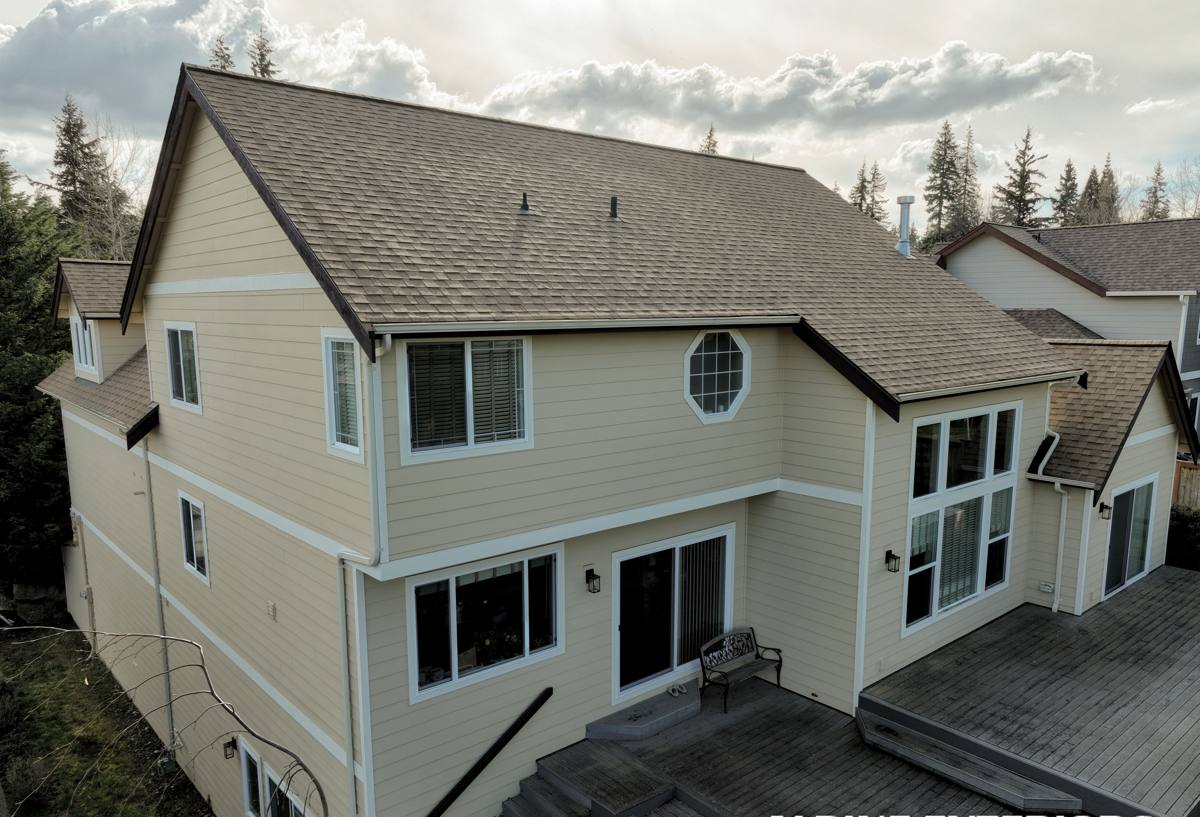
What Birchwood's Climate Does to Siding
Bellingham sits close enough to the Strait of Georgia and Bellingham Bay that salt-laden air reaches inland neighborhoods like Birchwood on a regular basis, especially with onshore winds. Add Whatcom County's long, wet fall-through-spring stretch of driving rain, and siding here is dealing with two separate stresses at once: corrosive salt exposure on fasteners and trim, and sustained moisture load on every seam and joint.
Then there's the moss. Shaded lots, tree cover, and months of damp, mild weather make Birchwood good moss habitat — and moss doesn't just grow on roofs. It colonizes siding surfaces, battens, and ground-level trim, holding moisture against the material far longer than open air would allow. On the wrong substrate, that's a slow, steady path to swelling, delamination, or rot.
Why This Matters More for Board & Batten Specifically
Vertical siding systems have more horizontal joints and batten seams per square foot than a lap siding wall, and every one of those seams is a potential water entry point if it's not detailed correctly. A board and batten wall installed without proper flashing, gapping, and a drainage plane will trap water behind the battens exactly where it's hardest to spot from the ground.
Board & Batten Done Right vs. Done Wrong
| Detail | Correct Installation | Common Shortcut |
|---|---|---|
| Drainage path | Rainscreen gap or drainable house wrap behind panels lets moisture escape | Panels fastened tight to the wall with no ventilation space |
| Fasteners | Stainless or Hardie-approved corrosion-resistant fasteners, correctly set | Standard galvanized fasteners that corrode faster in salt air |
| Batten spacing | Consistent width per manufacturer spec, allowing panel movement | Battens set by eye, causing uneven expansion stress |
| Bottom clearance | Proper gap above grade, decks, and roof lines to shed water | Siding run tight to grade or hardscape, wicking moisture up |
| Joint treatment | Factory-primed or ColorPlus-finished edges, sealed per spec | Field-cut edges left unsealed or under-caulked |
Why James Hardie for Board & Batten
We install James Hardie fiber cement exclusively — for board and batten and everything else — and we don't install vinyl board and batten or engineered wood versions of the same profile. That's a deliberate standard, not a sales pitch, so it's worth explaining honestly.
Vinyl Board & Batten
Vinyl board and batten is inexpensive and easy to install, and it holds up fine in a lot of climates. In a marine environment like Birchwood's, though, vinyl expands and contracts more with temperature swings, which stresses the fastening system over time, and it doesn't stand up to salt air and UV exposure as well as fiber cement over a 20-30 year horizon. It's also a thinner, hollower material that reads as less substantial up close — a real trade-off on homes where board and batten is meant to be a design statement.
Engineered Wood (LP-Style) Board & Batten
Engineered wood products can look great fresh off the truck, but they're wood-based, which means they're more sensitive to sustained moisture exposure than fiber cement — a real liability in a market with Birchwood's rainfall totals and moss pressure. If a seam or joint fails and starts taking on water, wood-based substrates are typically quicker to swell or deteriorate than cement-based ones. We'd rather not install a product where a single missed detail has that kind of consequence.
James Hardie's Board & Batten System
James Hardie's vertical siding system — whether HardiePanel with battens or the Artisan board and batten collection — is fiber cement: sand, cement, and cellulose fiber, non-combustible, and dimensionally stable across our temperature and humidity swings. It doesn't expand and contract the way vinyl does, and it doesn't absorb and hold moisture the way wood-based panels can. Factory-applied ColorPlus finish means the color and protective coating are baked on before the material ever reaches Birchwood, which matters when panels are sitting on a truck or job site through a wet stretch of weather.
Our Process on a Birchwood Board & Batten Job
Every project starts with an on-site look at the specific wall or elevation — sun exposure, tree cover, drainage around the foundation, and how the existing wall assembly is put together. That assessment drives the details, not a generic spec sheet.
- Tear-off and inspection: Remove existing siding and check the sheathing underneath for hidden moisture damage before anything new goes up.
- Weather-resistive barrier and drainage plane: Install or repair the house wrap and add a rainscreen gap so any moisture that gets behind the panels can drain and dry.
- Flashing at every transition: Windows, doors, roof lines, and horizontal trim all get flashed before panels go on — this is where most poor installations fail first.
- Panel and batten installation: Panels set with correct clearance at grade and rooflines, battens spaced to spec, all fasteners corrosion-resistant.
- Finish and detail check: Caulking at true joints only (not as a substitute for flashing), touch-up paint on any field cuts, and a final walk-through.
Why a Crew That Already Works Birchwood Matters
Whatcom County building requirements, typical lot drainage patterns, and the way local moss and moisture pressure interact with a wall assembly aren't things you learn from a manual — they're things you learn by working the neighborhood. A crew that's done siding work around Bellingham and Birchwood already knows where water tends to collect on these lots, how much clearance a given wall needs above grade, and which details get skipped on a rushed job. That local pattern recognition is often the difference between a wall that dries out after a storm and one that doesn't.
What Homeowners Should Check Before Hiring
- Ask specifically about the drainage plane or rainscreen detail — not just "house wrap," but how the wall actually sheds water behind the siding
- Confirm what fastener type is being used, and whether it's rated for coastal or high-moisture exposure
- Get the manufacturer and product line in writing — "board and batten" alone doesn't tell you if it's vinyl, engineered wood, or fiber cement
- Ask how bottom clearance at grade, decks, and patios will be handled
- Check whether the crew carries manufacturer certification for the specific installation method being used
- Ask what the warranty actually covers — material, labor, or both — and for how long
Maintenance After Installation
A correctly installed James Hardie board and batten wall is low-maintenance, not no-maintenance. In Birchwood's climate, that mostly means keeping an eye on moss and organic buildup, especially on shaded or north-facing walls, and rinsing the surface periodically rather than letting growth establish. It also means checking caulked joints every year or two, since caulk is a maintenance item on any siding system regardless of material. ColorPlus finish holds its color well over time, so repainting isn't part of the routine the way it can be with site-painted wood siding.
Cost Factors to Expect
Board and batten pricing depends on more than square footage. Wall height and access, the amount of trim and window detailing, whether it's a full elevation or an accent area, and the condition of the existing wall assembly underneath all factor in. A wall that needs sheathing repair or additional flashing work will cost more than one that's ready to go — which is exactly why the initial inspection matters before any number gets quoted.
If you're weighing board and batten for a Birchwood home, we're happy to walk the property, look at the specific wall or elevation you're considering, and put together a straightforward estimate — no pressure, no generic pricing. Use the form below to request a free, no-obligation estimate.