 Bellingham Siding
 Why Early Detection Matters More Here Than Most Places
Bellingham sits in a spot that's genuinely tough on exterior siding. You've got marine air rolling in off Bellingham Bay carrying salt that accelerates corrosion on fasteners and finishes. You've got driving rain that comes in sideways during fall and winter storms, testing every seam and joint on the west and south-facing walls. And you've got a moss season that, realistically, runs most of the year in Whatcom County — anywhere shaded or slow to dry becomes a growing surface within a season or two.
None of that means siding is doomed to fail. It means small problems don't stay small very long. A hairline crack that might sit dormant for years in a dry climate becomes a moisture entry point here within one wet season. The homeowners who avoid expensive repairs aren't the ones with better siding — often they're just the ones who caught the warning signs early and acted before water got behind the wall.
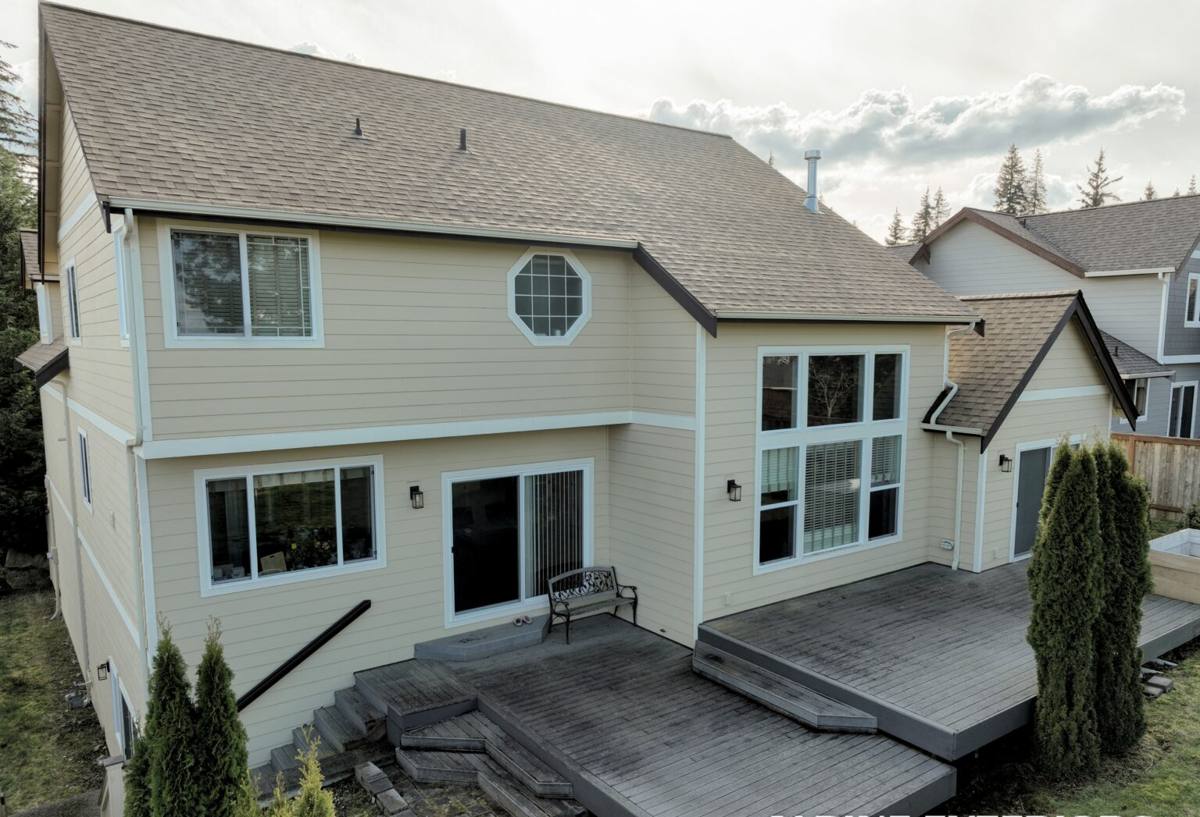
Visual Signs You Can Spot From the Ground
Most siding failure announces itself before it becomes structural. A slow walk around the exterior twice a year — once in late summer when things are dry, once after the first hard rain of fall — will catch almost everything on this list.
Surface and Finish Clues
- Paint that's bubbling, peeling, or alligatoring in patches rather than wearing evenly
- Chalky residue that rubs off white on your hand — a sign the finish is breaking down
- Visible warping, cupping, or bowing in individual boards or panels
- Cracks running along board edges or at butt joints between panels
- Dark streaking below nail heads or seams, which usually means water is tracking down from a failure point above
Structural and Gap Clues
Look for boards pulling away from the wall, visible gaps opening at corners or trim, and fastener heads that have backed out or left rust trails. Any of these let wind-driven rain — which Bellingham gets plenty of — work its way behind the cladding instead of running off the face.
Moisture-Specific Warning Signs
Because our climate stays damp for long stretches, moisture-related failure is the single biggest risk category for siding here. It's also the hardest to catch early because a lot of it happens behind the surface before it shows.
| Sign | What It Usually Means | Urgency |
|---|---|---|
| Soft or spongy spots when pressed | Water has saturated the substrate or sheathing behind the siding | High — schedule an inspection soon |
| Green or black growth on the surface | Moss, algae, or mildew colonizing a slow-drying section | Moderate — clean and monitor, watch for recurrence |
| Musty odor near an exterior wall | Trapped moisture, often with early mold growth in the wall cavity | High — investigate promptly |
| Swelling or delamination at panel edges | Water absorption at cut edges or seams that weren't properly sealed | High, especially on engineered wood products |
| Efflorescence (white mineral residue) near the foundation line | Moisture wicking up through masonry or lower siding courses | Moderate — check grading and drainage |
If you press on a wall and it gives even slightly, that's not a cosmetic problem — that's a sign moisture has already compromised the material underneath. Waiting rarely makes this cheaper to fix.
How Warning Signs Differ by Siding Material
Not all siding fails the same way, and knowing what to look for depends partly on what's on your walls. This matters a lot in a climate like ours, where some materials tolerate sustained moisture exposure far better than others.
| Material | Common Early Warning Signs | Climate Vulnerability Here |
|---|---|---|
| Cedar or primed wood | Checking, cupping, paint failure, soft spots at butt joints | High — needs frequent repainting and is prone to rot in shaded, damp areas |
| Vinyl | Cracking in cold snaps, fading, warping near heat sources, gaps at seams | Moderate — doesn't rot, but seams and gaps let moisture behind it unnoticed |
| LP SmartSide (engineered wood) | Swelling at cut edges, bubbling finish, soft spots where caulking has failed | Higher — edge sealing is critical and easy to miss during install or touch-ups |
| Fiber cement (James Hardie) | Caulk joint wear, factory finish dulling over many years | Low — the material itself doesn't absorb moisture like wood-based products |
This is a big part of why we standardized on James Hardie fiber cement for the homes we work on. It's not that other materials are unusable — plenty of houses in Whatcom County get by fine on vinyl or engineered wood with diligent maintenance. It's that fiber cement doesn't rot, doesn't swell at cut edges the way engineered wood can, and holds up to sustained damp exposure without the same maintenance schedule. In a climate where moss and driving rain are a given, that's a meaningful difference over a 20- or 30-year ownership horizon.
Interior Clues That Point Back to the Exterior
Some of the clearest siding warning signs don't show up outside at all — they show up in the house. If you notice any of the following, it's worth checking the exterior wall on the same side before assuming it's an unrelated interior issue.
- Peeling or bubbling paint on an interior wall, especially near a window or corner
- A musty smell that's localized to one room or wall, not the whole house
- Noticeably higher heating bills without a clear cause, which can mean wet insulation losing its R-value
- Visible mold on interior trim or drywall near an exterior wall
- A draft near a wall that shouldn't have one
These signs usually mean water has already been getting behind the siding for a while. By the time it shows up inside, the damage on the outside is typically further along than it looks from the street.
The High-Risk Zones to Check First
If you only have time for a five-minute check, focus on the areas that fail first in this region.
North and Shaded Walls
These dry slowest after rain, which makes them the first place moss and algae take hold and the last place a moisture problem gets noticed.
Ground-Contact and Low Sections
Siding that sits too close to soil, mulch beds, or hardscaping stays damp longer and is exposed to splash-back during heavy rain. This is one of the most common failure points we see.
Roof-to-Wall Intersections and Deck Ledgers
Anywhere a roofline, deck, or porch meets the siding is a flashing-dependent joint. Flashing failure here is quiet — no dramatic sign until water's already inside the wall.
Window and Door Trim
Caulk joints around openings are a maintenance item, not a permanent seal. Cracked or missing caulk here is one of the most preventable causes of hidden water intrusion.
A Practical Twice-a-Year Inspection Checklist
You don't need special tools for most of this — just a ladder, a flashlight, and a few minutes of attention.
- Walk the full perimeter and look for warping, cracking, or gaps at seams
- Press gently on any suspicious-looking section to check for softness
- Check caulk joints at windows, doors, and trim for cracking or separation
- Look at ground-contact areas for soil, mulch, or plantings touching the siding directly
- Inspect roof-to-wall and deck-to-wall intersections for gaps or staining
- Note any moss or algae patches and whether they're new or spreading
- Check the attic or crawlspace, if accessible, for musty smells or visible staining on the sheathing
- Photograph anything questionable so you can track whether it's getting worse over time
DIY Maintenance vs. Calling a Pro
Some of what you find is genuinely manageable yourself. Recaulking a trim joint, gently cleaning moss with a soft wash (not a pressure washer aimed directly at seams), and keeping plantings trimmed back from siding are all reasonable homeowner tasks that prevent bigger problems.
Softness under pressure, visible rot, recurring moisture behind a specific section, or signs that have shown up inside the house are different — those call for someone who can open up the area, see what's actually happening behind the surface, and tell you honestly whether you're looking at a repair or a replacement. Guessing on moisture damage almost always costs more later than an inspection costs now.
When Replacement Makes More Sense Than Repair
If warning signs are showing up across multiple walls, if the siding is original to an older home and reaching the end of a normal service life, or if repair costs start stacking up close to what replacement would run, it's worth stepping back and looking at the whole picture rather than patching section by section.
When homeowners in Bellingham and around Whatcom County get to that point, we install James Hardie fiber cement. It's non-combustible, holds its factory ColorPlus finish far longer than field-painted materials, is engineered for climates like this one, and comes with a strong transferable warranty. Given what our salt air, driving rain, and moss season do to lesser-suited materials over time, it's the product we're comfortable standing behind for a full re-side.
If you're seeing any of the signs above, or you'd just like a second set of eyes on your siding before a problem gets bigger, we're happy to take a look. Reach out for a free, no-pressure estimate using the form below.