 Bellingham Siding
 What LP SmartSide Actually Is
LP SmartSide is an engineered wood siding product made from wood strands bonded with resins under heat and pressure, then coated with a treated overlay and factory primer. It's manufactured to look like traditional lap or panel wood siding, it's lighter than fiber cement, easier on saw blades, and in the right climate it performs reasonably well. We're not here to tell you it's a bad product across the board. We're here to explain why, after installing and repairing siding across Whatcom County for years, we made the decision to stop installing it and put James Hardie fiber cement on every home we side instead.
Where LP SmartSide Gets It Right
To be fair to the product: LP has made real improvements to their engineered wood line over the past couple decades. The SmartGuard treatment process resists fungal decay and insect damage better than untreated wood strand product did in the past, and the panels are lighter to handle on a ladder or scaffold, which can speed up installation. In drier climates, or on homes with generous roof overhangs and good drainage planning, SmartSide can hold up for a long time. It's also generally less expensive than fiber cement, which matters to a lot of homeowners on a budget.
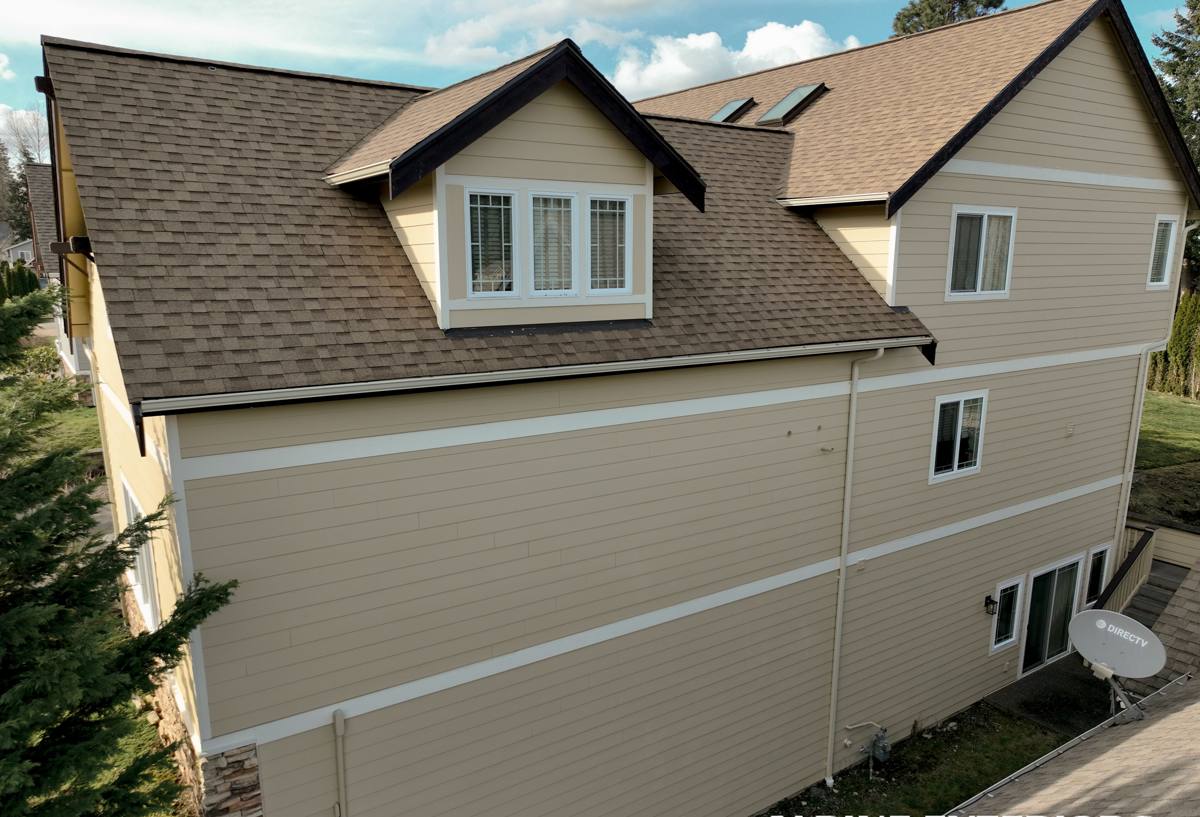
The Core Problem: It's Still Wood at Its Core
Here's the honest trade-off. Underneath the treated overlay and primer, LP SmartSide is still wood fiber. Wood swells and shrinks with moisture, and it's biologically food for fungus and insects if water gets past the surface protection. The overlay and treatment slow that process down considerably compared to raw lumber, but they don't change the fundamental material. Every seam, every fastener hole, every cut edge is a place where the protective layer has been broken, and every one of those spots depends on caulk, paint, and correct field sealing to keep water out for the life of the siding.
That matters a lot more here than it would in Arizona or eastern Washington. Bellingham sits on Bellingham Bay, which means homes anywhere near the water deal with a steady dose of salt air on top of everything else. Combine that with driving rain off the Strait, and a moss season that can run eight or nine months out of the year on north-facing walls and shaded siding, and you have a climate that's constantly testing every seam and cut edge on a house. Whatcom County doesn't give wood-based products much of a break.
Where It Fails in Practice
The failure mode we've seen repeatedly on engineered wood siding in this climate isn't dramatic — it's slow. Moisture works its way in at a butt joint that wasn't caulked tightly enough, or at the bottom edge of a panel where it wasn't primed on the cut, or behind a piece of trim where water sits longer than it should. The wood strand core starts to swell. Paint starts to bubble or peel at that spot years before the rest of the wall needs attention. Left long enough, that swelling turns into soft, deteriorating material that has to be cut out and replaced, not just repainted.
None of this means the product is defective. It means the product's long-term performance is tied directly to installation precision and ongoing maintenance in a way that fiber cement simply isn't. A crew in a rush, a homeowner who skips repainting on schedule, or a house with a lot of moss-holding shade can turn a 30-year siding job into a 12-to-15-year siding job.
Installation Sensitivity Is the Real Issue
Every manufacturer publishes an installation manual, and LP is clear about what's required: field-cut edges must be primed before installation, fastener patterns have to be followed precisely, panel gaps and caulking at every joint have to be maintained, and ground clearance and flashing details have to be right. When all of that is done correctly, the product performs close to spec. The problem is that these requirements are easy to shortcut on a job site, they're invisible once the siding is up, and there's no way for a homeowner to verify any of it after the fact. A house with painted-over siding looks identical whether every cut edge was primed or half of them were skipped.
We didn't like being in a position where our long-term reputation depended on catching every one of those details, every time, on every crew, forever — especially on a product where the consequences of a missed detail don't show up for five or ten years, well after the job is done and paid for.
Maintenance Burden Over Time
LP SmartSide needs to be repainted or recoated on a regular cycle to keep its protective layer intact — most manufacturers and painters recommend checking it every few years and repainting on roughly a 7-to-10 year cycle, sooner in harsh coastal exposure. Caulking at seams and trim needs to be inspected and renewed periodically too. That's a real, recurring cost and a real, recurring task that falls on the homeowner. Skip it, or fall behind on it during a busy stretch of life, and the material underneath starts absorbing water it wasn't designed to handle long-term.
Compare that to a factory-finished fiber cement product, and the maintenance conversation changes completely — which is the main reason we made the switch.
LP SmartSide vs. James Hardie: The Honest Comparison
| Factor | LP SmartSide | James Hardie Fiber Cement |
|---|---|---|
| Core material | Engineered wood strand | Cement, sand, and cellulose fiber |
| Combustibility | Combustible | Non-combustible |
| Moisture behavior | Swells/deteriorates if water penetrates the surface | Dimensionally stable; engineered to shed moisture |
| Finish | Factory-primed; field paint required, repaint cycle needed | ColorPlus factory-baked finish; no repaint for many years |
| Insect/pest resistance | Treated, but still an organic substrate | Not a food source for insects |
| Installation sensitivity | High — cut-edge priming and caulking critical | Moderate — still requires correct flashing and gapping, less moisture-dependent |
| Typical material cost | Lower | Higher |
| Warranty structure | Manufacturer limited warranty, prorated over time | Manufacturer limited warranty; ColorPlus finish and substrate warranties, transferable |
Why We Standardized on James Hardie Instead
James Hardie fiber cement is made from cement, sand, and cellulose fiber — there's no wood core to swell, rot, or feed insects. It's non-combustible, which matters more every year given the wildfire smoke and dry summer stretches the whole Pacific Northwest has seen recently, even in a normally wet county like ours. Hardie's ColorPlus factory finish is baked on in a controlled environment, not applied on a ladder in variable weather, and it's engineered specifically to hold color and resist the kind of moisture cycling and moss growth we deal with on shaded, north-facing walls all winter.
Hardie also builds product lines engineered for specific climate zones (their HZ5 line, which fits our Pacific Northwest exposure), so the substrate itself is matched to what our weather actually does to a house — not a general-purpose product asked to perform in every climate in the country. When it's installed to spec, correct fastening, correct clearance, correct flashing, it holds up under Whatcom County's rain and salt air with far less ongoing intervention from the homeowner than an engineered wood product requires.
What This Means for Installation Quality
Standardizing on one product also means our crews aren't switching between installation methods, fastener schedules, and manufacturer specs from one job to the next. Every crew member knows the Hardie install requirements cold because it's the only system we run. That consistency is worth as much as the material itself.
Questions to Ask Any Siding Contractor Before You Sign
- What product line are you installing, and is it rated for this specific climate zone?
- Will cut edges be factory-sealed or field-primed, and who's checking that it happens on every piece?
- What's the manufacturer's warranty, and is it transferable if you sell the house?
- What's the expected maintenance schedule — repainting, caulk inspection, or none at all?
- How is the siding flashed and gapped at windows, doors, and the foundation line?
- What happens to moisture that gets behind the siding — is there a drainage plane or house wrap detail?
The Bottom Line
LP SmartSide isn't a scam product or a bad choice everywhere. It's a wood-based product asking to perform like a non-wood one, in a climate — driving coastal rain, salt air off the bay, and a long moss season — that's tough on exactly the weak points that product has. We'd rather install fewer products and stand behind every one of them for decades than offer something we know depends on perfect field execution and a strict repaint schedule to hold up here. That's why every home we side gets James Hardie fiber cement, and nothing else.
If you're weighing siding options for a home in Bellingham or anywhere in Whatcom County, we're happy to walk your property, look at your exposure and sun/shade pattern, and give you a straight answer on what will actually hold up. Reach out for a free, no-pressure estimate using the form below.