 Bellingham Siding
 Siding Built for Blaine's Waterfront Climate
Blaine sits at the northern edge of Whatcom County, wrapped around Drayton Harbor and Semiahmoo Bay, with the Canadian border a few minutes away in either direction. That location is part of what makes the town special, and it's also exactly what makes exterior siding wear out faster here than it does twenty or thirty miles inland. Homes in Blaine deal with a combination of conditions that few siding products are actually engineered to survive long-term: salt-laden air off the water, wind-driven rain that hits walls sideways instead of just running down them, and a moss and mildew season that can stretch for most of the year in shaded or north-facing spots.
We install siding, roofing, windows, and decks across Whatcom County, and Blaine is one of the areas where we see the clearest gap between siding that's rated for "the Pacific Northwest" in general and siding that's actually built to hold up on a bay-front or near-coastal lot. That gap is the reason we made a hard call as a company: we install James Hardie fiber cement siding, and only James Hardie. Not vinyl, not LP SmartSide, not Cemplank or Allura, not primed wood. Below we explain what Blaine's climate does to a house, and why Hardie is the product we're willing to put our name behind here.
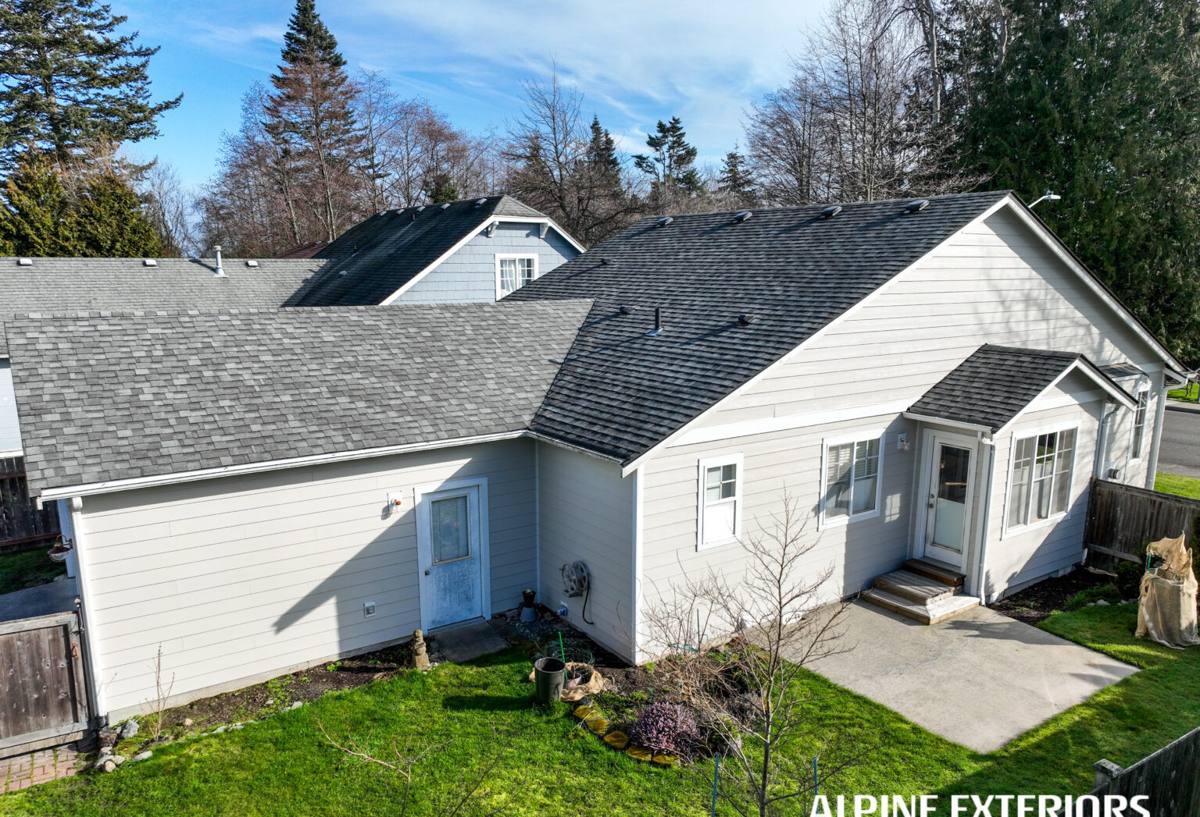
What Salt Air and Coastal Wind Actually Do to a House
Salt air isn't just a coastal cliché — it's a real corrosive load on a building. Airborne salt settles on siding, trim, and fasteners, and in a town like Blaine where a lot of homes have a direct or semi-direct sightline to the water, that exposure is constant, not occasional. A few things happen over time:
- Metal fasteners, flashing, and hardware corrode faster than they would inland, which matters a lot if a siding product's manufacturer requires specific corrosion-resistant fasteners to keep the warranty valid.
- Painted and coated surfaces chalk, fade, and break down faster under salt exposure combined with UV, so a finish that looks fine on a demo board can perform very differently after a few winters on a bay-facing wall.
- Wind-driven rain pushes moisture into seams, laps, and butt joints that would stay dry in a calmer inland setting, so any weakness in how a siding product sheds water at its joints shows up sooner near the water.
None of this means a house near the water is doomed to constant repairs. It means the materials and the installation details matter more here than they do in a lot of places, and cutting corners on either one shows up faster.
Why Driving Rain Is Different From Ordinary Rain
Whatcom County gets plenty of straight-down rain, but Blaine's exposure to open water means it also gets a lot of wind-driven rain — water moving sideways under enough force to push past siding laps, exposed nail heads, and poorly sealed trim. Products that rely on caulking or paint film to stay watertight tend to fail at this specific stress first, usually years before the "planned" lifespan of the material, because wind-driven rain finds the smallest gap and works it open over repeated freeze-thaw and wet-dry cycles.
The Long Moss and Mildew Season
Between the marine humidity, the shorter winter daylight, and the number of shaded north- and east-facing walls on Whatcom County lots, moss, algae, and mildew have a long runway to establish themselves on exterior surfaces. This isn't unique to Blaine, but waterfront and near-waterfront properties tend to run a notch damper than homes further inland, which extends the growing season for organic growth on siding.
Wood-based and wood-adjacent siding products are the most vulnerable here, because moss and mildew growth holds moisture against the substrate, and sustained moisture is what leads to swelling, delamination, and eventual rot in engineered wood products. Fiber cement doesn't offer organic growth the same foothold, and it doesn't swell or delaminate from moisture the way wood-based products can — which is a large part of why it holds up better through a Whatcom County wet season after wet season.
Why We Don't Install Vinyl, LP SmartSide, Cemplank, Allura, or Wood Siding
We get asked about all of these, so we'll be straightforward about each one rather than vague.
Vinyl Siding
Vinyl is inexpensive and easy to install, and for a lot of climates it does a reasonable job. But it's a petroleum-based product that expands and contracts significantly with temperature swings, it can crack or become brittle with age and cold exposure, and it's not the material we'd choose for a home taking direct salt spray and wind-driven rain off the water. It also can't be painted a custom color without extra products and effort, which limits it for homes that want a specific look.
LP SmartSide, Cemplank, and Allura
LP SmartSide is an engineered wood product — strand-based wood fiber with a resin binder. It performs reasonably when installed and maintained precisely to spec, but it's still a wood product at its core, meaning sustained moisture exposure (the kind Blaine's climate delivers) is its biggest long-term risk, especially at cut edges and butt joints that aren't perfectly sealed. Cemplank and Allura are both fiber cement products, similar in concept to James Hardie, and we don't dismiss them as inferior materials outright — but we've standardized our crews, our warranty process, and our installation training on one manufacturer's system so we can guarantee consistency, and James Hardie's regional-specific product engineering and factory finish process are what we settled on.
Primed Wood and Cedar
Real wood siding, primed or cedar, has a genuine aesthetic appeal that some homeowners specifically want, and we respect that. But it demands an ongoing maintenance commitment — recoating, caulking, spot repairs — that most homeowners underestimate, and in a climate with Blaine's moisture and moss exposure, deferred maintenance on wood siding turns into rot faster than it would inland. We're honest with clients about that trade-off up front rather than after the fact.
Why James Hardie Is What We Install Instead
James Hardie fiber cement siding is a cement, sand, and cellulose fiber composite — it's non-combustible, it doesn't support the kind of organic growth that wood-based products do, and it holds paint and factory-applied finishes far more stably over time than wood or vinyl. A few specifics that matter for a Blaine property:
- ColorPlus Technology is a factory-applied finish baked onto the board under controlled conditions, which resists fading, chipping, and chalking far better than field-applied paint — a real advantage against the UV and salt combination near the water.
- HZ5 and HZ10 product engineering means Hardie builds specific formulations for different climate zones, so the boards installed on a Blaine home are built for freeze-thaw and moisture cycling, not a generic national spec.
- Non-combustible core gives real fire-resistance value, which matters throughout Whatcom County given regional wildfire risk in dry summer stretches.
- A strong, transferable limited warranty backs the product when it's installed to Hardie's specifications — which is also why correct installation isn't optional for us.
What Correct Installation Looks Like Here
Fiber cement siding is only as good as its installation, and that's especially true on a coastal-exposure property. The details that matter most in Blaine's conditions:
- Proper rain-screen or drainage-plane assembly behind the siding, so any moisture that does get past the surface has somewhere to go instead of sitting against the sheathing.
- Correct fastener type and spacing — corrosion-resistant fasteners driven to Hardie's spec, not generic nails, given the salt exposure.
- Sealed and properly lapped joints, with flashing detailed around every window, door, and penetration rather than relying on caulk alone.
- Correct clearance from grade, decks, and roof lines, so the bottom edge of the siding isn't sitting in a moisture trap.
- Field-cut edges sealed per manufacturer spec, since an unsealed cut edge is the single most common failure point on any fiber cement job.
Comparing the Options
| Material | Salt/Moisture Resistance | Maintenance | Finish Stability | Our Position |
|---|---|---|---|---|
| Vinyl | Fair — can become brittle | Low | Fades over time, hard to repaint | Not installed |
| LP SmartSide | Moderate — moisture-sensitive at edges | Moderate | Field-applied, wears over time | Not installed |
| Primed wood / cedar | Lower — prone to rot with moss/mildew | High, ongoing | Requires recoating | Not installed |
| James Hardie fiber cement | Strong — climate-engineered lines | Low | Factory ColorPlus finish | What we install |
What This Means for a Blaine Home Specifically
Every property is a little different — how close you are to open water, how much tree cover and shade you have, which direction your walls face, and how old your current siding and flashing details are all change the picture. A house on a bay-facing lot with direct wind exposure needs a different level of attention at the joints and fastener spec than a home a few streets back with more tree buffer. That's part of why we walk every property in person before recommending anything: what your siding needs in Blaine isn't identical to what a job in Bellingham or further inland needs, even though the base product and installation standards don't change.
Roofing, Windows, and Decks in the Same Climate
Siding rarely fails in isolation — a roof that's shedding water poorly, windows with failed flashing, or a deck ledger that's trapping moisture against the wall all put extra load on the siding around them. Because we handle roofing, windows, and decks in addition to siding, we look at the whole exterior envelope on a Blaine property rather than treating siding as a standalone project. That matters most at transitions — where a roofline meets a wall, where a window is set into the siding plane, where a deck attaches to the house — since those are the spots where water intrusion actually starts.
What to Expect From the Process
A siding replacement in Blaine typically starts with an in-person walkthrough to assess your current siding, sheathing condition where accessible, and the specific exposure your walls face. From there we talk through Hardie product lines, colors, and a realistic cost range based on your home's size and detailing — not a generic square-footage number pulled from a spreadsheet. Timeline depends on scope and weather windows, since coastal wind and rain days affect scheduling more here than they would inland.
If you're weighing a siding project on a Blaine home — whether it's a full replacement, or you're seeing early signs of moss, moisture staining, or failing joints — we're happy to take a look and give you a straight, no-pressure assessment of what your home actually needs. There's a form below to get a free estimate started.