 Bellingham Siding
 Why Blaine's Climate Is Genuinely Hard on Siding
Blaine sits right on the water at the northern edge of Whatcom County, and that location shapes what a home's exterior has to deal with year-round. Salt-laden air off the bay works differently than inland moisture — it doesn't just wet a surface, it accelerates corrosion on fasteners and trim metal, and it can leave a fine residue on siding that traps grime and holds dampness longer than a rinse of plain rainwater would. Add the Pacific Northwest's long wet season, with wind-driven rain that hits walls at an angle instead of falling straight down, and you've got siding that spends a large part of the year genuinely saturated on its exposed face, not just splashed.
Then there's moss and algae. Whatcom County's combination of shade, humidity, and mild temperatures gives moss an unusually long growing window compared to drier parts of the state. On siding, that shows up as green-black streaking on north-facing walls, buildup in butt joints and trim returns, and — if the underlying material can't handle sustained moisture — softening or swelling behind the surface growth. None of this is exotic or rare in Blaine; it's the baseline condition every exterior product on a home here has to survive, every year, for decades.
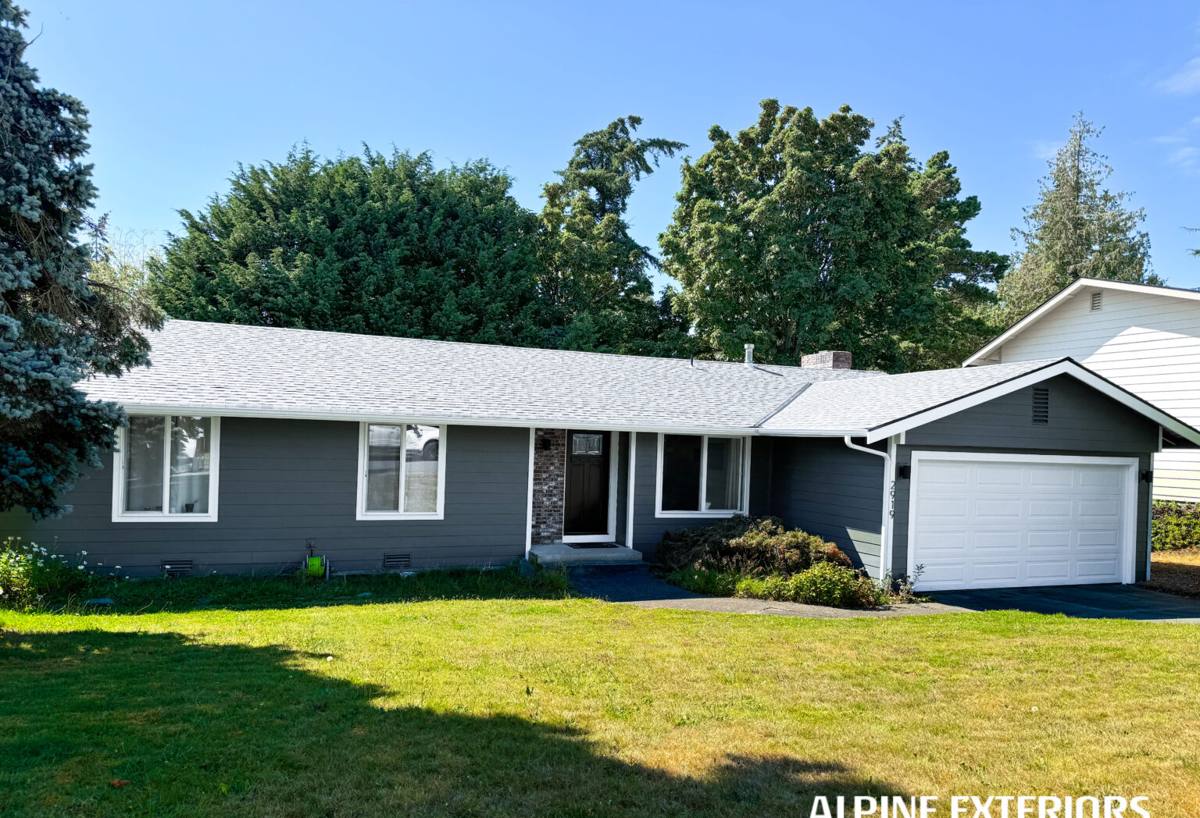
Why We Standardized on James Hardie for Homes Like This
We install James Hardie fiber cement siding exclusively. We don't install vinyl, LP SmartSide, Cemplank, Allura, primed spruce, or cedar, and that's a deliberate professional standard, not a sales pitch. Each of those alternatives has a real weak point in exactly the conditions Blaine specializes in:
- Vinyl expands and contracts significantly with temperature swings, can warp under sustained UV and moisture cycling, and its seams give salt-laden moisture a path to work behind the panel over time.
- LP SmartSide and other wood-strand products use an engineered wood core. Wood-based cores are dimensionally stable when the factory coating stays intact, but any breach — a missed caulk joint, a fastener installed wrong, storm damage — lets moisture into the core, and wood-based products swell and deteriorate faster than fiber cement once that happens.
- Cedar and primed spruce are natural wood. They look good on day one, but they need ongoing refinishing, and in a climate with this much sustained dampness and moss pressure, the maintenance interval to keep them protected is short and unforgiving.
James Hardie fiber cement is cement, sand, and cellulose fiber — it doesn't have an organic core for moisture to feed on, it doesn't expand and contract the way vinyl does, and it's non-combustible. That combination is why it holds up to a marine-influenced climate better than the alternatives, provided it's installed correctly, which is the part that actually determines how a siding job performs over 20-plus years.
What Correct Installation Looks Like on a Blaine Home
The Weather Barrier Comes First
Fiber cement siding is only as good as what's behind it. On a coastal, high-rainfall property, the water-resistive barrier and flashing details around windows, doors, and penetrations matter as much as the siding itself. We install per James Hardie's published fastening and clearance specifications — correct nail placement, minimum ground clearance, and proper flashing laps — because those details are what keep wind-driven rain from finding a way behind the panel in the first place.
Fastening and Joint Treatment
Fasteners need to be corrosion-resistant and driven correctly — not overdriven, not underdriven — and butt joints need to be treated with the right sealant or H-channel approach so they don't become a collection point for standing moisture and moss growth. This is the kind of detail that's invisible once the job is done but is exactly what separates a Hardie installation that looks good for two years from one that looks good for twenty.
Trim, Caulking, and Salt-Air Considerations
Near the water, we pay closer attention to fastener and trim material selection and to keeping caulked joints tight and fully sealed, since salt air accelerates wear on anything metal that isn't properly protected. A correct installation accounts for this rather than treating a coastal lot the same as an inland one.
Choosing the Right Hardie Product Line
James Hardie makes several siding profiles and product lines, and the right choice depends on the home's style and exposure, not just personal taste. HardiePlank lap siding is the most common choice for traditional home styles and comes in multiple exposure widths and textures (smooth or cedarmill). HardieShingle gives a shingle-style look without the maintenance burden of real wood shakes. HardiePanel works well for board-and-batten or modern vertical designs. All of these are available with the factory-applied ColorPlus finish, which is baked on and warranted separately from the substrate — a real advantage in a climate where UV and moisture both work against paint film over time.
For a property with heavier direct rain and wind exposure, we'll also talk through Hardie's engineered climate zone (HZ) product designations, which account for regional moisture and temperature patterns rather than using a one-size-fits-all specification nationwide.
Comparing Siding Options for a Coastal Whatcom County Home
| Factor | James Hardie Fiber Cement | Vinyl | Wood-Strand (e.g. LP SmartSide) | Cedar / Primed Spruce |
|---|---|---|---|---|
| Moisture tolerance | High — inorganic core | Moderate — seams can trap moisture | Moderate — vulnerable if coating is breached | Low without regular refinishing |
| Performance in salt air | Strong with correct fasteners/flashing | Fair — seams and fasteners at risk | Fair — moisture entry risk near coast | Weak — accelerates weathering |
| Moss/algae resistance | Good — non-organic surface | Fair — surface can hold grime | Fair to poor once surface is compromised | Poor — organic surface feeds growth |
| Fire resistance | Non-combustible | Combustible | Combustible | Combustible |
| Typical maintenance | Occasional wash, repaint only if not ColorPlus | Occasional wash | Regular coating inspection/repair | Refinishing every few years |
Our Process, Start to Finish
We keep the process straightforward and communicate clearly at each stage:
- On-site assessment. We look at the home's exposure — which walls take the most wind-driven rain, where moss is already established, condition of existing trim and flashing — and walk you through what we find.
- Product and profile selection. We help you choose the right Hardie line, exposure width, texture, and ColorPlus color based on the home's style and the site conditions, not a generic default.
- Written estimate. You get a clear scope of work and price before anything is scheduled — no surprise add-ons mid-project.
- Tear-off and inspection. Removing the old siding lets us check sheathing and framing underneath for hidden moisture damage before it's covered back up.
- Weather barrier and flashing installation. This is the step that determines long-term performance, and we don't rush it.
- Hardie installation to manufacturer spec. Correct fastening, clearances, and joint treatment throughout.
- Final walk-through. We review the finished work with you before calling the job complete.
What a Correct Job Should Include — A Homeowner's Checklist
- Proper ground clearance between siding and grade, decks, or patios
- Correctly lapped and sealed flashing at every window, door, and penetration
- Manufacturer-specified fastener type, spacing, and drive depth
- Properly treated butt joints, not just gaps caulked over
- ColorPlus finish handled carefully to avoid touch-up paint that won't match long-term
- A clear warranty explanation, both for the Hardie product and for our installation labor
Living With Moss Season: Realistic Maintenance
Even the right siding material benefits from basic upkeep in this climate. Fiber cement doesn't need refinishing the way wood does, but an occasional gentle rinse — never pressure-washed directly into joints or up under laps — keeps moss and algae from getting a foothold on north-facing walls and shaded areas. Keeping gutters clear and vegetation trimmed back from exterior walls also cuts down on the standing moisture that lets moss establish in the first place. This is a fraction of the upkeep cedar or primed wood would demand in the same location.
Warranty and What It Actually Covers
James Hardie backs its siding products with a manufacturer warranty, and ColorPlus finishes carry their own separate finish warranty. Warranty terms and transferability vary by product line, which is worth reviewing directly with your contractor before installation rather than assuming coverage. On the labor side, our installation is covered separately — ask us directly for current terms so you know exactly what's covered and for how long, and get it in writing before work begins.
Why It Matters That We Already Work in Blaine
Detail work — flashing laps, fastener choice, clearance at grade — is exactly where generic installation crews cut corners, usually without meaning to, simply because they're not thinking about a specific site's exposure. A crew that regularly works Blaine and the surrounding Whatcom County coastline already has a working sense of which walls on a given lot take the worst of the weather, how far moss creep tends to travel in a season, and where salt air does the most damage to fasteners and trim. That local pattern recognition doesn't replace following the manufacturer spec — it's what makes following the spec actually matter, because it tells us where to be most careful on your specific home.
If you're weighing a siding replacement or new construction siding in Blaine, we're happy to walk the property with you, explain what we see, and provide a free, no-pressure estimate — no obligation, just a straight answer about what your home needs.