 Bellingham Siding
 What Happy Valley Homes Are Up Against
Homes in and around Happy Valley sit close enough to Bellingham Bay and the broader Salish Sea shoreline that salt-laden air is a real factor in how exteriors age, not just a coastal-town cliché. Combine that with Whatcom County's long, wet fall-through-spring stretch of driving rain off the water, and you get an exterior environment that punishes anything not built or installed for it. Add the tree cover common to many Bellingham neighborhoods, and you get shaded, slow-drying surfaces that stay damp for days after a storm — exactly the conditions moss, algae, and mildew need to take hold.
None of this is unusual for the Pacific Northwest. But it does mean that generic, one-size-fits-all exterior work — the kind that might hold up fine in a drier climate — tends to show its weaknesses here faster. Paint fails sooner. Untreated wood swells and checks. Fasteners corrode. Moss works into seams and joints that were never properly sealed. The homes that hold up best in Happy Valley are the ones where the siding, roofing, windows, and decking were chosen and installed with this specific climate in mind.
What "Siding Done Right" Actually Means
A lot of siding problems people blame on "bad weather" are actually installation problems that bad weather simply exposed. Correct siding installation in a climate like Bellingham's comes down to a handful of details that are easy to skip and expensive to fix later:
- A proper drainage plane and weather-resistive barrier behind the siding, so any moisture that gets past the surface has somewhere to go
- Correct flashing at windows, doors, and every horizontal trim transition — the single most common source of hidden water intrusion
- Fastener patterns and clearances that match the manufacturer's specifications, not just what looks close enough
- Proper gapping and sealant at butt joints, corners, and penetrations so the assembly can move without cracking open
- Ground and roofline clearances that keep siding from sitting in standing moisture or constant runoff
Skip any one of these and the siding itself almost doesn't matter — moisture will find its way behind it eventually. This is why we treat installation practice as equal in importance to the product itself, and why we standardized on a single fiber cement system rather than installing whatever a homeowner asks for.
Siding That's Built for This Climate
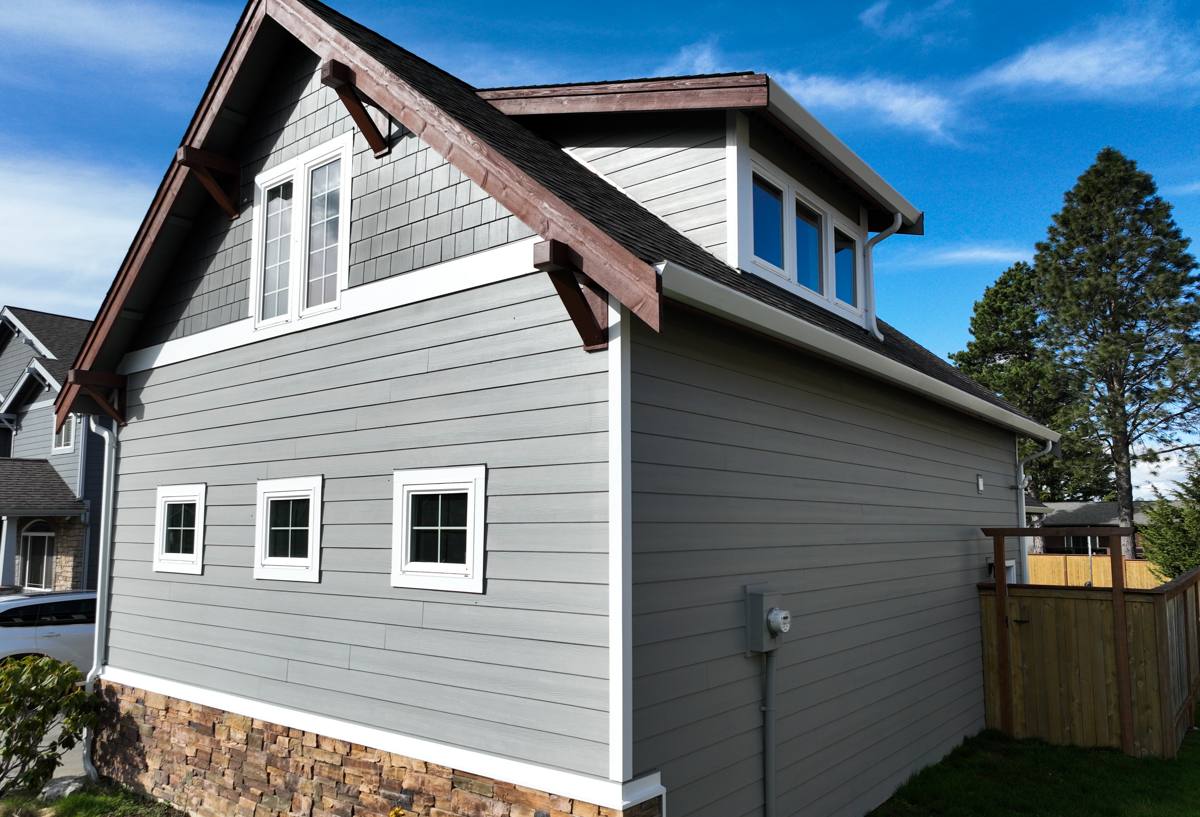
We install James Hardie fiber cement siding exclusively. It's a decision we made after weighing how different siding materials actually perform in a wet, coastal-influenced climate over the long haul, not just how they look on install day. Fiber cement is non-combustible, dimensionally stable in swings of moisture and temperature, and — with Hardie's ColorPlus factory-applied finish — holds color and resists the fade, chalking, and peeling that plague field-painted materials exposed to constant damp and UV cycling.
Hardie's HZ5 product line in particular is engineered for climates that see prolonged moisture exposure and freeze-thaw cycling, which describes a typical Whatcom County winter well. We don't install vinyl, LP SmartSide, Cemplank, Allura, or primed wood siding, and we're upfront about why: those products can be reasonable choices in the right circumstances, but each carries trade-offs — seam and moisture sensitivity, repainting cycles, warranty limitations, or long-term maintenance demands — that we don't think hold up well against decades of Pacific Northwest weather. We'd rather install one system correctly than several systems with an asterisk.
Moss and Algae on Siding
Shaded siding in Happy Valley is going to see moss and algae pressure no matter what material it's made of. What changes is how the material responds. Fiber cement doesn't feed mold growth the way wood fiber products can, and a factory finish resists the surface staining that makes moss and mildew visible faster on field-painted siding. Regular gentle washing still matters — no siding is maintenance-free — but the baseline resistance is meaningfully better.
Roofing That Sheds Bellingham's Rain
Roofing takes the most direct hit from driving rain and wind off the bay, and it's usually the first thing to fail when flashing, underlayment, or ventilation was cut corners. A roof system built for this area needs proper underlayment for wind-driven rain, correctly lapped and sealed flashing at every valley, chimney, and penetration, and ventilation that keeps moisture from condensing in the attic during long damp stretches. We handle full roof replacement and repair alongside siding work, which matters because roof and wall drainage are connected systems — a roof that dumps water wrong at the eaves will undermine even well-installed siding below it.
Windows That Handle Wind, Rain, and Condensation
Older or poorly flashed windows are one of the most common leak points we find during siding projects, and Happy Valley's exposure to wind-driven rain makes window flashing detail non-negotiable. Beyond leaks, single-pane or aging dual-pane windows in a cool, humid climate like this tend to show condensation and drafts that drive up heating costs through the long wet season. When we replace windows as part of an exterior project, we integrate the flashing with the new siding's weather barrier so the whole wall assembly works as one system instead of two separately sealed products fighting each other.
Decks Built to Survive a Wet Climate
Decks in this part of Whatcom County deal with the same moss, standing moisture, and UV cycling as siding, but with the added stress of foot traffic and horizontal surfaces that hold water longer. Proper decking work means attention to joist flashing and drainage beneath the deck boards, fastener choices that won't corrode or streak the surface, and material selection that accounts for how much shade and moisture exposure the specific yard gets. A deck tucked under tree cover in Happy Valley needs different upkeep expectations than one in full sun a few blocks away, and we talk through that honestly rather than selling the same package to every yard.
Comparing Exterior Material Choices in a Wet Coastal Climate
| Material | Moisture Behavior | Maintenance Over Time | Typical Longevity Here |
|---|---|---|---|
| Vinyl siding | Can warp or gap at seams; doesn't trap water but doesn't shed it as cleanly at joints | Low, but limited repair options if damaged or faded | Moderate, shorter in direct storm exposure |
| Untreated or primed wood | Absorbs moisture readily; prone to swelling, checking, and rot in damp shade | High — regular repainting and sealing required | Shortest without diligent upkeep |
| LP SmartSide / engineered wood | Better than raw wood but still moisture-sensitive at cut edges and seams | Moderate to high; edge sealing is critical | Moderate, install-quality dependent |
| James Hardie fiber cement | Dimensionally stable; resists swelling, rot, and moss staining | Low; periodic gentle washing | Longest of the common options when installed to spec |
This isn't a knock on every product on that list — plenty of homes around the country wear vinyl or engineered wood siding just fine. It's a statement about what we've decided performs best against this specific climate, which is why fiber cement is the only siding we put our name behind.
What to Ask Before Hiring an Exterior Contractor Here
Whatcom County has no shortage of contractors, and not all of them are set up to handle coastal-adjacent, high-moisture work correctly. Before hiring anyone for siding, roofing, window, or deck work in Happy Valley, it's worth asking:
- Are you licensed and insured to work in Washington State, and can you provide proof?
- Who will actually be on the crew doing the installation — is it your own team or subcontracted out?
- How do you handle flashing and drainage detailing at windows, doors, and trim?
- What warranty applies to materials versus labor, and who honors it if something goes wrong years from now?
- Can you explain why you recommend a specific material for this house, not just a general sales pitch?
A contractor who can answer those clearly and specifically, without hedging, is usually one who's done the work enough times in this climate to know what actually matters.
Why a Local Crew Matters in Happy Valley
Exterior work in Bellingham isn't the same job as exterior work in a drier inland market, and crews that split time between very different climates don't always carry the same instincts about flashing details, drainage, and material choices that hold up here. A crew that works this area regularly knows how moss behaves on a shaded north wall, how far wind-driven rain travels under an eave, and which installation shortcuts simply don't survive a Whatcom County winter. That local pattern recognition is hard to replace with a generic install checklist.
If you're weighing a siding, roofing, window, or deck project for a home in Happy Valley, we're glad to walk the property, look at what your exterior is actually dealing with, and put together a straightforward, no-pressure estimate — no scare tactics, just an honest read on what your home needs.