 Bellingham Siding
 Happy Valley's Climate Is Harder on Siding Than It Looks
Happy Valley is one of Bellingham's older, more established residential pockets — mature tree canopy, a mix of home ages, and lots close enough to Bellingham Bay that salt-tinged marine air reaches the siding on most homes in the neighborhood. On paper that sounds mild. In practice it's a combination that's rough on exterior materials: salt air accelerates corrosion on fasteners and trim, the Pacific Northwest's driving, wind-blown rain finds every gap in flashing and caulk, and the tree cover that makes the neighborhood pleasant to live in also keeps north- and east-facing walls shaded and damp for weeks at a stretch. That last part is what drives Whatcom County's long moss season — moss doesn't need standing water, just persistent shade and moisture, and Happy Valley has both in spades.
None of this makes the neighborhood unusual for Bellingham. It's the same set of conditions the whole region deals with. But it does mean siding choice and installation quality matter more here than they would in a drier, sunnier climate, because the margin for error is smaller. A siding job that's "good enough" in Eastern Washington can fail within a decade in a shaded, bay-adjacent lot in Happy Valley.
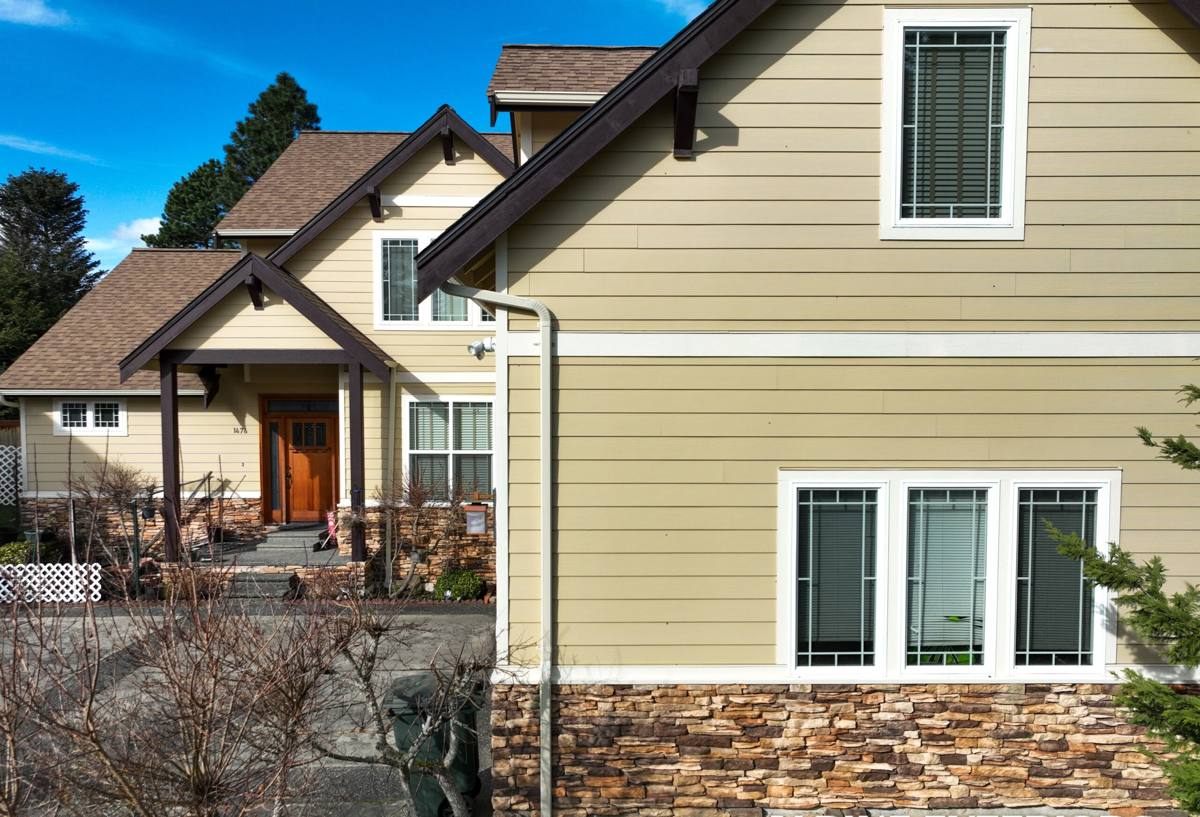
What Fiber Cement Needs to Deliver in This Environment
Fiber cement earns its reputation in coastal, wet climates because of what it doesn't do: it doesn't absorb water and swell the way wood-based products can, it doesn't rot, and it's non-combustible. But "fiber cement" isn't one uniform product — quality, density, and factory finishing vary by manufacturer, and those differences show up over time, especially under repeated wet-dry cycling and salt exposure.
For a Happy Valley home, the siding needs to:
- Resist moisture absorption at cut edges and butt joints, where most fiber cement failures actually start
- Hold a factory finish that won't chalk, fade, or need repainting every few years
- Stay dimensionally stable through the region's wet winters and drier summers without cracking at fasteners
- Shed moss and mildew growth on shaded elevations without the surface degrading
- Handle salt-laden air near the bay without the finish breaking down prematurely
This is why we don't treat "fiber cement" as a generic category and install whatever's cheapest. It's why we install James Hardie exclusively.
Why We Install Only James Hardie Fiber Cement
There are other fiber cement brands on the market — Cemplank and Allura among them — and other siding materials entirely, like LP SmartSide (engineered wood, not fiber cement) and vinyl. We don't install any of them. That's a deliberate standard, not a sales pitch, and it comes down to three things Hardie does that we haven't seen matched consistently elsewhere.
Climate-Engineered HZ Product Lines
Hardie manufactures its siding in different formulations for different climate zones — HZ5 for regions with freeze-thaw cycles, HZ10 for milder, wetter coastal climates. Western Washington falls into the range where the wet-climate engineering matters: the product is formulated to perform under sustained moisture exposure rather than just tolerate it. That's a meaningful distinction in a neighborhood with Happy Valley's shade and moisture profile.
ColorPlus Factory Finish
Field-painted siding is only as good as the paint job and the maintenance schedule behind it. Hardie's ColorPlus finish is baked on at the factory in multiple coats under controlled conditions, which gives it more consistent coverage and better fade resistance than most site-applied paint jobs achieve — and it comes with its own finish warranty separate from the substrate warranty.
A Warranty Structure That Actually Transfers
Hardie backs its products with a long, transferable limited warranty on the siding itself and a separate finish warranty on ColorPlus color. That matters for resale — a documented, transferable warranty on the exterior is worth something to a buyer, and it's leverage for you if a manufacturing defect shows up years down the road.
What a Correct Installation Actually Involves
Fiber cement siding fails less often because of the product and more often because of how it was installed. In our experience, the difference between a Happy Valley job that lasts thirty years and one that starts showing problems in five almost always comes down to the details most homeowners never see once the siding's up.
Flashing and Clearance
Every window, door, and roof-to-wall transition needs proper flashing underneath the siding, not caulk substituting for it. Siding also needs minimum clearance from grade, decks, and roof lines — installers who let siding sit too close to soil or hardscape are setting up a wicking point that stays wet long after a storm passes, exactly the kind of spot where rot and moss take hold first.
Fastening and Joints
Hardie specifies fastener type, placement, and spacing for a reason — get it wrong and you either crack the board over time or leave gaps that let water behind the plane of the siding. Butt joints at the ends of boards need to be treated correctly, not just butted together and caulked, since that's one of the more common places moisture gets in on a poorly installed job.
Field Touch-Up on Factory-Finished Boards
Cut edges on ColorPlus boards need to be sealed with the manufacturer's touch-up product, and any field-painted trim needs a compatible product. Skipping this step is a small shortcut that shows up as a visible failure point within a year or two, usually right where you'd notice it most — around windows and corners.
Moss, Moisture, and the Mistakes We See on Wooded Lots
Happy Valley's tree cover is a defining feature of the neighborhood, and it's also the reason certain elevations of certain homes need extra attention. Shaded, north- or east-facing walls that don't get direct sun stay damp longer after every rain, and that's where moss and mildew establish first — not because the siding material failed, but because moisture sat against the surface for days instead of hours.
The most common issues we run into on jobs in this kind of setting aren't dramatic. They're small, cumulative gaps in the original installation:
- Siding installed with insufficient clearance from a deck, patio, or planting bed, trapping moisture at the base
- Missing or improperly lapped flashing at window and door heads
- No drainage gap or rainscreen behind the siding, so incidental moisture has nowhere to go
- Gutters and downspouts discharging directly against a wall instead of away from it
- Vegetation planted too close to the house, keeping a wall perpetually shaded and damp
Every one of these is preventable at the install stage or with basic upkeep — none of them require exotic solutions, just attention to the details that matter in a wet, shaded climate.
Cost Factors for a Happy Valley Fiber Cement Project
We don't quote pricing without seeing the house, but the factors that move a fiber cement job up or down in cost are consistent. Here's what typically drives the range on a project in this area:
| Factor | Why It Matters Here |
|---|---|
| Existing wall condition | Sheathing or framing rot found after tear-off, more likely on older homes or walls with a history of moisture intrusion, adds repair scope before new siding goes on |
| Access and lot terrain | Wooded, sloped lots common in the neighborhood can complicate scaffolding, material staging, and disposal |
| Trim and detail complexity | Homes with more corners, dormers, and window trim take more time per square foot than a simple rectangular elevation |
| Tear-off vs. install over existing siding | Full removal costs more upfront but lets us inspect and correct flashing and sheathing issues that a re-side over old siding would hide |
| Color and finish selection | Factory ColorPlus finishes vs. field-painted primed boards affect both material cost and long-term maintenance cost |
Our Process, Start to Finish
A siding job on your Happy Valley home starts with a walk-around, not a sales pitch. We look at every elevation, check for existing moisture damage around windows, doors, and the base of the walls, and note anything the shade and tree cover have already caused. From there:
- We assess the wall assembly and flag any sheathing or framing repair needed before new siding goes on
- We tear off existing siding rather than installing over it, so we can verify what's actually behind the wall
- We correct or install flashing at every penetration and transition point before a single piece of Hardie board goes up
- We install to Hardie's specified fastening pattern, clearances, and joint treatment
- We seal all field-cut edges and complete any field-painted trim with compatible products
- We walk the finished job with you before calling it done
None of this is unusual for a properly run siding job — it's just easy to skip when a crew is moving fast, and skipping it is exactly what causes the problems we get called to fix on other people's work years later.
Maintenance: What Ownership Looks Like After Install
Fiber cement is low-maintenance compared to wood, but "low-maintenance" isn't "no-maintenance," especially with Happy Valley's moss season. A short annual routine keeps a correctly installed job performing for decades:
- Rinse siding annually, and more often on shaded walls where moss and mildew tend to establish first
- Keep gutters clear so water isn't overflowing directly onto siding below
- Trim back vegetation that's keeping any wall shaded and damp longer than necessary
- Inspect caulking at trim, windows, and joints every year or two and re-caulk where it's cracked or pulled away
- Watch for any soft spots or discoloration near the base of walls, which can signal a clearance or flashing issue worth addressing early
This routine takes an afternoon a year for most homes and catches small issues before they become expensive ones.
Why Local Experience Matters in Happy Valley
A crew that's worked homes in this neighborhood already knows which elevations tend to hold moisture, how the tree cover affects drying time after a storm, and what the City of Bellingham and Whatcom County expect in terms of permitting and code compliance for a re-side. That's not something you get from a crew that's mostly worked drier climates or unshaded subdivisions — the details that matter here are specific to this kind of lot and this kind of weather.
If you're weighing a siding replacement or repair in Happy Valley, we're glad to walk your property, point out what we see, and give you a straight answer about what it needs. There's no pressure and no cost to get an estimate — just fill out the form below and we'll take it from there.