 Bellingham Siding
 Siding in Sudden Valley: A Different Kind of Exposure
Sudden Valley sits along Lake Whatcom, tucked into the forested hills east of Bellingham, and that setting shapes what happens to a home's exterior over time. Homes here deal with a combination most Whatcom County properties share but that plays out with its own local twist: heavy tree cover that keeps siding damp longer after every storm, lake-effect moisture, and long stretches of gray, low-sun winter days that never quite dry things out. Add in the region's salt-tinged marine air drifting in off the Puget Sound corridor, and you get an exterior environment that rewards good materials and good installation — and punishes anything less.
We've worked on homes throughout Bellingham and the surrounding Whatcom County communities long enough to know that Sudden Valley's mix of forest shade, lake humidity, and seasonal rain is exactly the kind of environment where cheap or poorly installed siding fails early. It's also exactly the kind of environment where the right product, installed correctly, can go decades without giving the homeowner a second thought.
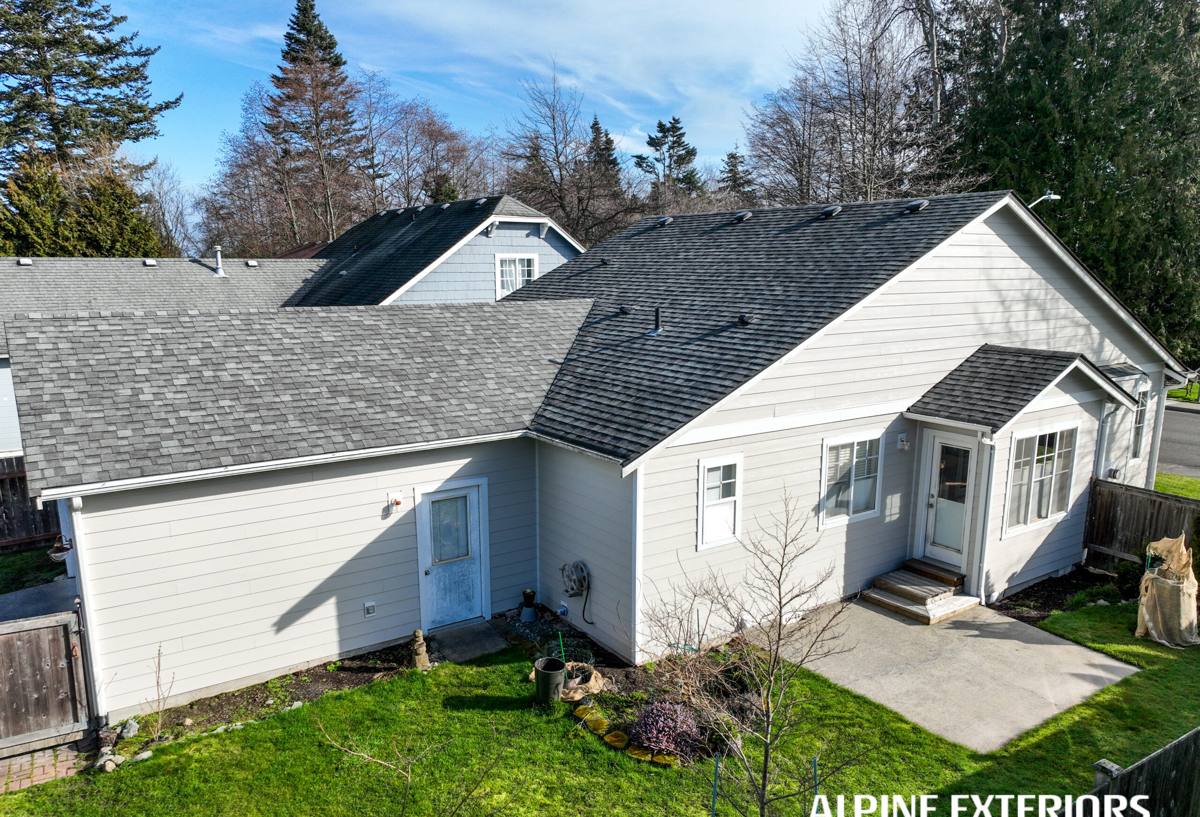
What the Climate Actually Does to a House Here
Moss and Organic Growth
Wooded lots mean shade, and shade means siding that doesn't get a full daily dry-out cycle the way a home in an open field might. Moss, algae, and mildew take hold on north-facing walls, under eaves, and anywhere airflow is limited. On absorbent or poorly sealed siding materials, that organic growth isn't just cosmetic — it holds moisture against the substrate and accelerates rot underneath.
Driving Rain and Wind-Driven Moisture
Storms coming off the Pacific don't always arrive straight-on. Wind-driven rain gets pushed sideways into wall assemblies, testing every seam, joint, and piece of flashing on a home's exterior. Over enough winters, any weak point in the water management system — a gap in caulking, a poorly lapped panel, a missing kick-out flashing — turns into a slow leak that rots sheathing long before anyone notices a stain on the drywall inside.
Salt Air and Corrosion
While Sudden Valley is inland from the open coast, the broader Whatcom County air carries enough marine moisture and salt content to matter over the life of a building. Salt-laden air accelerates corrosion of fasteners, flashing, and any metal components on the exterior, and it degrades certain coatings faster than a dry inland climate would.
Freeze-Thaw and Temperature Swings
Whatcom County winters aren't brutally cold, but they do dip below freezing often enough that any water trapped in or behind siding can freeze, expand, and crack whatever is holding it. Materials that absorb moisture are especially vulnerable to this cycle repeating year after year.
Why Product Choice Matters More Here Than in Drier Climates
In a dry climate, a lot of siding materials can get away with mediocre installation or a less rigorous product spec. Sudden Valley doesn't offer that margin for error. This is why our company made a deliberate decision: we install James Hardie fiber cement siding exclusively. We don't install vinyl, LP SmartSide, primed spruce, cedar, or fiber cement alternatives like Cemplank or Allura. That's not a marketing position — it's a standard we hold because we've seen what this climate does to homes over a 20- and 30-year horizon, and we only want our name on work that holds up.
What Makes Hardie the Right Fit for This Climate
- Non-combustible composition: Hardie fiber cement doesn't feed a fire, which matters in a region where wildfire smoke and dry summer spells are becoming a more regular concern even in wetter western Washington.
- Engineered moisture resistance: Fiber cement doesn't absorb and swell the way wood-based products do, which directly addresses the moss, mildew, and freeze-thaw issues common in shaded, damp lots.
- Factory-applied ColorPlus finish: The finish is baked on in a controlled factory environment rather than field-applied, which gives far more consistent coverage and adhesion than job-site painting — a real advantage when a crew is fighting rain windows to get a house dried in.
- HZ5 climate-engineered formulation: Hardie's HZ product lines are engineered for specific climate zones, including the wetter, more temperate regions of the Pacific Northwest, rather than a one-size-fits-all formulation.
- Long, transferable warranty: A strong manufacturer warranty that can transfer to a new owner adds real value if a Sudden Valley home ever goes up for sale.
What Full-Service Exterior Work Looks Like for a Sudden Valley Home
Siding rarely fails in isolation. The roof, windows, and siding all work together as one water-management system, and treating them separately is how small problems turn into big ones. We handle all four exterior trades — siding, roofing, windows, and decks — specifically so that flashing details, water paths, and structural transitions are coordinated rather than patched together by different contractors working from different assumptions.
Siding
Full Hardie plank, panel, or shingle siding installation and replacement, with attention to the flashing, house wrap, and drainage plane details that matter most in a high-moisture, tree-covered setting.
Roofing
Roof inspections, repairs, and replacements that account for moss growth, valley flashing, and the ice-and-water shield details that matter on shaded, north-facing roof sections common on wooded Sudden Valley lots.
Windows
Window replacement and re-flashing done in coordination with siding work, since window-to-wall transitions are one of the most common leak points on older homes in this area.
Decks
Deck construction and repair built to handle the same rain and shade exposure as the rest of the exterior, with materials and fastener choices suited to a damp, wooded environment.
Comparing Exterior Cladding Options for This Climate
| Material | Moisture Behavior in Wet/Shaded Lots | Maintenance Burden | Why We Don't Install It (where applicable) |
|---|---|---|---|
| Vinyl siding | Doesn't rot, but seams and panels can trap moisture behind them; can warp in temperature swings | Low, but cosmetic damage is permanent and panels fade unevenly | Doesn't offer the impact resistance or factory finish durability we require |
| Cedar / wood siding | Absorbs moisture readily; highly susceptible to moss and rot in shaded, damp settings | High — regular staining, sealing, and moss treatment needed | Ongoing maintenance burden is too high for this specific climate |
| Primed spruce / OSB-based siding | Vulnerable to swelling and edge deterioration if moisture reaches the substrate | Moderate to high, dependent on paint maintenance | Moisture-sensitive substrate is a poor match for a high-rainfall, shaded environment |
| Fiber cement alternatives (Cemplank, Allura) | Similar base material to Hardie, but different formulation and factory finish process | Varies by manufacturer warranty and finish quality | We standardized on Hardie's specific HZ formulation and ColorPlus process |
| James Hardie fiber cement | Engineered to resist moisture absorption and swelling; non-combustible | Low — occasional washing, no repainting needed for years | Our standard product |
Signs a Sudden Valley Home Needs an Exterior Evaluation
- Visible moss or dark streaking on siding, especially on shaded or north-facing walls
- Soft spots, bubbling, or warping anywhere on the siding surface
- Peeling or chalking paint that keeps returning after repainting
- Gaps or separation at seams, corners, or window and door trim
- Moss buildup on roof valleys or north-facing roof slopes
- Water stains on interior ceilings or walls near exterior corners
- Fastener corrosion or rust streaking visible on siding or trim
Why a Local Crew Matters
Installation quality determines whether siding performs for 10 years or 40, and that's especially true in a climate like this one. Flashing has to be lapped correctly, house wrap has to be integrated properly with window and door openings, and fastener spacing has to account for the expansion and contraction that comes with the region's temperature and humidity swings. A crew that works in Whatcom County year-round knows what this specific mix of rain, shade, and lake humidity does to a building, and builds accordingly — rather than applying a generic installation approach that might be fine in a drier climate but leaves gaps here.
We also know the practical side of working in a community like Sudden Valley: navigating wooded, sometimes sloped lots, coordinating around tree cover for material staging, and scheduling around the wetter months so siding isn't installed into a wall assembly that hasn't had a chance to dry.
What to Expect From the Project
Every siding project starts with an honest look at what's actually happening behind the existing exterior — not just what's visible on the surface. From there we scope the work, walk through material and color options within the Hardie product lines, and give a clear, written estimate before anything starts. Timeline and sequencing depend on weather windows, since installing over wet sheathing is one of the fastest ways to trap moisture in a wall system, so we plan around the region's rain patterns rather than fighting them.
If you're noticing moss buildup, soft siding, or you're just planning ahead for a home in Sudden Valley, we're happy to take a look and give you a straightforward, no-pressure estimate — no invented urgency, just an honest read on where your exterior stands.