 Bellingham Siding
 Sudden Valley's Siding Problem Isn't the Same as Downtown Bellingham's
Sudden Valley sits in the trees along Lake Whatcom, and that setting creates a different set of demands on exterior siding than a home closer to the water in Bellingham proper. Heavy tree canopy keeps large sections of most homes in shade for much of the day, which means siding here dries out slower after every rain. Add Whatcom County's long wet season, moisture-laden air that moves inland off Puget Sound and Bellingham Bay, and the humidity that collects under a forest canopy, and you get a moss and algae season that can run eight months of the year on the shaded, north- and east-facing walls of a house.
None of that makes siding fail overnight. It's a slow grind — moisture sitting against a wall a few extra hours after every storm, year after year, until whatever is under the paint or coating starts to give. The homes that hold up best in Sudden Valley are the ones where the siding, the flashing, and the drainage plane were all installed correctly the first time, using a material engineered to take that kind of abuse.
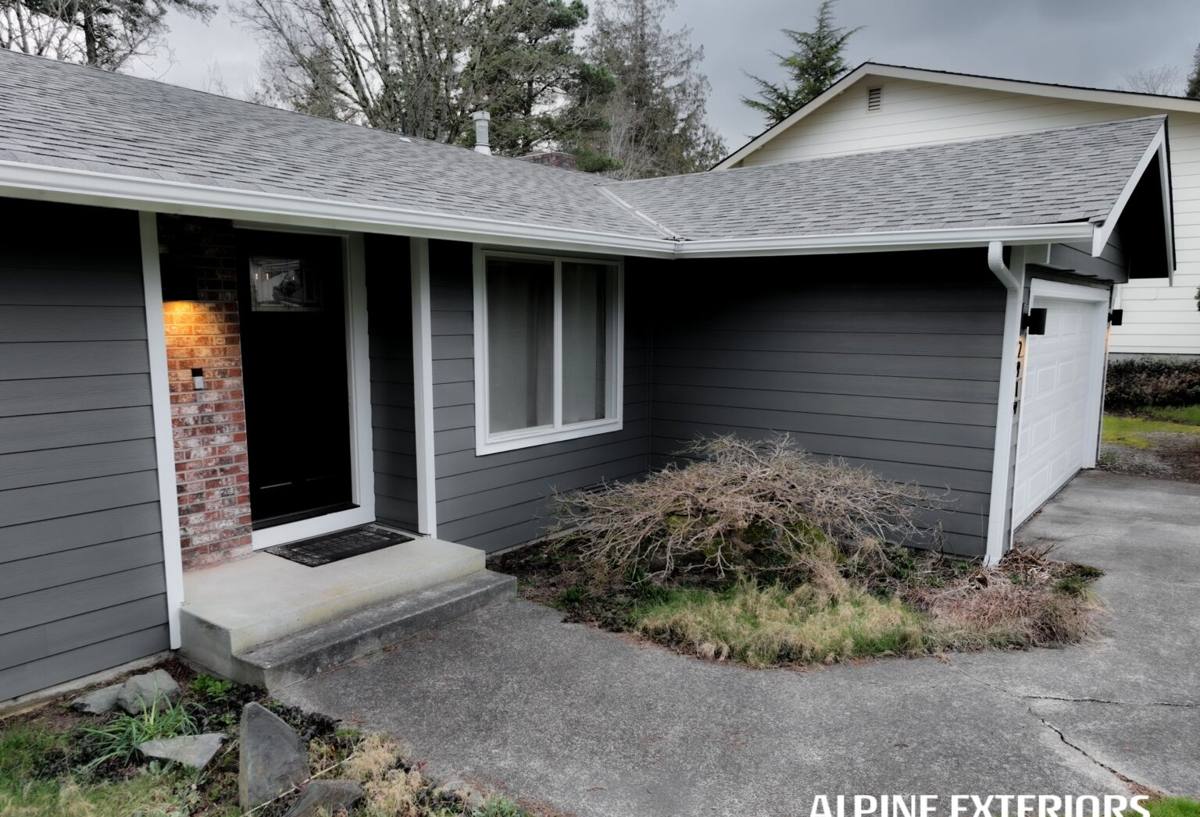
Why We Only Install James Hardie Here
We don't install vinyl, LP SmartSide, primed spruce, cedar, or generic fiber cement brands. That's not a marketing line — it's a standard we hold because of jobs we've seen go wrong in exactly this kind of shaded, damp environment. Wood-based products, including engineered wood siding, rely on a factory treatment and an intact paint film to keep water out. Once moisture gets past that layer — through a nail hole, a cracked caulk joint, or a spot where moss has been sitting against the wall — wood-based siding can swell, delaminate, or rot from the inside, and by the time it shows on the surface the damage is often already done underneath.
James Hardie fiber cement doesn't rot, and it isn't food for mold or moss the way wood-based products can be. It's cement, sand, and cellulose fiber, cured into a dense board that holds its shape and its paint line even when it stays damp longer than a homeowner would like. That's the whole reason we standardized on it: in a climate like this one, the material itself has to be able to shrug off long stretches of moisture contact, not just resist it while everything is installed perfectly and nothing ever cracks.
HZ5 Panels: Matched to This Climate Zone
James Hardie engineers its siding by climate zone, and Whatcom County falls in the HZ5 category — cooler, wetter regions where freeze-thaw cycling and sustained moisture exposure are the main threats. HZ5 panels are formulated for that reality. We don't substitute a warmer-climate HZ10 product to save a few dollars on a Sudden Valley job; the panel needs to match the zone it's going on, full stop.
What Correct Installation Actually Involves
James Hardie siding performs the way it's rated to only when it's installed to the manufacturer's specification. On a shaded, moisture-prone lot like a typical Sudden Valley property, a few details matter more than they would on an open, sun-exposed site:
- A continuous weather-resistive barrier behind the siding, lapped correctly so water sheds outward at every seam.
- A rain screen gap on shaded walls so air can move behind the panels and let them dry out between storms instead of sitting wet against the sheathing.
- Correct fastener placement and spacing — Hardie specifies exact nailing patterns, and getting this wrong is one of the most common causes of premature cracking or panel movement.
- Proper flashing at every window, door, and roofline intersection, including kick-out flashing where a roof edge meets a sidewall, which is a frequent leak point on multi-story homes tucked into trees.
- Clearance at grade and at planting beds — siding installed too close to soil, mulch, or landscaping holds moisture against the bottom course and invites the exact rot and staining problems homeowners are trying to avoid.
- Factory-sealed cut edges on every field cut, since an unsealed cut edge is one of the few places moisture can get into the board itself.
ColorPlus Factory Finish vs. Painted Siding in a Shaded Lot
Homes under heavy tree cover are hard on paint. Shade slows drying, falling debris and moss create a rougher surface for mildew to grab onto, and a paint film that would last a decade on an open, sunny wall can start chalking and peeling years earlier under a stand of trees. James Hardie's ColorPlus finish is baked on at the factory in a controlled process, which gives it better adhesion and UV and moisture resistance than a field-applied coat, and it comes with its own finish warranty separate from the substrate warranty. For a shaded Sudden Valley wall that's going to stay damp longer than average, that factory bond is doing real work that a site-applied paint job can't fully match.
Problems We Commonly Find Re-Siding Homes in This Area
When we tear off older siding on Sudden Valley homes, a few issues show up often enough to be worth flagging for anyone planning a replacement:
- Moss and algae staining concentrated on north- and east-facing walls, sometimes with soft or delaminated substrate underneath on wood-based products.
- Rot at the bottom courses where siding was installed too close to grade or where mulch beds and landscaping were built up against the wall over time.
- Missing or undersized kick-out flashing where a roof edge meets a sidewall, leading to a concentrated water path down one section of wall.
- Caulk joints that failed years ago and were never resealed, letting water track behind trim boards.
- Older siding types not rated for this climate zone, installed as a lower-cost substitute during a prior remodel.
None of these are unusual or embarrassing — they're what happens to any exterior over enough years in a wet, shaded climate without the right maintenance. The point of a correct James Hardie installation is to remove as many of these failure points as possible up front.
Our Process on a Sudden Valley Project
| Step | What Happens |
|---|---|
| Site walk and estimate | We look at sun exposure, tree cover, drainage, existing damage, and access before quoting — a shaded lakeside lot is priced differently than an open one. |
| Tear-off and sheathing check | Old siding comes off and we inspect the sheathing underneath for rot before anything new goes up; damaged sheathing gets replaced, not covered over. |
| Weather barrier and rain screen | A continuous WRB goes on first, with a rain screen gap on shaded elevations to let the wall assembly dry between storms. |
| Flashing and trim | All windows, doors, and roof-to-wall intersections get flashed before siding closes them in, including kick-out flashing at roof edges. |
| Hardie panel installation | Panels are installed to manufacturer fastener spec, with sealed field cuts and correct clearance at grade. |
| Final walkthrough | We walk the finished job with the homeowner and check caulking, trim lines, and clearances before calling it done. |
Cost Factors Specific to Sudden Valley Homes
| Factor | Why It Affects Price |
|---|---|
| Tree cover and access | Wooded, sloped lots with narrow or gated access can mean more staging time and hand-carrying material instead of machine access. |
| Existing damage | Rot found at tear-off means sheathing repair before new siding goes on, which isn't visible until the old material comes off. |
| Home height and complexity | Multi-story homes with dormers, multiple rooflines, or steep pitches need more flashing detail and staging. |
| Trim and detail level | Board-and-batten accents, wide trim, or custom color matching add labor beyond a straightforward lap-siding install. |
| HOA or gate coordination | Scheduling deliveries and crew access through a gated community adds planning time that an open-access property doesn't require. |
Why a Crew That Already Works This Neighborhood Matters
Sudden Valley isn't like a standard subdivision lot. Gated access, private roads, tree-lined driveways, and HOA coordination are all things a crew either already knows how to handle or has to figure out on your job, on your schedule. A crew that has worked in the neighborhood before knows how to stage a delivery, how much clearance a driveway actually has, and what kind of access requests the gate and HOA typically expect — none of which shows up in a generic estimate, but all of which affects how smoothly your project actually runs.
Local experience also means knowing which walls on a typical Sudden Valley lot take the worst of the shade and moisture, and building the installation — rain screen gaps, flashing details, clearance at grade — around that reality rather than a one-size-fits-all approach pulled from a warmer, drier part of the state.
What to Ask Before You Hire
- Do you install a rain screen gap on shaded or north-facing walls, or just face-nail directly to the sheathing?
- Will you inspect and replace damaged sheathing if you find rot at tear-off, and is that priced separately or included?
- What's your kick-out flashing detail at roof-to-wall intersections?
- Are you a James Hardie-only installer, or do you also sell vinyl or engineered wood — and if so, why would you recommend one over the other for my house?
- Have you worked inside Sudden Valley before, and do you know the HOA's process for scheduling exterior work?
If you're weighing a siding replacement on a Sudden Valley home, we're happy to walk the property, look at what your walls are actually dealing with, and put together a straightforward estimate — no pressure, no obligation. Use the form below to get started.