 Bellingham Siding
 Siding in York: What Bellingham's Climate Does to a House
York is one of Bellingham's established in-town neighborhoods, and like the rest of Whatcom County, it sits in a marine climate that is genuinely hard on exterior building materials. The combination that matters most for siding is threefold: proximity to salt air off Bellingham Bay and the Salish Sea, long stretches of driving, wind-blown rain in the fall and winter, and a moss and algae season that can run eight months out of the year in shaded or north-facing spots. None of these on their own is unusual for the Pacific Northwest. Together, over years, they are what separates a siding job that still looks good at year fifteen from one that's peeling, swelling, or growing green by year five.
Salt-laden air accelerates corrosion on fasteners, flashing, and any exposed metal trim. Driving rain finds every gap in a building envelope that isn't properly flashed and lapped, and it doesn't need a storm to do it — a normal Bellingham winter delivers weeks of sustained, wind-pushed moisture. And moss doesn't just look bad; it holds water against the siding surface far longer than open air would, which is exactly the condition that rots wood-based products and delaminates poorly made composites.
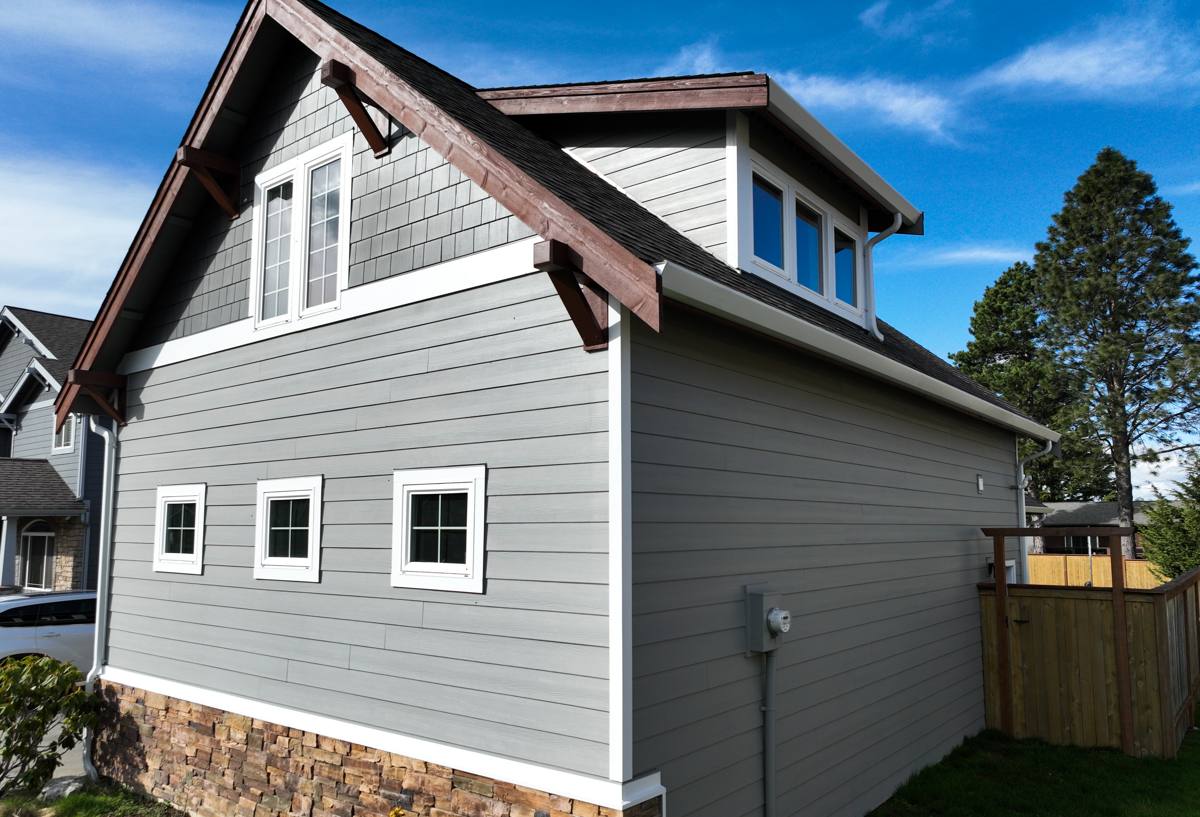
What We See on York Homes
York has a mix of housing stock — older homes from earlier decades of the neighborhood's development alongside newer infill and remodels. On the older end, we regularly find original wood siding or cedar that's been repainted many times, now past the point where another coat of paint solves anything. On homes from the past couple of decades, we see a lot of vinyl and some LP SmartSide, both of which have their own well-documented weak points in this specific climate — more on that below. What's consistent across almost every property, regardless of age, is that the north and west-facing walls (the ones catching the most wind-driven rain and holding the most shade) show wear first and worst.
Common Problems We're Called Out For
- Moss and algae staining on shaded walls and near roof lines
- Paint failure and visible wood grain telegraphing through old cedar or lap siding
- Swollen, soft, or delaminating edges on OSB-based siding products
- Warped or buckled vinyl panels from heat cycling or poor original installation
- Caulk failure and gaps around trim, windows, and corner boards letting moisture behind the cladding
Why We Only Install James Hardie Fiber Cement
We made a decision, as a company, to install exactly one siding system: James Hardie fiber cement. That's not a marketing angle — it's a standard we hold to because of what this climate does to alternatives, and because fiber cement performs differently at a material level than wood, vinyl, or wood-composite products.
Fiber cement is a mix of cement, sand, and cellulose fiber, engineered and pressed into planks and panels. It doesn't rot, because there's no organic wood fiber exposed to the weather the way there is with cedar or engineered wood siding. It's non-combustible, which matters increasingly for insurance conversations and for homeowners who simply want one less flammable material on their exterior. Hardie also makes a version of its product line — the HZ5 formulation — specifically engineered for climates with heavy moisture exposure, which is exactly the environment Whatcom County sits in.
The factory-applied ColorPlus finish is another piece of this. Instead of field-painting siding after installation (which is where a lot of moss, mildew, and premature paint failure gets baked in from uneven coverage or painting in less-than-ideal weather), Hardie's ColorPlus color is baked on in a controlled factory environment, backed by its own finish warranty, and formulated to resist the fading and staining that Pacific Northwest weather causes over time.
What Correct Installation Actually Involves
Fiber cement only performs as advertised when it's installed to Hardie's published specifications — this is where a lot of siding jobs, on any product, quietly go wrong. Correct installation means proper clearance from grade and roof lines, correctly lapped and sealed house wrap or weather-resistive barrier underneath, flashing at every window, door, and penetration, proper fastening pattern and fastener type (especially given the salt-air corrosion factor), and caulking only where Hardie's specifications actually call for it — not as a substitute for proper flashing.
What We Don't Install, and Why
We get asked fairly often why we don't offer vinyl, LP SmartSide, cedar, or primed spruce as options, since all of them are common around Bellingham and generally cheaper up front. Our answer is honest, not dismissive of those products — each one has a legitimate use case somewhere, just not one we're willing to put our name behind here.
- Vinyl siding is inexpensive and low-maintenance in mild climates, but it expands and contracts significantly with temperature swings, can warp or crack in wind-driven rain and cold snaps, and has no meaningful fire resistance. It also doesn't hold up visually the way fiber cement does over a 20-30 year horizon.
- LP SmartSide and other engineered wood products use a wood-strand core with a resin coating. When that coating is compromised — at a cut edge, a nail hole, or a joint that wasn't sealed correctly — moisture gets into the wood core and it can swell or delaminate. In a climate with York's rainfall and humidity, that's a real long-term risk, not a hypothetical one.
- Cedar and primed spruce are beautiful, traditional, and genuinely appropriate for some homes and budgets, but they're organic wood products that need ongoing paint or stain maintenance to keep water out, and they're the most vulnerable of any option to the rot and moss issues we see constantly in this climate.
Fiber cement costs more than vinyl and often more than engineered wood up front. We think that's the honest trade-off worth making for a product that doesn't rot, doesn't need repainting on any regular cycle, and is backed by a strong transferable warranty.
Our Siding Installation Process
Inspection and Tear-Off
Every project starts with a real inspection — not just of the siding surface, but of what's underneath it. We're checking sheathing condition, looking for existing rot or moisture damage (common on older York homes with original wood siding), and identifying any structural issues that need to be addressed before new siding goes on. Covering up a moisture problem with new siding just hides it; it doesn't fix it.
Weather Barrier and Flashing
This is the step that determines whether a siding job lasts 30 years or fails in five. We install or verify a continuous, correctly lapped weather-resistive barrier, then flash every window, door, deck ledger, and penetration so water is directed out and down, never trapped behind the cladding. In a climate that delivers sustained driving rain, this layer matters more than the visible siding itself.
Installation to Manufacturer Spec
Hardie planks and panels go on following the manufacturer's fastening schedule, clearance requirements, and joint treatment — not shortcuts that speed up the job but compromise how the system performs over time.
Finish and Cleanup
Trim, corner details, and caulking (only where specified) finish the installation, followed by a full site cleanup. We walk the job with the homeowner before calling it done.
Beyond Siding: The Full Exterior Envelope
Siding doesn't work in isolation. We also handle roofing, windows, and decks, because a home's exterior envelope is one connected system — a roof that's shedding water improperly, a window that's flashed wrong, or a deck ledger that's trapping moisture against the wall will undermine even a perfectly installed siding job. When we're on a York property for a siding project, we're looking at the whole envelope, not just the walls, and we'll flag issues we see with roofing, window flashing, or deck framing even if that's not the scope we were called for.
Cost Factors for a York Siding Project
Every home is different, but the factors that actually move the price of a siding job are consistent. We walk through these with every homeowner before we ever talk numbers.
| Factor | Why It Matters |
|---|---|
| Tear-off complexity | Multiple layers of old siding, or siding over sheathing that needs repair, adds labor before new material even goes up |
| Home size and stories | More square footage and taller walls mean more material, staging, and labor |
| Trim and architectural detail | Corner boards, window trim, and complex rooflines all take more time to flash and finish correctly |
| Siding profile chosen | Hardie offers lap, shingle, and panel styles at different price points within the product line |
| Underlying moisture or structural repair | Rot found during tear-off has to be repaired before new siding goes on — this is the most common source of change orders |
Fiber cement generally carries a higher material and installation cost than vinyl and a comparable-to-higher cost than engineered wood, offset over time by lower maintenance spending and a longer service life.
Choosing a Local Contractor
Whatcom County has no shortage of exterior contractors, and not all of them install to the same standard. A few things worth checking before you hire anyone for a siding project in York or elsewhere in Bellingham:
- Confirm they're licensed and insured to do exterior work in Washington State, and ask to see proof
- Ask specifically how they handle flashing and weather barrier detailing, not just what siding brand they sell
- Ask whether they're a certified installer for the specific product they're proposing
- Get a clear, written explanation of what's included — tear-off, disposal, repair contingencies, warranty terms
- Ask how they handle moisture or rot discovered mid-project, and how that affects cost
- Check whether the warranty is manufacturer-backed, installer-backed, or both, and what's actually covered
Living With Fiber Cement Siding in a Marine Climate
One of the practical benefits of switching to Hardie in a place like York is how little ongoing maintenance it asks for compared to wood or engineered wood. It won't need repainting on a five-to-ten-year cycle the way cedar or primed spruce does. It does still benefit from an occasional gentle rinse to keep moss and algae from building up in shaded areas, and from a periodic walk-around to check caulking at trim joints and around windows — the same kind of light check-up any exterior needs in a wet climate. That's a meaningfully lighter maintenance load than what most York homeowners are used to with their current siding.
If you're weighing a siding project in York — whether it's a full replacement, repair work after storm or moisture damage, or you're planning ahead for a home that's showing its age — we're happy to come take a look and talk through what we're actually seeing on your walls. There's no pressure and no cost to get an estimate; fill out the form below and we'll get in touch.