 Bellingham Siding
 Composite Decking Built for York's Weather, Not Against It
If you live in York and you're looking at a deck that's gone gray, spongy, or slick with moss by December, you already know the drill. Whatcom County doesn't get brutal winters, but it gets something harder on a deck in some ways: months of low sun, driving rain off the Sound, and a damp marine air that never really lets wood dry out between storms. A deck built without that reality in mind starts failing in year three or four. One built for it can go two decades with nothing more than an annual wash.
We're a Bellingham-based crew that works York regularly, along with the surrounding neighborhoods. This page covers what composite decking actually involves here — not the marketing version, the real one: what the climate does to a deck, what a correctly built one looks like underneath, and how we run the job from first look to final walkthrough.
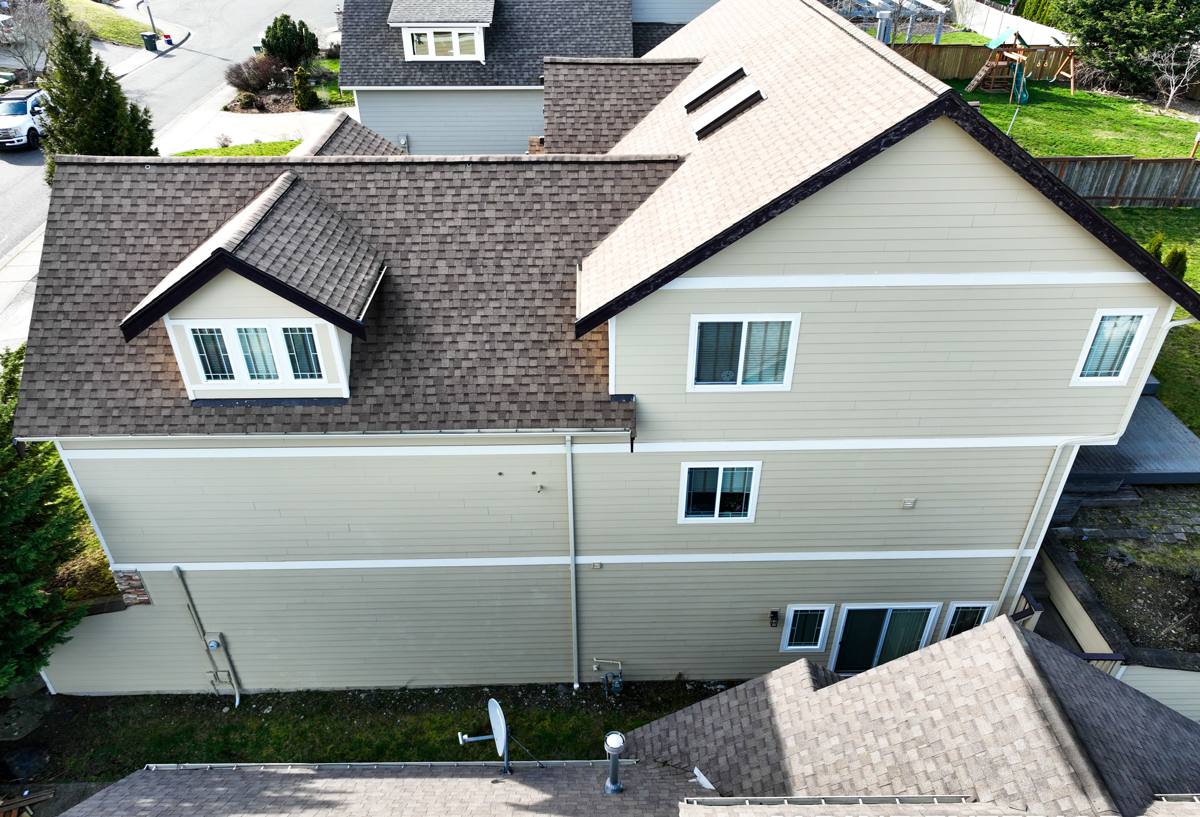
What Bellingham's Climate Actually Does to a Deck
Three things drive almost every deck problem we see in this part of Whatcom County:
- Salt-laden air. Being close to the water means airborne salt settles on everything outdoors, including fasteners, flashing, and railing hardware. Uncoated or poorly rated metal corrodes faster here than it would inland.
- Driving rain, sideways as much as straight down. Storms off the water don't just fall on a deck, they get pushed into ledger connections, stair stringers, and any gap where water can find a path to wood framing underneath.
- A long moss and algae season. Shaded, north-facing, or tree-covered decks in York can stay damp for weeks at a stretch, especially October through April. That moisture film is exactly what moss and algae need to take hold on a deck surface.
None of that is unusual for the region — it's just the baseline a deck has to be built to handle, rather than something to discover the hard way after a couple of wet winters.
Why Wood Struggles With This Combination
Traditional wood decking can absolutely work in this climate, but it demands consistent upkeep: annual cleaning, periodic sealing, and close attention to any spot where water sits or splashes back. Skip a season or two of maintenance and you start seeing cupping, splintering, and soft spots. In a market where a lot of homeowners want a deck that looks good without a maintenance calendar attached to it, that's the main reason composite has become the default recommendation we give York homeowners.
What Composite Decking Actually Solves — and What It Doesn't
Composite boards (a blend of wood fiber and polymer, usually with a protective outer cap) don't absorb water the way solid wood does, so they don't cup, splinter, or rot in the board itself. That's a real advantage in a climate this wet. But composite isn't maintenance-free — it's low-maintenance, and the difference matters:
- Capped composite still needs periodic washing to stay ahead of surface algae and pollen film, especially on shaded sections.
- The framing underneath — joists, beams, ledger board — is still usually pressure-treated wood or steel, and it still needs to be built and flashed correctly. Composite decking on top of poorly protected framing just hides a rot problem longer before it shows up.
- Not all composite is equal. Cheaper, uncapped boards absorb more moisture at the core and are more prone to staining and mold in a climate like this one. We're specific about which product lines we use for exactly that reason.
So the honest pitch is this: composite solves the board-level problem (rot, splintering, constant sealing) very well. It does not solve a badly built substructure. That's why our focus is as much on what's underneath the decking as the decking itself.
What a Correctly Built Composite Deck Involves
A composite deck is only as good as the frame and connections underneath it. In a wet, salt-exposed climate, a few details matter more than they would somewhere drier:
Ledger and Structural Connections
Where the deck attaches to the house is the single most common failure point on any deck, composite or wood. It needs proper flashing that sheds water away from the house band board, not toward it, and fasteners rated for the moisture and salt exposure this area sees. A ledger connection that traps water against the house framing will cause rot behind the siding long before the decking itself shows any wear.
Joist Protection
Composite decking manufacturers generally require joist tape or an equivalent protective barrier over the top of each joist. It's a thin detail that's easy to skip and impossible to see once the boards are down — but it's what keeps rainwater that gets between board gaps from soaking directly into the joist top, which is the most common way a deck frame starts to fail underneath a perfectly good-looking composite surface.
Hardware and Fasteners
Given the salt air here, we use fasteners and structural hardware rated for coastal or wet-exposure use — not standard interior-grade hardware. This is a small cost difference at build time and a significant difference in how long connections last before corrosion becomes a problem.
Airflow Underneath
Decks built low to the ground or over concrete patios with poor airflow underneath stay damp longer after storms. Proper joist spacing, venting where possible, and correct drainage slope all help the structure dry out between rain events instead of staying saturated through an entire wet season.
Board Spacing and Fastening
Composite boards expand and contract with temperature more than people expect. Gapping and fastening have to account for that movement, especially on longer runs, or you end up with boards that buckle or pull away from clips over time.
Framing and Fastener Comparison
| Component | Standard-grade approach | What we use in York |
|---|---|---|
| Ledger fasteners | Standard exterior screws | Corrosion-resistant, coastal-rated fasteners |
| Joist protection | Bare treated lumber | Joist tape over every joist top |
| Railing hardware | Basic zinc-coated hardware | Stainless or marine-rated hardware |
| Ledger flashing | Caulk only, no flashing | Metal flashing plus membrane at the ledger |
| Board type | Uncapped composite | Fully capped composite boards |
None of this shows up in a photo of the finished deck. All of it shows up in whether the deck is still solid in fifteen years.
How Our Process Works
- On-site assessment. We look at the existing structure (if there is one), grading and drainage around the deck footprint, sun/shade exposure, and how the deck will tie into the house.
- Plan and product selection. We walk through composite board options, color and finish, railing style, and layout based on how the space will actually be used.
- Permitting. Deck projects in this area typically require a permit depending on size and height — we handle that process rather than leaving it to the homeowner.
- Demo, if replacing an existing deck. Old decking and, where needed, old framing is removed and hauled off.
- Framing and structural work. Ledger, posts, footings, and joists are built or reinforced to code, with the protective details above built in from the start.
- Decking, railing, and stairs installed. Boards, fascia, railing, and stairs go in per manufacturer spec, including expansion gaps and fastening pattern.
- Final walkthrough. We go over the finished deck with the homeowner, including basic care so it stays looking good with minimal effort.
Before You Sign a Deck Contract: A Practical Checklist
- Ask specifically what fastener and hardware grade will be used — "exterior rated" is not the same as coastal or marine rated.
- Ask whether joist tape or equivalent joist protection is included, not just assumed.
- Confirm whether a permit is required for your project and who's pulling it.
- Ask how the ledger connection will be flashed, specifically, not just "sealed."
- Get the manufacturer and product line of the composite decking in writing, not just "composite decking."
- Ask about the warranty structure — what's covered by the manufacturer versus what's covered by the installer's workmanship warranty, and for how long.
Repair or Full Replacement?
Not every aging deck in York needs to come out entirely. If the framing underneath is still sound — dry, solid to the touch, no soft spots at the ledger or posts — it's sometimes reasonable to replace just the surface decking and railing with composite while keeping a structurally good frame. If there's any sign of rot at the ledger, posts, or joists, or the deck was built without proper flashing to begin with, replacing the surface without addressing the frame just delays the real problem. We'll tell you honestly which situation you're in before recommending a scope of work — a full rebuild isn't always the answer, and neither is a surface-only refresh.
Why Hiring a Crew That Already Works in York Matters
Building codes, permit requirements, and even typical soil and drainage conditions vary block to block in a place with this much microclimate variation — a shaded, tree-covered lot behaves very differently than an open one a few streets over, even both being in York. A crew that's already worked in the neighborhood isn't guessing at how a deck here will hold up through a wet Whatcom County winter; they've seen what happens to the last one that wasn't built for it. That local familiarity shows up in small decisions throughout the build — where extra flashing matters most, how much slope to build in for drainage, which corners genuinely can't be cut on a coastal Bellingham property.
Living With a Composite Deck Here
Once it's built right, upkeep is genuinely simple. A seasonal rinse with a hose or gentle pressure wash, keeping gutters and nearby drainage clear so water isn't dumping onto the deck surface, and an occasional check of railing hardware for any early corrosion is about the full list. Compared to the sanding, staining, and sealing cycle that solid wood decking demands in this climate, it's a significant reduction in ongoing work — without giving up how the deck looks or feels underfoot.
If you're planning a new deck or replacing one that's not holding up to Bellingham's weather, we're happy to take a look and give you a straightforward, no-pressure estimate — just fill out the form below.