 Bellingham Siding
 Siding Built for York's Corner of Bellingham
The York neighborhood sits close enough to Bellingham Bay and the surrounding hillsides that its homes take a particular kind of weather beating year-round. Salt-tinged air drifts in off the water, driving rain arrives sideways more often than straight down, and the long gray stretch from October through April gives moss and algae months to establish themselves on anything that stays damp. Older homes in this part of Bellingham often show the pattern clearly: paint failing at the bottom courses first, dark streaking under eaves and behind downspouts, and soft spots where trim meets siding near ground level. None of that is bad luck. It is what happens when a siding material and installation detail aren't matched to this specific climate.
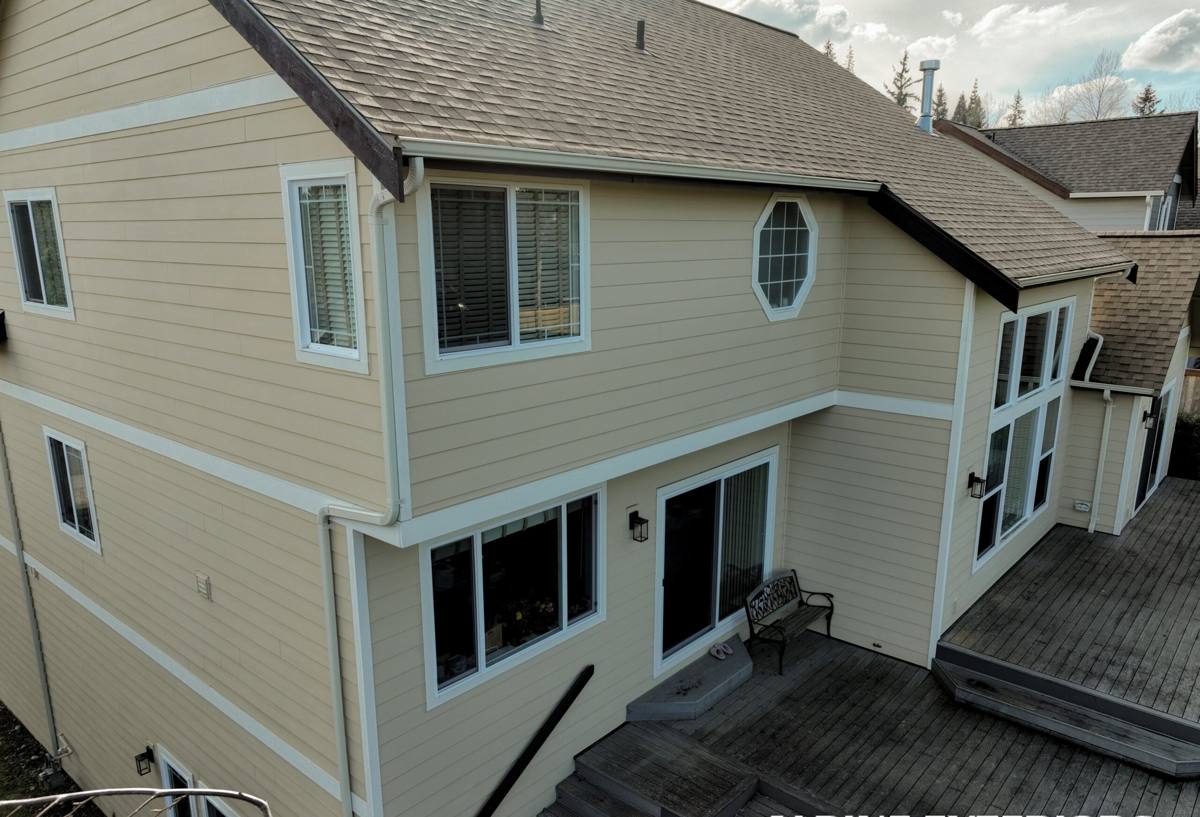
We install James Hardie fiber cement siding exclusively, and we work this neighborhood regularly enough to know which details matter most here. This page is about what a correct Hardie installation looks like for a York home specifically — not a generic overview of the product line.
What Whatcom County Weather Actually Does to Siding
Bellingham's climate isn't extreme in the way a hurricane zone or a desert is extreme. It's a slow, persistent kind of wear. Three factors matter most for siding performance in York:
- Salt air: Even a few miles inland from the bay, airborne salt accelerates corrosion of exposed fasteners, flashing, and staples. Untreated or under-spec'd metal fails years before the siding around it would otherwise need attention.
- Driving rain: Wind-driven rain off Puget Sound doesn't just fall on a wall — it gets pushed sideways into seams, laps, and butt joints. Any siding system that relies on caulk alone at those joints, rather than proper overlap and flashing, will eventually let water in.
- Moss and algae season: Long, low-light, damp winters in Whatcom County give organic growth a head start most of the country doesn't deal with. North-facing walls and anything shaded by trees or a neighboring structure stay damp longer, which is exactly what moss needs to take hold.
Wood-based and wood-adjacent siding products struggle most with this combination because moisture that gets past the surface has somewhere to go — into the substrate. Fiber cement doesn't have that vulnerability the same way, which is a big part of why we standardized on it.
Why James Hardie Specifically
James Hardie fiber cement is engineered from cement, sand, and cellulose fiber — it doesn't rot, it isn't a food source for moss or mildew the way wood is, and it's non-combustible. Hardie also makes a version of its product specifically for the Pacific Northwest: the HZ5 line, engineered for regions with sustained moisture exposure and freeze-thaw cycling. That's not a marketing distinction — the formulation and factory finish are built around holding up in exactly the conditions York deals with every winter.
The ColorPlus factory finish matters here too. It's baked on in a controlled environment rather than field-applied, which means better adhesion and more consistent coverage than a job-site paint job — and touch-up paint is available to match if siding is ever cut or damaged. Combined with a strong transferable warranty, it's a product system built to be maintained, not replaced, for decades.
What We Don't Install, and Why
We don't install vinyl, LP SmartSide, cedar, primed spruce, Cemplank, or Allura. Each of those has legitimate uses elsewhere, but for this climate specifically, they carry trade-offs — moisture sensitivity at cut edges, more frequent repainting, or performance that depends heavily on installer precision — that we're not willing to put our name behind here. Standardizing on one product means our crews install it correctly every time instead of relearning a new material's quirks on each job.
What a Correct Installation Involves
The siding material is only part of the equation. In a neighborhood like York, where wind-driven rain is a regular event, the installation details determine whether a home stays dry for the next 30 years or starts showing water damage in five.
| Detail | Why It Matters in York |
|---|---|
| Weather-resistive barrier, properly lapped | Provides a drainage plane behind the siding if any water gets past the face — critical with driving rain off the bay |
| Rainscreen or proper furring where called for | Lets moisture and moisture vapor escape instead of trapping it against the sheathing |
| Correct fastener type and placement | Salt-air corrosion resistance; improperly placed fasteners can also void Hardie's warranty |
| Flashing at every horizontal transition | Windows, trim boards, and roof lines are the most common leak points if flashed incorrectly |
| Proper clearance above grade and hard surfaces | Keeps the bottom course from sitting in standing moisture, which is where moss and paint failure show up first |
| Sealed and primed cut edges | Factory finish doesn't cover field cuts — leaving them unsealed invites moisture into the board |
Skipping any one of these doesn't usually cause an immediate problem. It shows up two, five, or ten years later, which is exactly why installation quality is harder for a homeowner to evaluate up front than the product brand is.
Signs a York Home Needs Siding Attention
Because of the climate here, certain warning signs show up earlier and more consistently than they might elsewhere:
- Dark green or black streaking, especially on north- or shade-facing walls
- Paint that's peeling or bubbling near the bottom few courses rather than uniformly across the wall
- Soft or spongy trim boards around windows, doors, or corner boards
- Visible gaps or separation at butt joints and seams
- Rust staining below fasteners or flashing
- Consistently damp siding that doesn't dry out between rain events
Any one of these is worth a look. Several at once usually means moisture has been getting behind the siding for a while, not just sitting on top of it.
Our Process for York Jobs
1. On-Site Assessment
We walk the exterior with you, check current siding and trim condition, look at drainage and grade around the foundation, and identify any areas — north walls, shaded sections, spots near downspouts — that need extra attention given how water moves around this particular property.
2. Scope and Product Selection
We spec the correct Hardie product line (typically HardiePlank lap siding or HardiePanel, depending on the home's style) in the HZ5 formulation, and walk through ColorPlus color options that hold up to the Pacific Northwest's UV and moisture profile.
3. Prep and Removal
Old siding comes off, sheathing gets inspected for hidden rot or damage (common in older homes in wetter neighborhoods), and any necessary repairs happen before anything new goes up. We don't cover up a problem behind new siding.
4. Installation to Spec
Weather barrier, flashing, fastening, and clearances are installed to James Hardie's published specifications — not shortcuts, not "close enough." This is what keeps the manufacturer's warranty valid and what actually keeps water out.
5. Final Walkthrough
We review the finished work with you, confirm caulking and touch-up paint match where needed, and go over basic maintenance expectations for a home in this climate.
Maintenance in a Moss-Prone Climate
Fiber cement siding is low-maintenance compared to wood, but "low" isn't "none," especially in Whatcom County. A rinse-down once or twice a year on shaded or north-facing walls helps prevent moss and algae from establishing before they become a visible problem. Keeping gutters clear and downspouts directed away from the wall reduces the concentrated moisture exposure that causes most localized staining. Trimming back vegetation that shades a wall for most of the day also helps that section dry out between rain events, which matters more in York than in drier parts of the state.
What to Ask Before Hiring Anyone for This Job
- Are you a certified or experienced James Hardie installer, and can you explain the HZ5 vs. standard product distinction?
- What weather-resistive barrier and flashing details will you use at windows, doors, and trim transitions?
- How do you handle fastener selection for a coastal-adjacent climate?
- Will cut edges be sealed and primed before installation?
- What does the warranty cover, and is it transferable if the home sells?
A crew that already works in York and similar Bellingham neighborhoods should be able to answer all of these without hesitation, because they're solving for the same climate on every job.
Get a Straight Answer About Your Home
If you're seeing early warning signs, planning ahead, or just want an honest read on your current siding's condition, we're happy to take a look. There's no pressure and no sales script — just a straightforward assessment and, if it makes sense, a clear estimate for James Hardie siding done right for a York home. The form below is the easiest way to get started.