 Bellingham Siding
 Why Puget-Area Homes Go Through Siding Faster
Homes in the Puget area near Bellingham sit close enough to Whatcom County's marine air that siding takes a different kind of beating than it would twenty miles inland. Salt-laden moisture works into seams and fastener heads. Driving rain off the water finds every gap in flashing and caulk. And the long, low-sun stretch from fall through spring keeps north- and west-facing walls damp for weeks at a time, which is exactly the environment moss and mildew need to take hold. None of this is dramatic on its own, but stacked together year after year, it's why siding that would last decades in a drier climate can start failing here in half that time if it wasn't installed with this exposure in mind.
This page is about one job, done right, in this one area: replacing siding on a Puget-area home. Not a general overview of siding — the specific decisions, sequencing, and materials that matter when the house is a few miles from saltwater and gets more wet-season days than almost anywhere else in Washington.
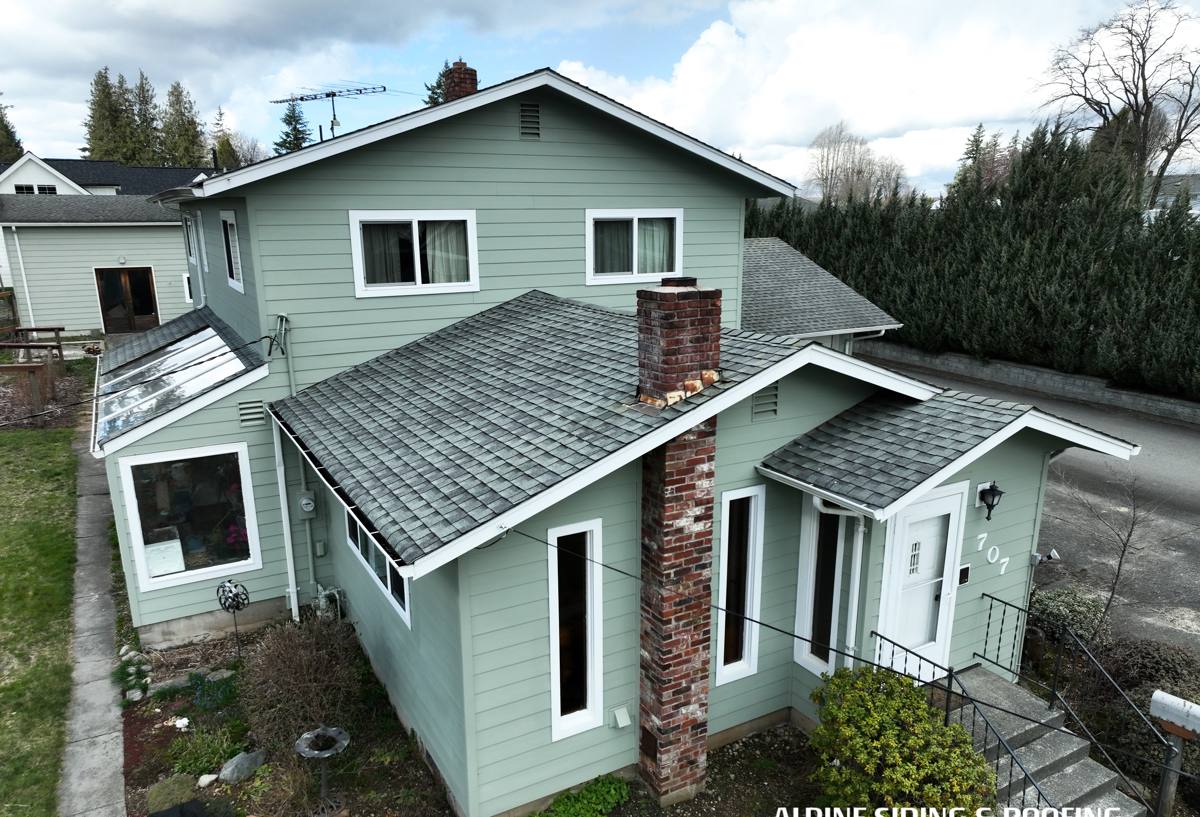
What Salt Air, Rain, and Moss Actually Do to Siding
Salt air
Airborne salt is corrosive to metal fasteners, flashing, and trim. Where a builder used the wrong grade of nail or skipped corrosion-resistant flashing, you'll see staining, streaking, or fastener pops well before the siding material itself has aged out. Salt exposure doesn't destroy fiber cement siding, but it does mean every metal component in the assembly — nails, flashing, drip caps — has to be spec'd for it from day one.
Driving rain
Wind-driven rain doesn't just wet the surface of a wall — it pushes water sideways and upward under laps, around window and door trim, and into any gap where the water-resistive barrier wasn't lapped correctly. A siding job that looks fine from the curb can still be letting water behind the cladding if the flashing details were rushed. That's a slow, hidden problem: rot in sheathing and framing that doesn't show up until the siding is pulled off.
Moss season
Whatcom County's wet season runs long, and shaded or north-facing walls can stay damp for extended stretches. Moss and algae need sustained moisture and low light to establish, and once they get a foothold on porous or textured siding, they hold moisture against the surface and accelerate whatever decay process is already underway. Smooth, factory-finished fiber cement resists this far better than raw wood, primed spruce, or textured vinyl, but no siding is immune if gutters are clogged or vegetation is crowding the wall.
Signs a Puget-Area Home Needs Siding Replacement, Not Just Repair
- Soft, spongy, or crumbling spots when you press on the siding, especially near the bottom courses or under windows
- Persistent moss or dark staining that comes right back within a season of cleaning
- Visible gaps, warping, or buckling panels, particularly on the walls that face prevailing wind and rain
- Paint that won't hold — blistering, peeling, or needing a repaint far more often than the rest of the house
- Rust streaks below nail heads or trim, a sign the fasteners aren't holding up to the salt air
- Rot or soft framing discovered when a small section is opened up for another repair
- Rising energy bills with no other explanation, which can point to water-compromised insulation behind the siding
One or two of these on their own might mean a targeted repair is enough. Several at once, or any sign of moisture behind the siding rather than just on it, usually means the assembly has failed and a full replacement is the honest recommendation — patching over a wet wall just delays a bigger repair later.
What a Correct Replacement Involves
Siding replacement in this climate is not just swapping old boards for new ones. The sequence matters as much as the material:
- Full tear-off and inspection. Old siding comes off so the sheathing and framing underneath can actually be looked at, not guessed at. Any soft or rotted wood gets replaced before anything new goes up — covering damaged sheathing with new siding just hides the problem.
- Water-resistive barrier, installed and lapped correctly. This is the layer that actually keeps bulk water out even if some gets past the siding face. In a driving-rain climate, correct shingle-lap sequencing at every seam, window, and penetration is non-negotiable.
- Flashing at every water-prone point. Windows, doors, roof-to-wall transitions, and deck ledgers all need flashing detailed to shed water outward, not trap it. This is the single most common place a rushed job fails.
- Correct fastening. Fastener type, length, and placement affect both wind performance and long-term corrosion resistance — especially important given the salt-air exposure here.
- Proper clearances. Siding held too close to grade, decks, or roof lines stays wet longer and starts wicking moisture. Manufacturer-specified clearances aren't a suggestion; they're what keeps the bottom courses from being the first thing to fail.
- Finish and caulking done to spec. Factory-finished panels reduce the number of field-painted, failure-prone joints compared to site-primed products.
Why We Install James Hardie Fiber Cement — and Nothing Else
We get asked why we don't offer vinyl, LP SmartSide, or cedar as options. The honest answer is that for a climate with this much sustained moisture and salt exposure, we've standardized on one product system because it holds up without asking the homeowner to gamble on installation quality or maintenance discipline.
| Material | How it handles this climate | Long-term trade-off |
|---|---|---|
| Vinyl siding | Won't rot, but expands/contracts with temperature and can warp or crack; seams are a constant water-entry risk in driving rain | Shorter realistic lifespan here; fading and brittleness over time |
| LP SmartSide (engineered wood) | Wood-based core is sensitive to sustained moisture exposure; performance depends heavily on caulking and edge sealing being maintained | Higher ongoing maintenance burden in a wet climate; edge swelling if maintenance lapses |
| Cedar / primed spruce | Attractive, but untreated wood in salt air and long moss seasons needs frequent refinishing and is a food source for the organisms that cause rot | Highest maintenance cost over 10-20 years; repainting/resealing cycle never really stops |
| James Hardie fiber cement | Non-combustible, dimensionally stable, factory ColorPlus finish resists moss staining better than raw wood | Requires correct installation to spec (which is what our process is built around) |
Hardie's fiber cement is dimensionally stable — it doesn't swell, shrink, or warp the way wood-based products can when they cycle through wet and dry seasons. The ColorPlus factory finish means the color coat is baked on under controlled conditions rather than field-applied, which matters a lot when field painting is at the mercy of Whatcom County's rain calendar. And Hardie's HZ product lines are engineered specifically for climate zones like this one — freeze-thaw and moisture exposure were part of the design brief, not an afterthought. None of that means Hardie is maintenance-free; it still needs correct installation, proper clearances, and normal upkeep. But it removes the biggest variable — the base material's own vulnerability to sustained moisture — from the equation.
Our Process for a Puget-Area Replacement
We work this part of Whatcom County regularly, and the process reflects that:
- On-site assessment that looks specifically for moisture damage patterns common to homes in this exposure — not just a visual siding check
- Sheathing and framing inspection once old siding is off, with any repairs scoped and priced before new siding goes up, not discovered mid-job
- Weather-timed scheduling that accounts for how much of the year here is wet — we plan tear-off and WRB installation around dry windows so the wall isn't left exposed longer than necessary
- Full Hardie installation to manufacturer specification: correct fastening, flashing, and clearances throughout
- Final walkthrough covering what normal upkeep looks like for a home in this specific microclimate
What Drives the Cost
| Factor | Why it matters here |
|---|---|
| Extent of hidden damage | Homes with a history of moisture intrusion often need sheathing or framing repair discovered only after tear-off |
| Wall exposure | Walls facing prevailing wind and rain may need extra flashing detail versus more sheltered elevations |
| Home size and complexity | Corners, window/door count, and roofline transitions all add flashing and labor time |
| Siding profile and color | Hardie offers multiple plank widths, textures, and ColorPlus colors at different price points |
| Trim and accessory work | Fascia, soffit, and trim replaced alongside siding adds cost but avoids mismatched future repairs |
We give a specific number after seeing the house — broad ranges without an on-site look aren't useful to you and we won't pretend otherwise.
Why a Crew That Already Works This Area Matters
A contractor who works Bellingham and the surrounding Whatcom County communities regularly already knows which walls in this kind of exposure tend to fail first, what flashing details actually hold up to driving rain off the water, and how long the wet season really runs when scheduling tear-off. That's not something a crew coming from a drier region picks up on the first job — and siding is not a product where you want to be the one they're learning on. It's also worth asking any contractor, ours included, how they handle fastener and flashing material in salt-air exposure specifically — the answer tells you a lot about how the rest of the job will go.
Maintenance After Replacement
Correctly installed Hardie siding is low-maintenance, not no-maintenance. In this climate, that means an annual rinse-down to keep moss and algae from establishing, keeping gutters clear so water isn't sheeting down the wall, keeping vegetation trimmed back from shaded walls, and a visual check of caulking at trim and penetrations every year or two. None of it is heavy work, but skipping it is how a well-installed job starts looking tired early.
If you're seeing early signs of trouble on a Puget-area home, or your siding is simply old enough that you're wondering whether it's time, we're glad to take a look and give you a straight answer — no pressure, no upsell, just what we'd actually recommend for your house. Reach out for a free estimate using the form below.