 Bellingham Siding
 Why York Homes Need Siding Built for This Climate
The York neighborhood sits inside Bellingham's marine climate zone, which means the siding on these homes is dealing with three separate stresses every year, not just one. Salt-tinged air drifting off Bellingham Bay slowly attacks fasteners, seams, and any exposed wood fiber. Driving rain — the kind that comes in sideways during a fall or winter storm — pushes water into joints and laps that would stay dry in a calmer climate. And a moss season that can run from October through May keeps north- and shade-facing walls damp for weeks at a stretch, which is exactly the environment moss, algae, and rot fungi need to get established.
None of these three things is dramatic on its own. The problem is that they overlap for most of the year in Whatcom County, and older or lower-grade siding systems weren't engineered with that overlap in mind. A siding product that works fine in a drier inland climate can fail here in half the time — not because it's a bad product everywhere, just because it's the wrong product for York's specific weather load.
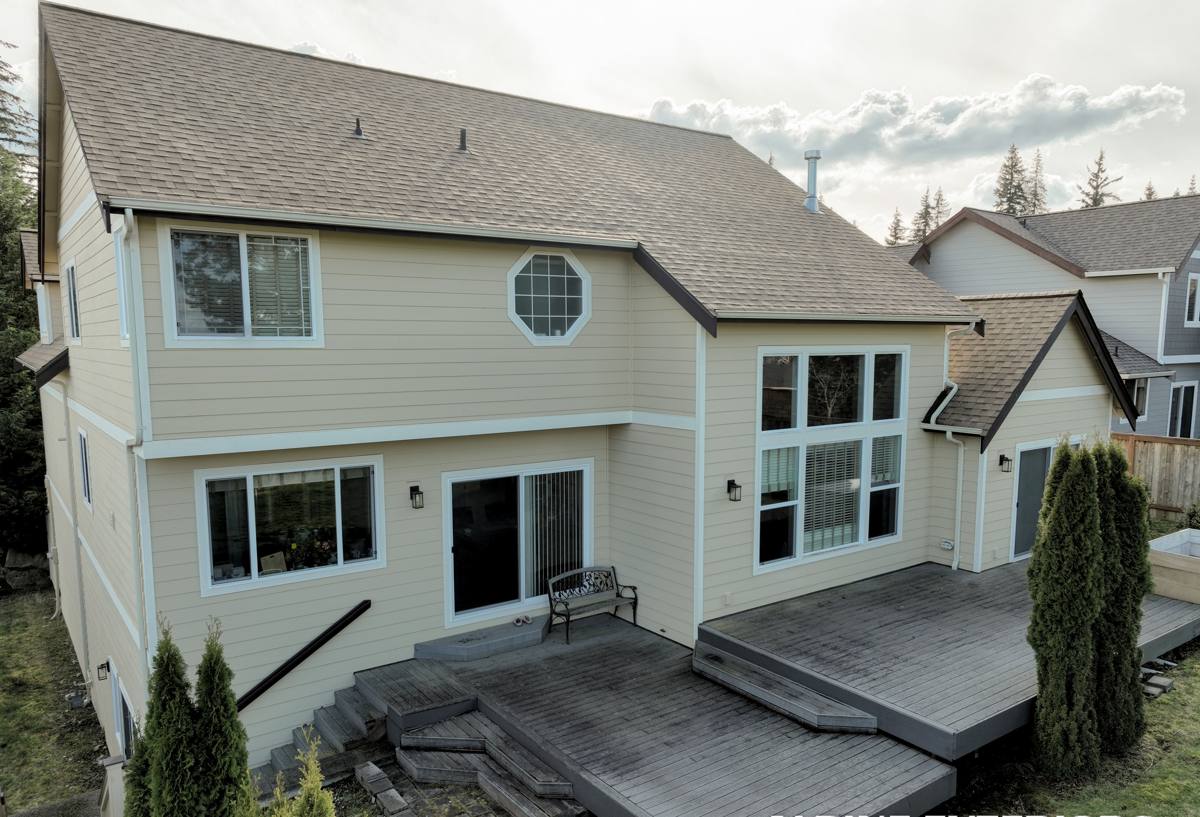
What "Correct" Fiber Cement Siding Actually Involves
Fiber cement siding is only as good as its installation. The material itself is dense, stable, and non-combustible, but the parts of a siding job that actually fail in this region — leaks, buckling, premature paint failure — almost always trace back to installation details, not the panels themselves. A correct job on a York home includes:
- A drainage plane behind the siding. A weather-resistive barrier (and ideally a rainscreen gap) so any moisture that gets past the siding has somewhere to go instead of sitting against the sheathing.
- Proper flashing at every penetration. Windows, doors, hose bibs, light fixtures, and vents all need step or head flashing that sheds water downward and outward — never just caulk covering a gap.
- Correct fastening. Fiber cement needs the right nail type, spacing, and depth per the manufacturer's install manual. Overdriven or underdriven fasteners are one of the most common causes of early siding trouble.
- Factory-cut and sealed edges. Every field cut needs to be sealed per spec, and joints need proper caulking with a product rated for exterior movement, not whatever tube happened to be on the truck.
- Clearance from grade, decks, and roof lines. Siding that ends too close to soil, concrete, or a roof surface wicks up moisture no matter how good the panel is.
Skip any one of these steps and you're relying on the siding material to compensate for a construction defect — which it can't do indefinitely, especially with the rain volume this area gets.
Why We Install James Hardie Only — and Nothing Else
We standardized on James Hardie fiber cement for every job we do, including here in York, and we don't install vinyl, LP SmartSide, primed spruce, cedar, or other fiber cement brands like Cemplank or Allura. That's a deliberate professional standard, not a sales pitch, and it's worth explaining honestly:
- Vinyl is inexpensive and low-maintenance, but it expands and contracts with temperature swings, can crack in impact or extreme cold, and simply isn't as dimensionally stable over decades as fiber cement.
- Wood products (cedar, primed spruce) look great fresh, but they need ongoing refinishing and are the most vulnerable of any common siding material to the rot and moss pressure that defines a Whatcom County winter.
- LP SmartSide and other engineered wood products perform reasonably when installed and maintained exactly to spec, but they're wood-based at the core, which means moisture intrusion at a cut edge or fastener hole behaves very differently than it does with a cement-based panel.
- Other fiber cement brands compete on price but don't offer James Hardie's specific HardieZone engineering for Pacific Northwest conditions, or the same factory finish warranty backing.
James Hardie is engineered in HZ5 and HZ10 formulations specifically for climates like ours — colder, wetter, higher moisture exposure than the national baseline. The ColorPlus factory finish is baked on and warranted separately from the substrate, which matters in a climate that's hard on paint. And because it's non-combustible, it doesn't feed a fire the way wood-based siding can. For a home that's going to sit in salt air and driving rain for the next 30-plus years, that combination is why we put it on every house we side, no exceptions.
James Hardie Product Lines Available for York Homes
| Product | Best Use | Notes for This Climate |
|---|---|---|
| HardiePlank lap siding | Most common full-house application | Available in smooth and cedar-textured finish; the standard choice for York streetscapes |
| HardiePanel vertical siding | Modern facades, accent walls, gables | Clean vertical lines; pairs well with lap siding for mixed-material looks |
| HardieShingle | Craftsman and cottage-style homes | Staggered or straight-edge shingle profiles without the maintenance of real wood shakes |
| HardieTrim | Corners, window and door trim, fascia | Matches the siding's moisture resistance so trim doesn't become the weak point |
Our Process for a York Siding Project
1. On-Site Assessment
We walk the exterior and look specifically at the things that matter in this climate: current siding condition, moisture staining, sheathing softness at penetrations, existing flashing quality, and which elevations get the most driving rain and shade-driven moss growth. That assessment drives the plan, not a generic template.
2. Tear-Off and Substrate Check
Once the old siding is off, we check the sheathing and framing underneath for hidden rot or moisture damage before anything new goes up. Covering a compromised substrate with new siding just hides the problem — we repair it first.
3. Weather Barrier and Flashing
We install the drainage plane and flashing system before a single piece of Hardie goes on. This is the step that determines whether the house stays dry for the next few decades, and it's the step that's easiest to shortcut if a crew is in a hurry.
4. Installation to Manufacturer Spec
Panels are cut, fastened, and sealed per James Hardie's published installation guidelines — fastener spacing, gapping, caulking, and clearances all follow the manual, which is also what keeps the manufacturer warranty valid.
5. Final Walkthrough
We inspect every elevation with you before calling the job done, including the details that are easy to miss from the ground — flashing laps, caulk lines, and trim seams.
Why Hiring a Crew That Already Works in York Matters
Siding installation quality varies enormously by crew, and the details that matter most in Whatcom County — rainscreen gaps, flashing at wall penetrations, clearance from grade — are exactly the details that get shortcut by installers used to drier climates or working off a generic playbook. A crew that regularly works Bellingham's neighborhoods already knows which elevations take the worst of the driving rain, how long moss season really runs on shaded walls, and what a proper install needs to look like to survive it. That's not something you can fully substitute with a install manual alone; it's pattern recognition built from doing the work here repeatedly.
Cost Factors for a York Siding Project
| Factor | Why It Affects Price |
|---|---|
| Home size and elevation count | More square footage and more wall complexity (dormers, bump-outs) means more material and labor |
| Tear-off vs. new construction | Removing and disposing of old siding, plus repairing any hidden substrate damage, adds cost tear-off jobs don't avoid |
| Product line and finish | Smooth vs. textured lap, shingle profiles, and trim packages carry different material costs |
| Access and site conditions | Steep lots, tight setbacks, or limited staging area affect labor time |
| Extent of moisture or rot repair needed | Homes with long-deferred maintenance may need sheathing or framing repair before siding goes on |
Signs Your York Home's Siding Needs Attention
- Soft or spongy spots when you press on the siding, especially near the bottom courses
- Persistent moss or algae growth that returns within weeks of cleaning
- Paint that's peeling, bubbling, or chalking faster than it should
- Visible gaps or cracking at seams, corners, or around windows and doors
- Warping, buckling, or cupping panels, particularly on north- or shade-facing walls
- Water stains on interior walls near exterior corners after a heavy rain
If you're seeing any of these, the earlier it's assessed the less likely it is that the damage has spread to the sheathing or framing behind the siding.
Get a Straightforward Estimate
If you're weighing options for your York home's siding, we're happy to take a look, walk you through what we're seeing, and give you a straightforward estimate for a James Hardie install built for this climate — no pressure, no upsell to a product we wouldn't put on our own homes. Fill out the form below to get started.