 Bellingham Siding
 Why Sudden Valley Siding Wears Differently
Sudden Valley sits in a wooded, lakeside setting on Lake Whatcom, and that setting shapes how siding ages here. Heavy tree cover means many homes stay shaded for long stretches of the day, which slows drying time after every rain. Combine that with Whatcom County's long, wet fall-through-spring stretch and the driving rain that comes off Bellingham Bay and the Sound, and you get siding that simply doesn't get the chance to dry out the way it would on an open, sun-exposed lot.
That shade and moisture combination is exactly what moss and algae need to take hold. On a lot with full sun, a little surface growth might come and go with the seasons. On a shaded Sudden Valley lot backed up against trees, moss can establish itself on north-facing walls, under eaves, and in any spot where siding stays damp longer than it should — and once it's established, it holds moisture against the wall surface year-round, not just during the rainy months.
None of this means every Sudden Valley home needs new siding. It means repair work in this neighborhood has to account for conditions that a generic "patch and paint" approach doesn't. We've done that work in this community enough times to know where problems tend to start and what a correct fix actually requires.
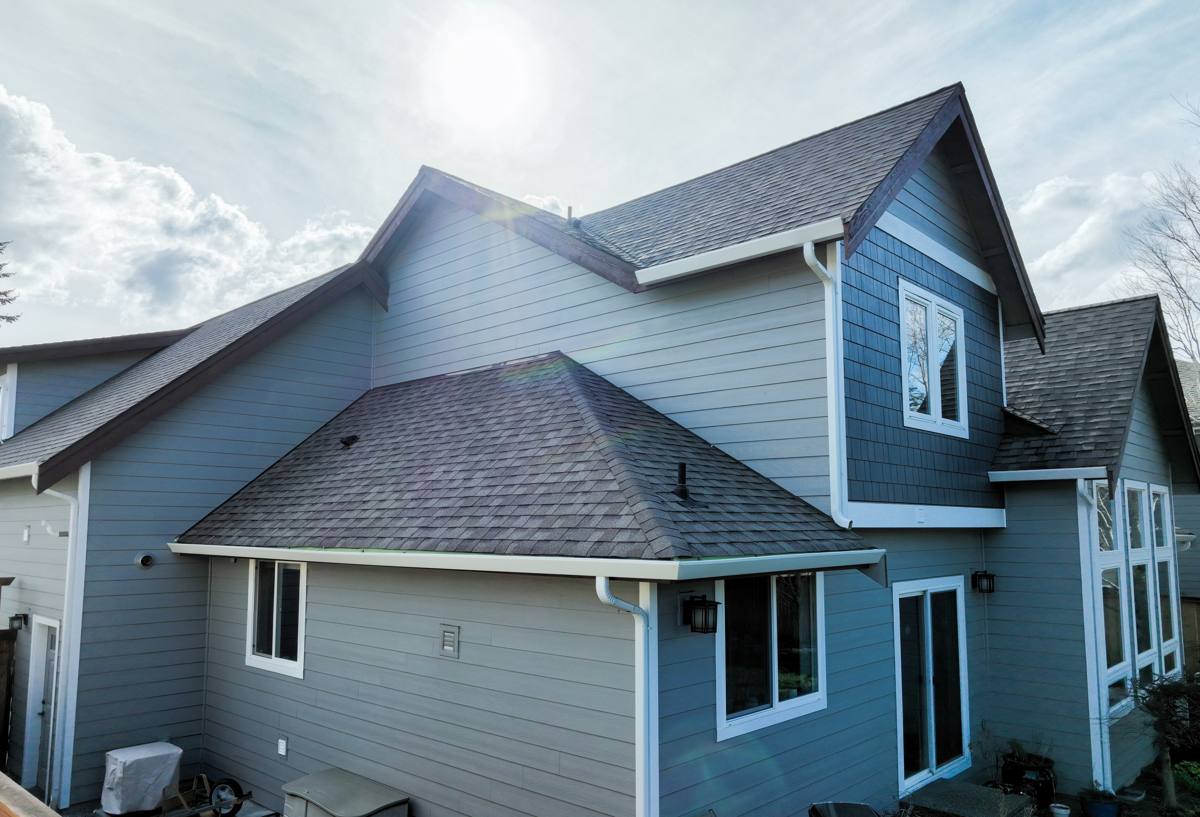
Signs Your Siding Needs a Repair Call
Most siding problems don't show up as an obvious hole or crack. They show up as small signals that are easy to write off as cosmetic — until they aren't. Here's what we tell Sudden Valley homeowners to watch for:
- Dark streaking or green-black growth on shaded walls, especially north- and east-facing sides near tree lines
- Soft or spongy spots when you press on the siding, particularly near the bottom courses or around window and door trim
- Visible gaps, cracks, or separation at seams, corners, and trim joints
- Paint that's peeling, bubbling, or failing in a localized area rather than evenly across the whole wall
- Staining or discoloration on interior walls near exterior corners — a sign water has already gotten past the siding
- Swelling, warping, or a visible change in the board's shape compared to the siding around it
- Persistent moss or algae growth that keeps coming back within a season of cleaning
Any one of these on its own might be minor. Several together, or any sign paired with visible moisture damage, usually means it's worth having someone look before the next wet season sets in.
What a Correct Siding Repair Actually Involves
Finding the Real Cause, Not Just the Symptom
The visible damage — a cracked board, a soft spot, a stained corner — is rarely the whole story. Most siding failures trace back to a water intrusion point somewhere nearby: failed caulking, a flashing detail that was never installed correctly, a gap where trim meets siding, or a spot where moss and debris have been holding moisture against the wall for months. Repairing the visible board without finding and fixing that source just buys you a repeat call in a year or two.
Matching Materials the Right Way
A patch that doesn't match the existing siding's profile, reveal, or finish stands out immediately and can also create a new water path if it doesn't integrate cleanly with the surrounding boards. Getting a repair to disappear into the wall takes matching the plank width, the butt joint pattern, and the finish — not just grabbing whatever's on the truck.
Water Management, Not Just Cosmetics
Any repair that touches siding also touches the water management behind it — house wrap, flashing, and the drainage plane that's supposed to move any water that gets past the surface back out and away from the wall assembly. A repair that skips this step and just re-covers the area is cosmetic, not structural, and it won't hold up through another wet Whatcom County winter.
Repair vs. Replacement: How We Make the Call
Homeowners often assume any siding damage means full replacement. That's usually not true — but it depends on how far the damage has spread and what's driving it. Here's the general framework we use:
| Factor | Points Toward Repair | Points Toward Replacement |
|---|---|---|
| Extent of damage | Isolated to one or two areas | Spread across multiple walls or elevations |
| Underlying structure | Sheathing and framing are sound | Rot has reached the wall structure itself |
| Age of existing siding | Mid-life, otherwise performing well | Near or past its expected service life |
| Water intrusion history | Single identifiable source, now correctable | Chronic, whole-house moisture problems |
| Material match | Existing product still available or close match exists | Discontinued profile or badly weathered mismatch |
We'll always tell you honestly which side of that table your home falls on. A targeted repair that solves the actual problem is a better outcome for you than an unnecessary full tear-off — but we'll also tell you plainly when patchwork repair is just delaying a bigger cost.
Why We Repair and Rebuild With James Hardie Fiber Cement
When a repair calls for replacing damaged sections, or when a home's existing siding has reached the point where repair no longer makes sense, we rebuild with James Hardie fiber cement — and only James Hardie. We don't install vinyl, LP SmartSide, cedar, or primed spruce, and in a climate like this one, the reasoning isn't complicated.
Fiber cement doesn't feed the moss and algae growth the way wood-based products can, it holds paint and factory finish far longer under constant damp-shade conditions, and it doesn't swell, rot, or delaminate the way engineered wood products can when water finds a way in. James Hardie's HZ5 product line is specifically engineered for the freeze-thaw and heavy-moisture conditions common to the Pacific Northwest, and the ColorPlus factory finish holds color and resists fading and moss staining better than field-applied paint. For a shaded, tree-lined lot like a typical Sudden Valley property, that durability difference shows up faster than it would on an open, sun-exposed site.
When we do a partial repair on Hardie siding, we can match the existing product's profile and finish precisely because it's the same manufacturer system, not a guess at a comparable look from a different product line.
Our Process for a Sudden Valley Repair
1. On-Site Inspection
We walk the exterior and look past the obvious damage — checking trim, flashing, caulk lines, and any areas where tree cover keeps the wall shaded and slow to dry. We'll point out what we find in plain terms.
2. A Written Scope, Not a Guess
You get a clear explanation of what's actually wrong, what it will take to fix it correctly, and an honest read on whether repair or partial replacement is the right call — before any work starts.
3. Fix the Water Path First
Before any new siding goes up, we correct the flashing, sealant, or drainage issue that caused the damage in the first place. Re-covering a problem without fixing its source isn't a repair.
4. Match and Install
New material is matched to the existing siding's profile and finish and installed to manufacturer spec — correct fastening, correct clearances, correct joint treatment — so the repaired section performs as well as the rest of the wall.
5. Clean Handoff
We clear debris, walk the finished area with you, and make sure you understand what was done and why, including any maintenance that will help the repair last.
Why Hiring a Crew That Already Knows Sudden Valley Matters
Sudden Valley's wooded, hilly lots aren't like a flat, open subdivision. Access can be tighter, driveways steeper, and tree cover changes how a crew has to stage material and work around a home safely. A crew that's already worked in the neighborhood knows what to expect before the truck even arrives — which saves time and avoids surprises that can turn into extra cost or delay.
Just as important is knowing the moisture pattern of this specific setting. A repair crew used to open, sun-exposed neighborhoods might not think twice about a shaded north wall with light moss growth. A crew that's worked Sudden Valley homes knows that spot is often where the real problem is hiding, and checks it accordingly.
After the Repair: Keeping It From Happening Again
A correct repair should hold up for years, but a little seasonal attention helps, especially on a shaded, wooded lot:
- Rinse off moss and algae buildup before it has a chance to establish, rather than after it's visibly spread
- Keep gutters clear so overflow isn't running down the wall face during heavy rain
- Trim back branches and brush that keep siding in constant shade and slow its drying time
- Walk the exterior once a year and check caulk lines at trim, corners, and penetrations for cracking or gaps
- Address small issues — a loose piece of trim, a hairline crack — while they're still small
Whatcom County's climate isn't going to get drier or sunnier, so the goal with any repair is to give your siding the best possible chance to shed water and dry out between storms rather than fighting a losing battle against constant moisture.
Get a Straight Answer on Your Repair
If you're seeing moss, soft spots, staining, or anything else on your Sudden Valley home's siding that doesn't look right, we're happy to take a look and give you an honest assessment — repair, partial replacement, or otherwise — with no pressure to do more than what's actually needed. Reach out using the form below for a free estimate.