 Bellingham Siding
 Siding Repair in Blaine: Small Damage Doesn't Stay Small Here
Blaine sits at the northern tip of Whatcom County, right on the water and right on the U.S.-Canada border, which puts local homes squarely in the path of salt-laden air, storms rolling in off the water, and a moss season that can run most of the year. Siding that would show only minor wear in a drier, more sheltered part of the county tends to break down faster here, and a small crack, gap, or soft spot rarely stays small for long once salt air and driving rain get behind it. We're based in Bellingham and work throughout Whatcom County, and Blaine is regular territory for our repair calls — often specifically because a home's exterior has been fighting this coastal exposure for years before anyone noticed a problem.
We install and repair James Hardie fiber cement siding exclusively, and that standard doesn't change when the job is a small patch instead of a full re-side. That's not a marketing position — it's a professional standard built from years of tear-offs and repair calls across the county, watching which products hold up to Blaine's conditions and which ones quietly give homeowners more maintenance than they signed up for.
What's Really Behind Most Siding Damage in Blaine
Salt Air and Fastener Corrosion
Blaine's closeness to the water means a steadier dose of salt in the air than towns set further inland. Salt accelerates corrosion on fasteners, flashing, and exposed metal trim, and it wears through lower-grade paint and caulking faster than a dry climate would. A lot of the repair calls we get start with a corroded fastener or a failed seal at a trim joint — small failures on their own, but the kind that let moisture in behind the siding if they sit unaddressed.
Wind-Driven Rain
Storms coming off the water don't fall straight down — wind pushes rain sideways into wall assemblies, trim joints, and anywhere flashing wasn't lapped correctly the first time. That sideways load finds gaps a calmer, drier climate would never expose, which is why siding that looks fine from the street can still have moisture working behind it at a seam or corner.
A Moss Season That Doesn't Quit
Mild temperatures and near-constant moisture give moss and mildew a long growing season on shaded and north-facing walls. Beyond the cosmetic issue, moss holds moisture against the siding surface longer than it would otherwise sit, and any material with even a little surface porosity becomes a place for it to take hold and keep the substrate underneath damp.
Repair or Replace? How We Make That Call
Not every damaged section of siding means a full re-side, and not every homeowner who calls about "a repair" actually has one. Part of our job on the first visit is telling the difference honestly, rather than defaulting to whichever answer is easier to sell.
A repair usually makes sense when damage is localized — a cracked panel from an impact, a section that's come loose, corroded fasteners in one area, or a trim detail that's failed at a single point. Replacement becomes the better answer when we find moisture has already tracked behind multiple sections, when the sheathing underneath is compromised, or when the existing siding is a product with a track record of widespread failure under Blaine's conditions rather than an isolated problem. We'll tell you plainly which situation you're in, including when a repair is the right, honest answer instead of a bigger sale.
We also pay attention to pattern, not just the spot in front of us. A home that's needed three or four "small" repairs in different areas over a few years is usually telling us something about the original installation or the product itself, and at that point we'll say so rather than quoting yet another isolated patch.
Why Repairs Get James Hardie Materials, Not a Mixed Patch
When we're patching into existing Hardie siding, or replacing a section as part of a repair, we use Hardie fiber cement rather than a compatible-looking substitute, for the same reasons we install it new. It's non-combustible, which matters for safety and insurance considerations even on a small patch. It's dimensionally stable, so a new section won't swell, cup, or telegraph a different profile than the surrounding siding after a wet Blaine winter. And it keeps the home under Hardie's warranty coverage rather than voiding part of it with an off-brand patch. Hardie's HZ5 formulation is built for regions with sustained moisture and freeze-thaw cycling, which is exactly the kind of coastal exposure a Blaine repair needs to hold up to.
What a Proper Siding Repair Actually Involves
Diagnosing Before Patching
Visible damage is often just the symptom. Before we patch anything, we check how far moisture has traveled — behind adjacent panels, into trim, down into the wall assembly — because patching over a problem that's still active just hides it for a season or two. That means pulling back more of the siding than the damaged section alone if the situation calls for it, not just covering the visible spot.
Matching Existing Hardie Siding
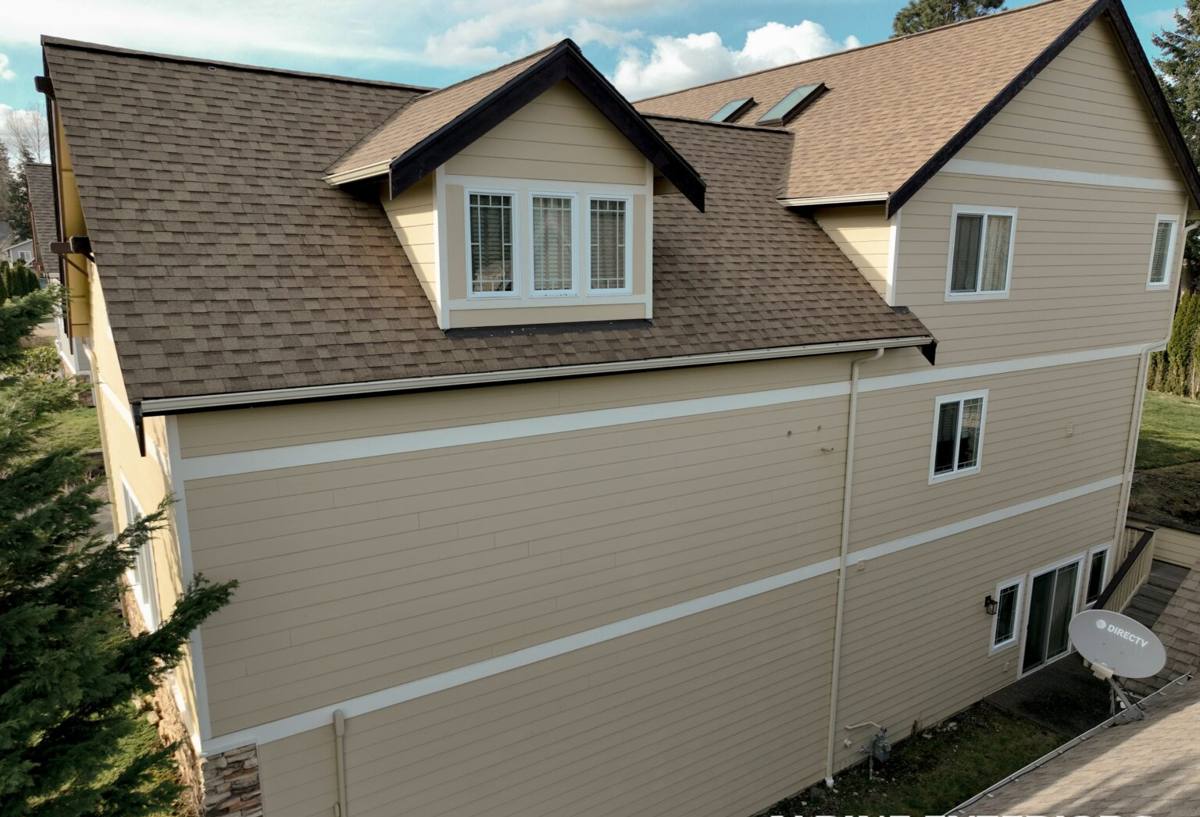
When the home already has James Hardie siding, a proper repair replaces the damaged panel or board with the same profile and, where possible, the same ColorPlus finish, so the repair blends in rather than standing out as an obvious patch. Hardie's factory-applied finish is more consistent over time than field-applied paint, which makes matching an existing installation more reliable than trying to match a hand-painted product years after the original job.
When the Damage Isn't in Hardie Siding
We get calls from Blaine homeowners with vinyl, LP SmartSide, cedar, or other products that were installed by someone else and are now failing. We'll still come look, and for a genuinely isolated repair we'll be straightforward about what we can and can't match. But if we're finding the same failure pattern in multiple spots — which is common with engineered wood and vinyl products in this climate — we'll tell you honestly that patching is a short-term fix, and that a full re-side in fiber cement is the more durable long-term answer. We won't talk you into replacing sound siding, and we won't pretend a spot repair will hold up on a product that's already failing broadly.
Our Siding Repair Process for Blaine Homes
- Inspection: We walk the exterior, check the damaged area and surrounding sections, and look for signs the problem has already spread.
- Diagnosis and honest recommendation: We explain what we found in plain terms, including whether a repair or a larger scope makes more sense.
- Written estimate: A clear scope and price before any work starts, with photos of what we found if it helps explain the recommendation.
- Repair work: Matching materials where possible, correct fastener spacing, properly lapped flashing, and sealed joints — the same installation standards we hold on a full siding job.
- Final check: We walk the completed repair with you before we consider the job done.
Cost Factors for Blaine Siding Repair
| Factor | Why It Matters |
|---|---|
| Extent of moisture intrusion | Repairs that require opening up wall sheathing cost more than a surface-level panel swap |
| Age and availability of matching siding | Matching an older Hardie color or profile is more straightforward than matching a discontinued product from another manufacturer |
| Number and location of damaged sections | Scattered damage across several walls takes more time than one contained area |
| Trim and flashing complexity | Corners, window trim, and roof-to-wall transitions take more careful work than a flat wall section |
| Access | Second-story or hard-to-reach sections add time regardless of the repair's size |
These are general factors, not a quote. We walk every property before pricing a repair, because the same visible crack can mean a twenty-minute fix on one house and a much larger scope on another once we see what's actually happening behind the siding.
Signs a Blaine Home Needs Siding Repair Now
- Cracked, warped, or visibly loose siding panels or boards
- Soft or spongy spots when you press on the siding, especially low on the wall
- Rust staining around fasteners or trim, more common this close to the water
- Gaps or separated joints at corners, trim, or panel seams
- Moss or dark staining that returns quickly after cleaning
- Peeling paint or discoloration concentrated on shaded, north-facing walls
- Interior signs like staining, soft drywall, or musty smells near an exterior wall
Any one of these on its own might be minor. Several together, or any sign paired with a musty smell or interior staining, is worth a look sooner rather than later — moisture behind siding rarely improves on its own.
Timing a Repair Around Blaine's Weather
Whatcom County's wettest stretch typically runs from late fall through winter, and Blaine's exposed, waterfront position makes that period harder on both the house and the repair itself — fiber cement, caulking, and sealants all perform better when they're installed and given time to cure under dry conditions. Spring and summer are generally the better window for a full repair scope. That said, active moisture intrusion doesn't wait for good weather, and a temporary, weather-tight fix followed by a proper repair once conditions allow is often the right call rather than leaving an active leak exposed through an entire wet season.
Why a Local Crew Matters for Repair Work in Blaine
Repair work rewards experience with a specific place more than almost any other part of this trade, because knowing which walls in Blaine take the worst of the wind-driven rain, which fastener types actually hold up to the salt air, and how quickly moss returns on a shaded north wall all come from working here repeatedly, not from a general contractor's checklist. A crew based in Bellingham that regularly works Blaine's coastal conditions brings that pattern recognition to a repair estimate — spotting the difference between a one-time impact crack and the early signs of a wider moisture problem before it turns into a much larger job, and being upfront with you either way.
Get a Free, No-Pressure Estimate
If you're seeing damage, staining, or soft spots on your Blaine home's siding, we're glad to take a look and give you an honest read on whether it's a straightforward repair or something bigger. Reach out using the form below to schedule a free estimate — no pressure, no upsell script.