 Bellingham Siding
 Blaine's Marine Climate Is Tougher on a Roof Than It Looks
Blaine sits right on the water, tucked against Drayton Harbor and Semiahmoo Bay near the Canadian border, and that location shapes everything about how a roof ages here. Salt-laden air off the water accelerates corrosion on exposed metal — fasteners, flashing, vent stacks — faster than it would a few miles inland. Add in driving, wind-blown rain that comes off the Strait at an angle instead of falling straight down, and you've got water finding its way into laps, valleys, and edges that would stay dry in a calmer climate.
Then there's moss. Whatcom County's long, wet stretch of fall through spring, combined with tree cover common on Blaine lots, keeps roof surfaces damp for extended periods. Moss doesn't just look bad — it holds moisture against the shingle surface, works its way under tabs, and speeds up granule loss. A roof that would coast for two more years in a drier climate can start showing real wear on a property like this.
None of this means asphalt shingle roofing is a poor fit for Blaine — it's still the most practical, cost-effective option for the vast majority of homes here. It means the installation details matter more than they would somewhere drier and calmer, and cutting corners shows up sooner.
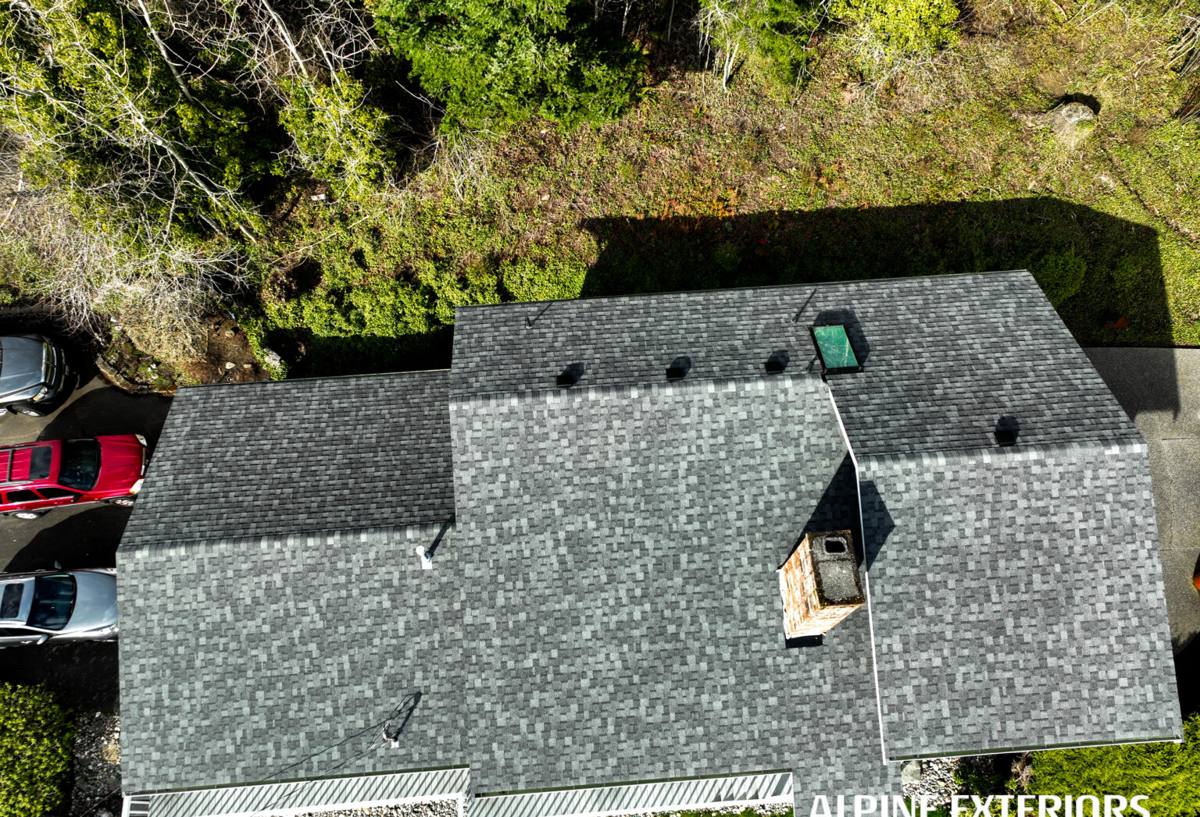
What a Correct Asphalt Shingle Installation Looks Like Here
A shingle roof is a system, not a single product. The shingles get the attention, but in a climate like Blaine's, the underlayment, flashing, and ventilation are what actually determine whether the roof holds up.
The Layers Underneath the Shingles
- A synthetic underlayment across the full deck, not just felt paper, for better resistance to the extended wet periods common here
- Self-adhered ice-and-water membrane at eaves, valleys, and any low-slope transitions, where wind-driven rain is most likely to work its way backward under the shingle courses
- A proper starter strip at eaves and rakes so the first course has full adhesive protection against wind uplift
- Correct nailing pattern and placement — high-nailing is one of the most common causes of early shingle failure, and it's invisible once the roof is finished
Flashing and Detail Work — Where Most Failures Actually Start
When a shingle roof leaks, the shingles themselves are rarely the cause. It's almost always a flashing detail: step flashing at a wall intersection, counter-flashing at a chimney, the boot around a plumbing vent, or a valley that wasn't given enough metal. In a salt-air environment, we pay close attention to the metal itself — corrosion-resistant flashing and fasteners hold up better here than standard-grade material would, since airborne salt shortens the life of anything that isn't rated for it.
Ventilation Matters as Much as the Shingle Choice
Balanced intake and exhaust ventilation keeps the attic from trapping the moisture that Blaine's climate throws at a roof all winter. Poor ventilation leads to condensation on the underside of the deck, which can rot sheathing from the inside — a problem no shingle, no matter how good, can fix from the outside.
Repair or Replace? Reading the Signs on a Blaine Roof
Coastal exposure and moss don't cause dramatic, sudden failures most of the time — they cause gradual wear that's easy to miss until it becomes a leak. Here's what we look for when we inspect a roof in this area:
- Granules collecting in gutters and at downspout outlets — a sign the shingle surface is breaking down
- Moss mats forming on north-facing slopes or under tree cover, especially where they've been left to grow rather than removed
- Shingles that are curling, cupping, or lifting at the edges, which lets wind-driven rain get underneath
- Soft or spongy spots on the deck when walked, suggesting moisture has already reached the sheathing
- Staining or active leaks around chimneys, skylights, or wall intersections — almost always a flashing issue rather than a shingle issue
- Age — asphalt shingle roofs are commonly rated for 20 to 30 years by manufacturers, but consistent salt exposure and moss growth can shorten that window if the roof wasn't detailed well to begin with
If a roof is showing one or two of these signs and the deck underneath is sound, a targeted repair is often the right call. Widespread granule loss, multiple leak points, or deck damage usually mean it's more cost-effective to replace than to keep patching.
Our Process for a Blaine Roofing Project
| Step | What We Do | Why It Matters in This Climate |
|---|---|---|
| Inspection | Walk the roof, check the attic, document flashing, ventilation, and deck condition | Most Blaine roof problems trace back to details, not the shingle itself — we look there first |
| Tear-off & deck check | Remove old roofing down to the deck and inspect sheathing for rot or soft spots | Moisture damage from years of moss and driving rain isn't always visible until the old roof is off |
| Underlayment & flashing | Install synthetic underlayment, ice-and-water membrane at vulnerable areas, and corrosion-resistant flashing | These layers do the real work of keeping wind-driven rain and salt air out |
| Shingle installation | Install shingles to manufacturer nailing specs with proper starter and ridge details | Correct installation protects the manufacturer warranty and resists wind uplift off the Strait |
| Ventilation check | Confirm intake and exhaust are balanced before closing out the job | Prevents attic condensation that can rot a deck from underneath, regardless of shingle quality |
| Walk-through & cleanup | Full site cleanup, magnetic sweep for nails, and a walk-through explaining the work done | You should understand exactly what's on your roof and why |
Choosing a Shingle for Salt Air and Moss Exposure
All the major manufacturers make asphalt shingles suitable for the Pacific Northwest, and we don't push one brand over another — the right choice depends on the home, the budget, and how much shade and moss pressure the roof actually deals with. What we do recommend as a professional standard for Blaine is choosing a tier and feature set that matches the climate rather than defaulting to the cheapest option.
| Shingle Type | Typical Fit | Consideration for This Climate |
|---|---|---|
| Standard 3-tab | Budget-conscious projects, simple roof lines | Lower wind rating and shorter lifespan; moss and granule loss show up sooner without algae-resistant granules |
| Architectural / laminate | Most homes — our most common recommendation | Heavier, better wind resistance, and typically available with algae-resistant (AR) granule options |
| Impact-resistant / premium laminate | Homes wanting maximum durability and warranty coverage | Highest upfront cost, but the added mat weight and granule quality hold up longest against sustained moisture exposure |
Algae-Resistant Granules
Many manufacturers offer shingles with copper- or zinc-infused granules specifically to slow algae and moss growth. Given how much shade and moisture Blaine roofs deal with for much of the year, we consider this a worthwhile upgrade on most jobs rather than a nice-to-have — it's a maintenance and longevity decision, not a cosmetic one.
Maintenance Checklist for Blaine Homeowners
A well-installed roof still needs basic upkeep in this climate. Simple, regular maintenance is the difference between a shingle roof reaching its full rated lifespan and one that needs early attention.
- Clear moss and debris off the roof surface and out of valleys once or twice a year, especially after fall leaf drop
- Keep gutters and downspouts clear so water isn't backing up under the eaves
- Trim back overhanging branches to reduce shade and let the roof dry out between rain events
- Never pressure wash a shingle roof — it strips granules and shortens shingle life; treat moss with proper roof-safe methods instead
- Have flashing around chimneys, skylights, and plumbing vents checked annually, since these are the most common leak points
- Confirm attic vents aren't blocked by insulation, nesting material, or debris
What Drives the Cost of a Blaine Roofing Project
| Factor | Why It Affects Cost |
|---|---|
| Roof pitch and access | Steeper roofs and difficult access take longer and require more safety setup |
| Number of existing layers | A full tear-off of multiple old layers takes more labor than a single-layer job |
| Deck condition | Rotted or soft sheathing found during tear-off needs to be replaced before new roofing goes on |
| Flashing complexity | Roofs with multiple valleys, wall intersections, chimneys, or skylights need more detail work |
| Ventilation upgrades | Adding or correcting intake/exhaust venting adds labor but prevents future moisture problems |
| Shingle tier | Standard, architectural, and premium/impact-resistant shingles carry different material costs |
Every roof is different, and the only way to give an honest number is to actually look at yours — roof size, pitch, current condition, and the scope of flashing and ventilation work all factor in.
Why a Crew That Already Works Blaine Matters
Roofing crews that mainly work inland or in drier parts of the state don't always default to the flashing metal, underlayment coverage, or ventilation details that a coastal, moss-heavy climate calls for. A crew that regularly works Blaine and the surrounding Bellingham and Whatcom County area already knows which details fail first out here, how the wind off the water behaves, and what a roof needs to hold up through a full wet season rather than just look good on installation day. That local familiarity shows up in the small decisions — where extra ice-and-water membrane goes, what grade of fastener gets used, how ventilation gets balanced — long before it ever shows up as a problem.
If you're weighing a repair, a full replacement, or just want a straight answer on the condition of your current roof, we're happy to take a look. The estimate is free, there's no pressure, and you'll get a clear explanation of what we find and what it would take to fix it — just fill out the form below.