 Bellingham Siding
 Building New in Columbia? The Windows Are Where Most Callbacks Start
If you're framing a new home or a major addition in the Columbia neighborhood, the windows are one of the few components that have to get everything right the first time. Once siding, trim, and interior finishes go on, a poorly flashed window opening becomes a hidden problem — one that usually doesn't show up until a wall cavity has already been wet for a year or two. In Bellingham, with the salt air coming off the bay, driving rain off the Sound, and a moss season that can stretch from October well into spring, new-construction window openings need to be built for water management from day one, not patched for it later.
New-construction windows are a different job from a retrofit or replacement. There's no old frame to work around and no existing siding to protect — which is actually an advantage, because it means the opening can be built correctly from the sheathing out. That only pays off if the crew doing the work treats flashing sequence, nailing fin integration, and sill pan detailing as the actual scope of the job, not an afterthought to "setting the window."
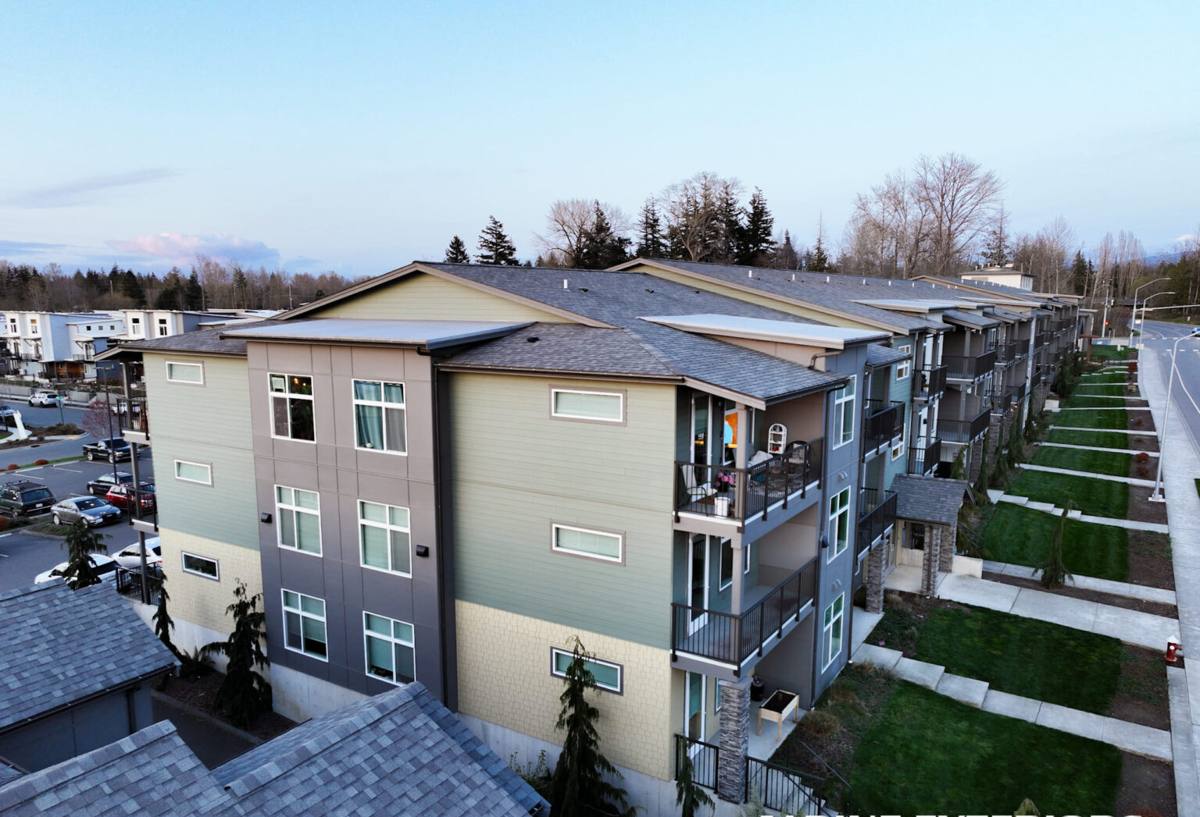
What Columbia's Climate Actually Does to a Window Opening
Columbia sits close enough to the water that salt-laden air is a constant, low-grade factor on anything metal or exposed. Combine that with Bellingham's wind-driven rain — which hits windows at an angle, not just straight down — and you get conditions that will find any gap in flashing or sealant within a few wet seasons. Add Whatcom County's long moss and algae season, where damp, shaded wall sections stay wet far longer than they would in a drier climate, and you have three separate pressures working on the same opening:
- Wind-driven rain pushes water sideways and upward under trim and siding laps, not just down the face of the wall.
- Salt air accelerates corrosion on exposed fasteners, unprotected metal flashing, and lower-grade hardware.
- Persistent moisture and moss keep wall assemblies damp longer, which matters most where water has any path into the sheathing or framing.
None of this is unique to Columbia specifically — it's the reality across most of Bellingham and Whatcom County. But it's exactly why a new-construction window install here has less margin for shortcuts than the same job would in a drier inland climate.
Why This Matters More During Framing Than Later
Once the window is set and the wall is closed up, the flashing details are buried. If they were done wrong, you don't find out until there's a stain on the drywall, a soft spot in the sill, or mold showing up around a lower corner — and by then the fix means opening the wall back up. Getting the sequence right during the build is dramatically cheaper than correcting it after occupancy.
What a Correct New-Construction Window Install Involves
A properly installed new-construction window isn't just "level, plumb, and nailed." The parts that actually keep water out are largely invisible once the job is done:
- Sill pan flashing — a sloped, sealed pan under the window that directs any water that gets past the window itself back outside the wall assembly, rather than letting it sit on the rough sill.
- Correct flashing sequence — sill flashing first, then the window, then jamb flashing, then head flashing, each one lapping over the layer below it (shingle-style) so water is always directed outward and down, never trapped behind a layer.
- Weather-resistive barrier integration — the housewrap or building paper has to be cut, lapped, and taped into the flashing system correctly, not just stapled around the opening.
- Nailing fin and fastener attention — fins fully engaged and fastened per the manufacturer's schedule, with corrosion-resistant fasteners given the salt-air exposure.
- Sealant placement — sealant goes where it's supposed to manage water, and stays out of the weep paths and drainage gaps that let incidental moisture escape. Sealing every gap solid can trap water rather than shed it.
- Insulation and air-sealing at the rough opening — gaps between the frame and rough opening filled with a compatible, low-expansion product so the window isn't bowed and the thermal envelope stays intact.
Skip or rush any one of these steps and the window can look perfect for years while still leaking. That's the frustrating part of window failures — they're rarely visible until the damage is already established.
New-Construction Windows vs. Replacement Windows
These two jobs get lumped together in casual conversation, but they're built differently, priced differently, and solve different problems. If you're working with a general contractor on a Columbia build, it helps to know which one you're actually doing:
| Factor | New-Construction Window | Replacement Window |
|---|---|---|
| Installation method | Nailing fin fastens to sheathing before siding goes on | Fits into the existing frame/opening, siding stays in place |
| Flashing access | Full access to sheathing, WRB, and rough opening | Limited to what's exposed once the old sash is removed |
| Best suited for | New builds, additions, full wall reframes | Existing homes with sound framing and intact siding |
| Typical failure point if done poorly | Flashing sequence or WRB integration | Gap sealing and old-frame condition |
| Long-term water management | Best possible, if detailed correctly | Good, but constrained by existing conditions |
For a Columbia new build, this is the version of the job that gives you the best shot at a wall assembly that stays dry for decades — but only if the flashing work matches the opportunity.
Frame Material: What Holds Up Near the Water
Material choice matters more here than in a drier, inland part of the state, mostly because of the combination of salt air and sustained moisture. A few honest trade-offs:
- Vinyl — resists corrosion entirely since there's no metal to salt-attack, low maintenance, and cost-effective. The trade-off is less rigidity on very large openings and some limits on dark exterior colors in direct southern exposure.
- Fiberglass — dimensionally stable, handles temperature swings well, and holds up to coastal exposure with minimal upkeep. It costs more than vinyl, which matters when you're specifying windows across an entire new build.
- Wood-clad — attractive interior wood look with an exterior-facing clad layer for weather protection. The trade-off is that the cladding and its seams need to be detailed carefully, since any breach exposes wood to exactly the sustained moisture this climate produces. We'll install these when specified, but we're upfront that they demand more precise flashing and more owner-side maintenance vigilance over time than vinyl or fiberglass.
None of these is objectively "the" answer — it depends on budget, the home's design, and how much long-term maintenance the owner wants to take on. We'll walk through the trade-offs for your specific plans rather than push one product line by default.
Our Process for New-Construction Window Work
On a Columbia build, our sequence looks like this:
- Plan review — we check window schedules, rough opening sizes, and elevation details against the actual framing before install day, catching sizing conflicts early.
- Sill pan and flashing installation — built and tested before the window ever goes in, using a shingle-lap sequence suited to Bellingham's wind-driven rain.
- Window set and fastening — leveled, plumbed, and fastened per manufacturer spec, with corrosion-resistant hardware given the salt-air exposure this close to the water.
- WRB integration — housewrap tied into the flashing system so the whole wall assembly drains as one unit, not a patchwork of separate layers.
- Documentation — photos of the flashing and pan work before it's covered by siding, so there's a record of what's behind the wall if it's ever needed.
- Final walk-through — operation, seals, and trim checked with the builder or homeowner before we move off the job.
Why Hire a Crew That Already Works Columbia
A window crew that's never worked this specific stretch of Whatcom County can still install a window correctly on paper — but they're guessing at how much margin to build in for salt exposure, how aggressive the rain angle gets in a given exposure, and how long a shaded wall section stays damp through moss season. A crew that already works Columbia and the surrounding Bellingham area has seen what actually fails here versus what holds up, and builds accordingly instead of relying on generic specs. That local pattern-recognition is the difference between a window that's technically installed and one that's installed for this climate specifically.
Cost Factors on a New-Construction Window Job
| Factor | How It Affects Cost |
|---|---|
| Window count and size | More openings and larger units mean more flashing work and material, not just more units |
| Frame material | Vinyl is typically most economical; fiberglass and wood-clad cost more upfront |
| Wall height and access | Second-story and hard-to-access openings take longer to flash and set safely |
| Coordination with framing/siding trades | Tight scheduling with other trades keeps the opening protected and the job efficient |
| Custom or specialty shapes | Bay windows, arched units, and oversized openings require more detailed flashing plans |
We give straightforward, written estimates broken out by these factors rather than a single lump number, so you can see where the cost is actually going.
A Quick Checklist Before Your Windows Go In
Whether you're the builder, the homeowner, or coordinating both, these are worth confirming before install day:
- Rough openings match the window schedule dimensions, with proper tolerance for shimming
- Sill pan flashing is planned and material is on-site before the window arrives
- WRB (housewrap) sequencing is coordinated so it can lap correctly into the flashing
- Fastener and flashing materials are corrosion-resistant, given the salt-air exposure
- Someone is documenting flashing details with photos before siding covers them
- A weather window is planned so openings aren't left exposed during a stretch of driving rain
Let's Talk About Your Columbia Build
If you're framing or planning a new build or addition in Columbia and want windows installed with this climate actually in mind, we're glad to walk through your plans, your window schedule, and your budget. Reach out through the form below for a free, no-pressure estimate — no obligation, just a straight look at what the job actually involves.