 Bellingham Siding
 Why Birch Bay Siding Has to Work Harder
Birch Bay sits right on the water, and that waterfront position is exactly what makes siding decisions here different from a job a few miles inland in Bellingham. Homes along this stretch of Whatcom County take on salt-laden air coming off the Strait of Georgia, wind-driven rain that hits siding sideways instead of straight down, and a long, wet moss season that gives algae and mildew months to establish themselves on anything that holds moisture. None of that is exotic weather — it's just the normal cost of living on the water in the Pacific Northwest. But it means the siding on a Birch Bay home is doing more work, more often, than siding on a home in a drier, more sheltered spot.
Salt air is corrosive to exposed metal fasteners and trim, and it accelerates the breakdown of finishes that aren't formulated to handle it. Driving rain finds every gap in flashing, caulking, and butt joints that a calmer climate would never expose. And moss doesn't just grow on roofs — it takes hold in siding seams, behind trim boards, and anywhere water sits instead of draining. Over years, that combination punishes materials that can't shed water fast or that swell, rot, or delaminate when they stay damp.
Why We Standardized on James Hardie for Homes Like This
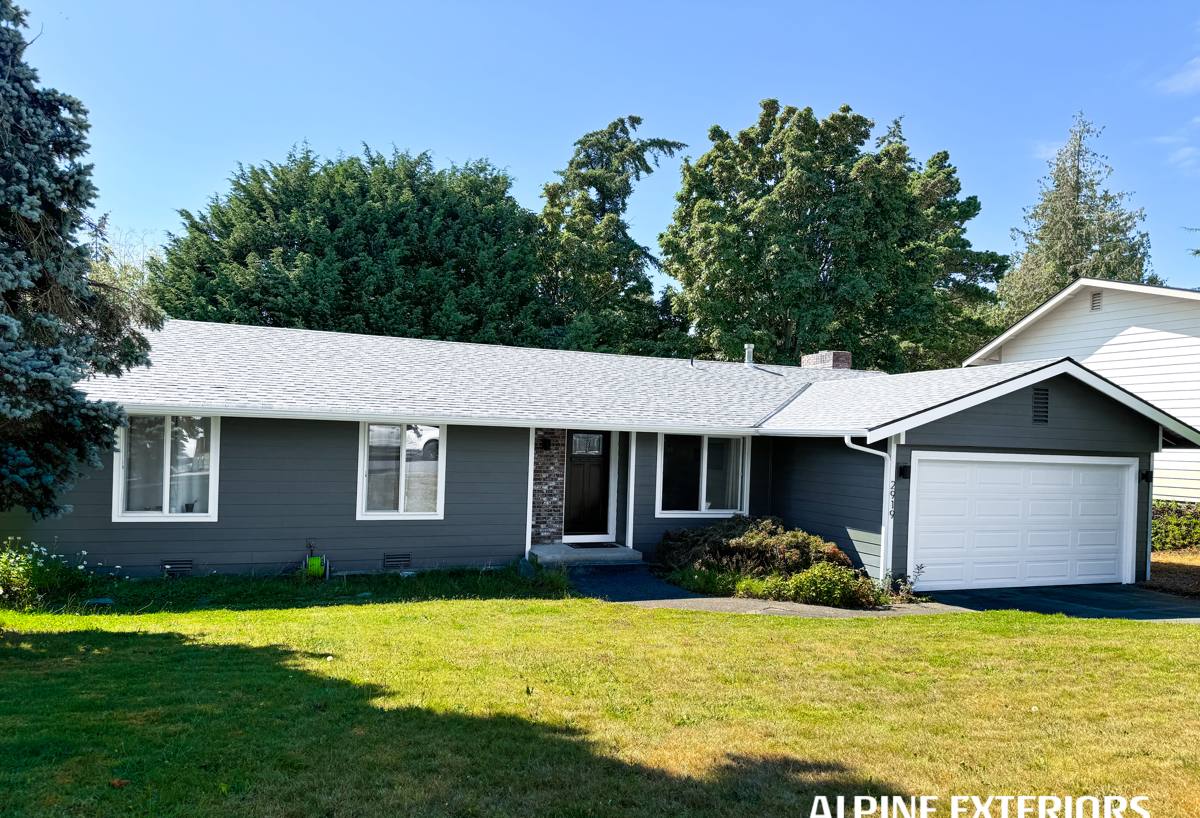
We install James Hardie fiber cement siding exclusively — we don't offer vinyl, LP SmartSide, Cemplank, Allura, primed spruce, or cedar. That's not a marketing position, it's a decision based on what actually holds up in coastal Whatcom County conditions over the long haul. Hardie's fiber cement is engineered from cement, sand, and cellulose fiber, which means it doesn't absorb and swell with moisture the way wood-based or engineered-wood products can, and it doesn't degrade under UV and salt exposure the way some vinyl formulations do over a couple of decades on an exposed site.
Hardie also builds region-specific product lines, and for a place like Birch Bay that matters. Their HZ5 formulation is engineered for climates with more moisture cycling, and the ColorPlus factory-applied finish is baked on and warranted separately from the substrate — so you're not relying on a field-applied coat of paint to be the only thing standing between the siding and years of salt spray and rain. It's also non-combustible, which is a real advantage during dry-season wildfire smoke and ember exposure that reaches even wet coastal counties in bad fire years.
What Homeowners Give Up With Other Products
Vinyl siding is affordable and low-maintenance in mild conditions, but it can become brittle and fade faster under sustained UV and salt exposure, and it has almost no structural rigidity of its own — it flexes with wind, which matters on an exposed waterfront lot. LP SmartSide and similar engineered-wood products perform well when installation and caulking are perfect and stay perfect, but they're wood-based, so any breach in the factory coating or field-applied finish gives moisture a path into the substrate, and repairs are time-sensitive once that happens. Cedar is a beautiful traditional choice, but it requires an ongoing maintenance commitment — refinishing, staining, and moisture monitoring — that most homeowners underestimate until they're a few years in. We'd rather put a product on your home that tolerates a missed maintenance year without a serious consequence.
Siding Materials Compared for a Birch Bay Waterfront Lot
| Material | Salt Air / Moisture Behavior | Maintenance Burden | Typical Field Lifespan |
|---|---|---|---|
| James Hardie Fiber Cement | Doesn't absorb moisture into the substrate; factory finish resists salt and UV fading | Low — occasional rinse and caulk check | Multiple decades with correct install |
| Vinyl | Can become brittle and fade under sustained UV/salt exposure | Low, but limited repair options if damaged | Shorter in harsh coastal exposure |
| Engineered Wood (LP-type) | Vulnerable once coating is breached; moisture intrusion can spread | Moderate — coating and caulk need monitoring | Depends heavily on maintenance discipline |
| Cedar | Absorbs moisture, prone to moss/mildew in shaded, damp spots | High — refinishing and moisture checks needed | Shorter without diligent upkeep |
What a Correct James Hardie Install Actually Involves
Fiber cement siding is only as good as the installation behind it, and a coastal job has a few details that matter more than they would inland.
Water Management First
Before a single board goes up, the water-resistive barrier and flashing details need to be right — proper overlaps at windows, doors, and penetrations, a drainage plane that lets any incidental moisture escape rather than pool, and correctly installed weep screeds and flashing at the base of the wall. On a site exposed to driving rain off the water, these details are what actually keep water out; the siding itself is the second line of defense, not the first.
Fastening and Gapping to Spec
Hardie publishes specific fastening patterns, gapping requirements at butt joints and trim, and clearance requirements above grade, decks, and roof lines. Skipping these — nailing too tight, closing up expansion gaps, or setting siding too close to grade where splash-back and moss thrive — is how you end up with premature caulk failure or moisture trapped behind the board, even with a top-tier product.
Finish and Touch-Up Done Right
ColorPlus finished boards come with factory-matched touch-up products, and cut edges need to be sealed with that matched product, not generic paint, to preserve both the look and the warranty. It's a small step that gets skipped by crews that aren't Hardie-focused every day.
How Our Process Runs on a Birch Bay Job
- Site walk and exposure assessment — we look at which sides of the home take the worst of the wind-driven rain and salt spray, where moss has already gained a foothold, and where prior moisture damage shows up around trim, corners, and low-clearance areas.
- Tear-off and substrate check — removing existing siding lets us inspect sheathing and framing for rot or moisture damage that needs to be addressed before new siding goes on; covering up a hidden problem never ends well on a wet site.
- Water barrier and flashing installation — done to manufacturer spec, not shortcuts, since this is the layer that actually keeps a coastal home dry.
- Hardie board installation — correct fastening, gapping, and clearances, matched to the HZ5 product line and the specific exposure of each elevation.
- Finish and detail work — trim, caulking with appropriate sealants for a marine-influenced climate, and factory-matched touch-up on any cut edges.
- Final walkthrough — checking clearances, seams, and flashing details before we call the job done.
Living With Salt Air and Moss Season: A Maintenance Checklist
Correctly installed James Hardie siding is low-maintenance, not no-maintenance. In a Birch Bay exposure, a little seasonal attention goes a long way:
- Rinse salt residue off exterior walls a couple of times a year, especially on sides facing the water
- Walk the exterior each fall and spring to check caulking at trim, windows, and butt joints for cracking or gaps
- Keep gutters and downspouts clear so water isn't overflowing onto siding below
- Trim back vegetation and clear debris that traps moisture against the wall or shades a section long enough for moss to establish
- Check clearance at grade, decks, and patios periodically — landscaping and mulch can build up over the years and reduce the clearance your siding needs
- Address any soft spots, staining, or bubbling in caulk lines promptly rather than waiting for the next off-season
Why Local Experience in Birch Bay Matters
A crew that only occasionally works this close to the water will treat a Birch Bay home like any other siding job. A crew that works Whatcom County's coastal exposures regularly knows which elevations typically take the worst weather, how much clearance and drainage detail a waterfront lot actually needs versus the code minimum, and what early moss or moisture patterns look like before they become a bigger repair. That familiarity shows up in fewer callbacks and a job that's built for the specific way this stretch of coastline behaves, not a generic install plan borrowed from a drier part of the state.
What Affects the Cost of a Birch Bay Siding Project
| Factor | Why It Matters |
|---|---|
| Home size and wall complexity | More corners, gables, and trim detail mean more labor and material |
| Condition of existing siding and sheathing | Hidden moisture or rot found during tear-off adds repair scope |
| Hardie product line and profile chosen | Lap, panel, and shingle profiles carry different material and labor costs |
| Site access and exposure | Waterfront lots can involve more careful staging and weather-dependent scheduling |
| Trim, color, and detail work | Custom trim and color choices affect both material cost and install time |
We give straightforward, honest estimates based on what we actually find at your home — no inflated numbers, no pressure to upgrade beyond what makes sense for your situation.
Ready to See What This Looks Like on Your Home?
If your Birch Bay home's siding is showing its age, or you're planning ahead before the next wet season sets in, we're happy to take a look and give you a straight answer about what it needs. Reach out for a free, no-pressure estimate — we'll walk the exterior with you, point out anything we see, and explain exactly what a correct James Hardie installation would involve for your specific home.