 Bellingham Siding
 Why Roofs in Lynden Wear Differently
Lynden sits inland from Bellingham Bay, but the marine air that moves through Whatcom County doesn't stop at the water's edge. It rides the wind up the Nooksack Valley and settles over the farmland and tree-lined lots around town, keeping roof surfaces damp far longer than homeowners in drier parts of the state ever have to deal with. Add in driving rain events off the Strait of Georgia and a moss season that can run nearly nine months out of the year, and you have a climate that's genuinely tougher on a roof than the shingle warranty label admits.
None of this means a roof in Lynden needs exotic materials or a radically different design. It means the ordinary things — tear-off quality, flashing detail, ventilation balance, and material selection — have to be done right the first time, because this climate finds every shortcut. A roof that's merely "installed" instead of installed correctly will show it here in half the time it would take somewhere drier.
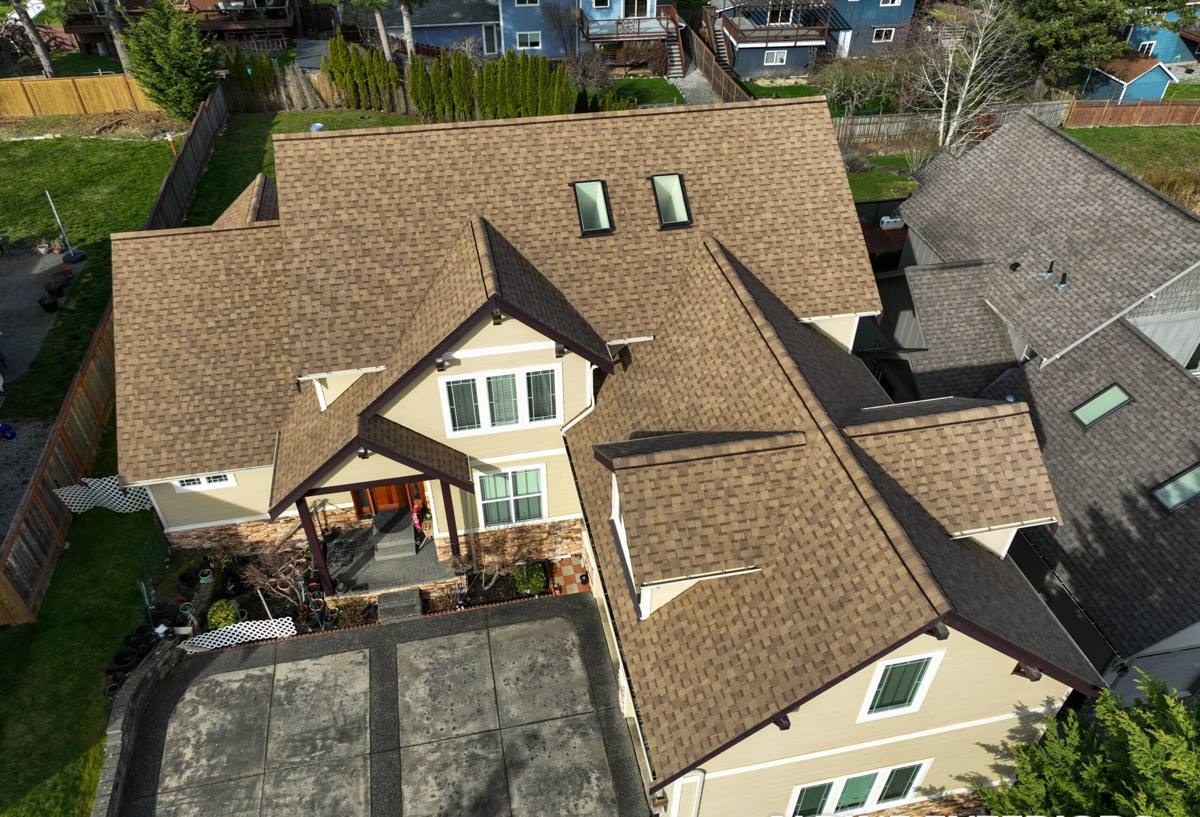
Signs a Roof Needs Replacement, Not Another Repair
We get called out to a lot of roofs that have had two or three patch jobs already. Sometimes another repair is the honest answer. Other times, patching is just delaying a replacement and spending money that won't show up in the roof's remaining life. A few signs tend to separate the two:
- Granules collecting in gutters and downspouts, or bald patches showing on south- and west-facing slopes
- Shingles that are cupping, curling at the edges, or cracking when lightly flexed
- Soft or spongy spots underfoot on the roof deck, especially near valleys and chimneys
- Daylight visible through the roof deck from inside the attic
- Moss established under the shingle tabs rather than just on the surface
- Recurring leaks in the same general area despite prior repairs
- A roof original to a home built more than 20-25 years ago in this climate, regardless of the material's rated lifespan
Asphalt shingles rated for 25 or 30 years by the manufacturer often don't reach that number here, simply because they rarely get a chance to fully dry out between rain events. That's not a defect in the shingle — it's the reality of installing a product built to a national average in a climate that's wetter than average.
What a Correct Roof Replacement Actually Involves
A roof replacement is more than swapping old shingles for new ones. The parts of the job that don't show from the ground are usually the parts that determine whether the new roof lasts.
Ventilation and Moisture Control
Attic ventilation is where a lot of otherwise good roofs fail early in this region. Warm, moist air from the living space rises into the attic and needs a clear path out through the ridge, balanced by cool air pulled in at the soffits. When that balance is off — blocked soffit vents, insufficient ridge exhaust, or insulation stuffed against the roof deck — moisture gets trapped against the underside of the sheathing. Over a few wet Whatcom County winters, that trapped moisture leads to soft decking, premature shingle failure from below, and conditions that help moss and algae take hold faster on the surface above.
Flashing, Valleys, and Penetrations
Chimneys, skylights, dormers, and roof-to-wall transitions are where the vast majority of leaks start, not in the open field of shingles. A correct replacement includes new step flashing and counter flashing at these points, not a bead of caulk over what's already there. Valleys need underlayment and flashing sized for real volume, since a steady Pacific storm can move a lot of water through a narrow channel in a short time.
Underlayment and Ice-and-Water Protection
A synthetic underlayment across the full deck, with self-adhering ice-and-water membrane at eaves, valleys, and penetrations, gives the roof a real second line of defense. In a climate with frequent wind-driven rain, that membrane is often what keeps a hard storm from becoming an interior leak while the shingles above are doing their job.
Choosing a Roofing Material for This Climate
There's no single "best" roofing material for every home — pitch, budget, and the look of the house all factor in. But some materials handle sustained moisture and moss pressure better than others, and that's worth weighing seriously here.
| Material | Typical Local Lifespan | Moss/Algae Resistance | Relative Cost | Notes |
|---|---|---|---|---|
| Architectural asphalt shingle | 20-25 years | Good, especially with algae-resistant granules | Moderate | Our most common recommendation — good balance of durability and cost |
| Standing seam metal | 40-50+ years | Excellent — sheds moss and debris naturally | Higher | Strong choice for steep, shaded, or moss-prone roofs |
| Synthetic/composite shake | 30-40 years | Good | Higher | Wood shake look without the moisture maintenance |
| Basic 3-tab asphalt | 12-18 years locally | Fair | Lower | We generally steer clients away from this for full sun/moss exposure — thinner mat and lower wind rating shorten its service life here |
We're upfront when a material isn't a good fit for a particular roof. That's not a knock on the product itself — a 3-tab shingle performs fine on plenty of homes in drier climates. It's a judgment call based on how that product behaves under sustained Whatcom County moisture, and we'd rather say so before the contract is signed than after the moss shows up in year six.
Our Roof Replacement Process
- Inspection and estimate. We walk the roof, check the attic for ventilation and moisture signs, and give you a written scope — not a vague number.
- Material walkthrough. We go over the options that make sense for your roof's pitch, exposure, and budget, including the trade-offs of each.
- Property protection. Landscaping, siding, and gutters get covered or protected before tear-off starts.
- Full tear-off and deck inspection. Old roofing comes off completely so we can see the actual condition of the decking underneath. Any rotted or delaminated sheathing is replaced, not covered over.
- Underlayment and flashing installation. New ice-and-water membrane, synthetic underlayment, and flashing go in at every valley, penetration, and transition.
- Roofing material installation. Installed to manufacturer specification, including nailing pattern and exposure, so the material's wind and warranty rating actually applies.
- Ventilation check. Intake and exhaust are confirmed to be balanced before we call the job done.
- Cleanup and magnetic nail sweep. The site is cleared of debris and swept for stray fasteners.
- Final walkthrough. We go over the finished roof with you and provide documentation for your records and warranty.
Moss, Algae, and the Long Season Here
Moss doesn't just sit on top of a roof — it holds moisture directly against the shingle mat and works its way under tabs and edges, prying them up slightly over time. That lifted edge is exactly what wind-driven rain needs to get underneath the shingle instead of running off it. In a climate where moss can actively grow for most of the year, that slow prying action adds up faster than most homeowners expect.
A few things make a real difference in how much moss pressure a new roof deals with over its life:
- Algae-resistant shingles, which use copper- or zinc-infused granules to slow regrowth
- Keeping gutters and valleys clear so water isn't sitting against the roof edge
- Trimming back overhanging branches to reduce shade and let the roof surface dry between storms
- Gentle, low-pressure moss removal rather than pressure washing, which can strip granules and shorten shingle life faster than the moss itself would
None of this eliminates moss entirely — that's not realistic in this part of Whatcom County. But the right material and a little regular upkeep keep it from becoming the reason a roof fails early.
What Affects the Cost of a Roof Replacement
Every roof is priced on its own scope, and we don't think broad averages are much use to a homeowner trying to plan. What actually moves the number on a specific home is fairly consistent, though:
- Total roof area and how many layers of existing roofing need to come off
- Roof pitch and complexity — a simple gable roof costs less to work on than one with multiple valleys, dormers, and penetrations
- Condition of the decking once it's exposed, and how much rotted sheathing needs replacing
- Material selected, from standard architectural asphalt up to metal or composite options
- Access — driveway slope, tree cover, and how close a dump trailer or lift can get to the house
We give a written estimate that breaks these factors out by line item, so you can see exactly what you're paying for rather than a single lump figure.
Why It Matters to Hire a Crew That Already Works in Lynden
A roof replacement isn't a one-size-fits-all job, and a crew that regularly works Whatcom County homes brings a few advantages that don't show up on paper. We know how exposed the more open, farmland-adjacent lots around Lynden get in a winter windstorm, and we account for that in nailing pattern and material choice. We know which shaded, tree-heavy properties are going to fight moss no matter what, and we set expectations accordingly instead of overpromising. We're familiar with local permitting requirements, and we're close enough that if a warranty question or storm-related concern comes up after the job, we're not driving in from three counties away to deal with it.
Local experience also means fewer surprises mid-project. A crew that's replaced roofs across this specific stretch of coastal Washington climate has already seen the version of your roof's problems before, which shortens the learning curve on your job.
Roof Replacement Checklist for Lynden Homeowners
Before signing a contract with any roofing company, it's worth confirming the scope actually covers what a durable roof needs in this climate:
- Full tear-off to the deck, not a layover on top of existing shingles
- Written inspection and replacement of any rotted or damaged decking
- Ice-and-water shield at eaves, valleys, and penetrations, not just standard felt
- New flashing at chimneys, skylights, and roof-to-wall transitions
- Balanced intake and exhaust ventilation, checked after installation
- Installation to manufacturer specification so material warranties are valid
- A contractor who is licensed, bonded, and insured, with local references you can call
- A detailed written estimate, not a verbal quote
If a bid skips most of these details, it's worth asking why before you compare it on price alone.
If your roof is showing its age or you just want an honest opinion on what shape it's really in, we're happy to take a look. Fill out the form below for a free, no-pressure estimate on your Lynden home.