 Bellingham Siding
 Fairhaven's Climate Asks More of Your Siding Than Most Neighborhoods
Fairhaven sits close enough to Bellingham Bay that salt-laden air is a daily fact of life for anything mounted on the outside of a house. Add Whatcom County's long wet season, wind-driven rain off the water, and heavy tree cover that keeps north- and west-facing walls shaded for months at a time, and you get a set of conditions that punishes siding materials and installation shortcuts faster than almost anywhere else in the region. A siding job that would hold up fine in a drier inland town can start showing problems within a few years here if it wasn't built for this specific environment.
That's the starting point for every siding installation we do in Fairhaven: this isn't a generic re-side. It's an install planned around salt exposure, sustained moisture, and moss growth from day one.
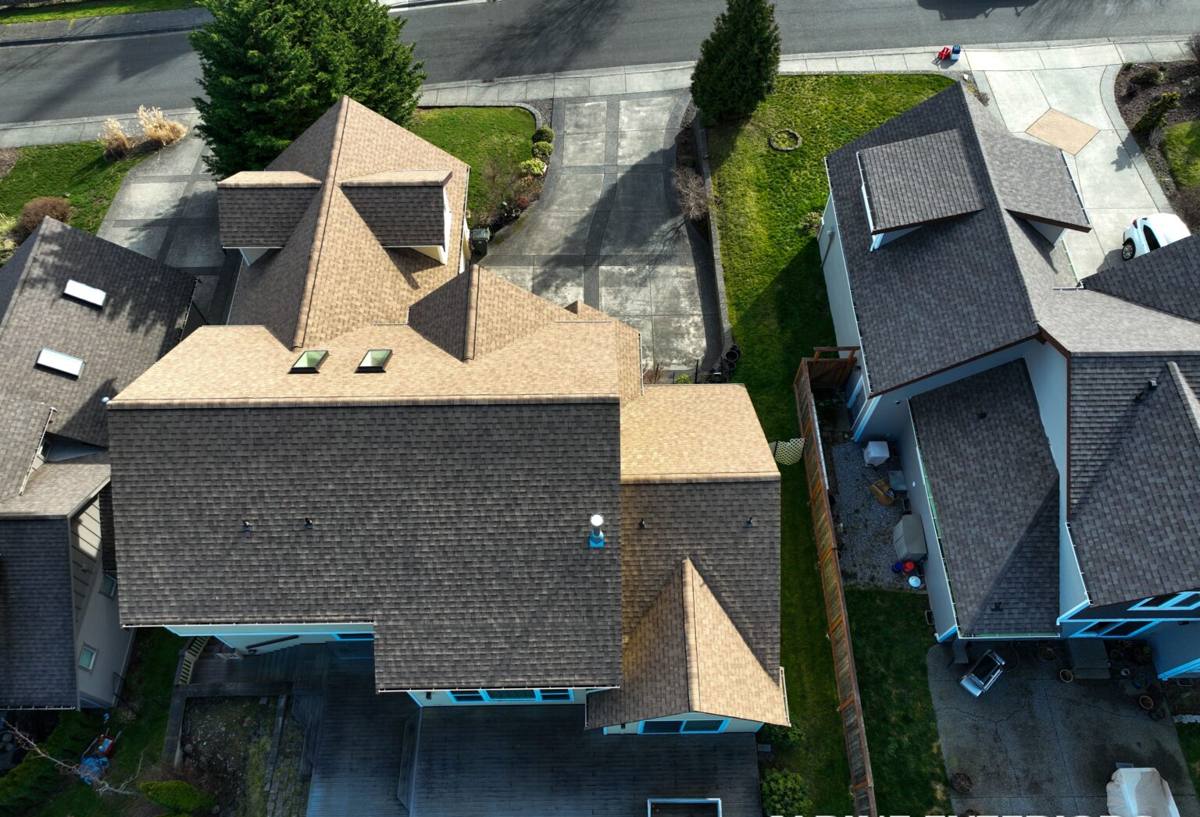
What Fairhaven's Salt Air, Rain, and Moss Actually Do to Siding
Salt Air
Airborne salt from the bay settles on exterior surfaces and accelerates corrosion of exposed metal fasteners, trim flashing, and hardware. Materials or finishes that aren't formulated to resist this kind of exposure can chalk, pit, or fail early, and any fastener that isn't corrosion-resistant becomes a weak point sooner than it would a few miles inland.
Driving Rain
Storms coming off the water don't just drop rain straight down — wind pushes it sideways into siding laps, seams, and trim joints. This is a wind-driven-rain environment, which means the drainage plane behind the siding, the flashing details around windows and doors, and the lap geometry of the siding itself all matter more here than in calmer climates. A material or installation that only handles vertical rainfall well isn't enough.
Moss and Mildew
Shaded walls under mature trees, combined with months of damp weather, create ideal conditions for moss, algae, and mildew to take hold on exterior surfaces. Beyond looking bad, sustained moisture and organic growth against siding can trap water against the substrate, degrade paint finishes, and — on materials that aren't dimensionally stable — contribute to swelling, cupping, or rot at the edges.
What a Correct Siding Installation Involves Here
A siding job is only as good as what's underneath it and how it's fastened, flashed, and gapped. In Fairhaven's conditions, we treat the following as non-negotiable, not upgrades:
- Continuous weather-resistive barrier installed correctly behind the siding, lapped shingle-style so water sheds outward rather than working its way in
- Proper flashing at every window, door, deck ledger, and roof-to-wall intersection — the majority of siding failures we see start at a flashing detail, not the siding field itself
- A drainage gap or rainscreen so any moisture that does get behind the cladding can drain and dry instead of sitting against the wall assembly
- Corrosion-resistant fasteners rated for the exposure, not standard fasteners that will corrode faster in salt air
- Correct fastening schedule and clearances — nailing patterns, butt joint treatment, and ground clearance all affect how the siding performs over 20-plus years, not just how it looks on install day
- Caulking used sparingly and correctly — caulk is a detail, not a substitute for proper flashing and lap sequencing
Skip any one of these and the siding may still look fine at the walkthrough. The problems show up two, five, or ten years later, usually as trapped moisture, staining, or fastener failure — and by then it's a repair job, not a touch-up.
Why We Only Install James Hardie Fiber Cement Siding
We standardized on James Hardie fiber cement siding for every home we side, including in Fairhaven, and we don't install vinyl, LP SmartSide, or other fiber cement brands. That's a deliberate choice based on how these products perform in exactly the conditions described above, not a sales preference.
Fiber cement is dimensionally stable — it doesn't expand, contract, warp, or cup the way wood-based and some engineered wood siding products can when they take on repeated moisture. It's also non-combustible, which matters increasingly to insurers and homeowners in the Pacific Northwest. James Hardie's HZ5 product line is specifically engineered for climates like ours — freeze-thaw cycles, sustained moisture, and coastal exposure — rather than a one-size-fits-all formulation.
The factory-applied ColorPlus finish is another piece of why we trust it here: it's baked on under controlled conditions and backed by its own finish warranty, so it holds color and resists the fading and chalking that field-applied paint jobs are more prone to under UV and salt exposure. Combined with James Hardie's transferable product warranty, homeowners get a siding system with a real, documented performance track record — not just a material that looks good on the truck.
None of this means every other siding product is unusable everywhere. It means that for the specific combination of salt air, driving rain, and moss exposure Fairhaven homes deal with, fiber cement engineered for this climate is the material we're willing to put our name behind.
Our Installation Process
1. On-Site Assessment
We walk the home, check the current siding and substrate condition, look for existing moisture damage, and note the specific exposure of each wall — which sides take the worst wind-driven rain, which are shaded and moss-prone, and where flashing details need the most attention.
2. Removal and Substrate Check
Old siding comes off and we inspect the sheathing underneath for rot, soft spots, or prior water intrusion before anything new goes up. Hidden damage gets addressed before it's covered — not discovered five years later.
3. Weather Barrier and Flashing
House wrap or building paper goes on correctly lapped, and flashing is installed at every penetration and transition point — windows, doors, roof lines, and any wall-mounted fixtures.
4. Siding Installation
James Hardie panels or planks are installed to manufacturer specification: correct fastener type and placement, proper reveal and clearance, and butt joints treated to shed water rather than collect it.
5. Trim, Caulking, and Cleanup
Trim is fitted and finished, caulking is applied only where it belongs, and the site is cleaned up — old siding and debris hauled off, not left for the homeowner to deal with.
6. Final Walkthrough
We walk the finished job with the homeowner, point out what was done and why, and answer questions before calling it complete.
Signs a Fairhaven Home May Need New Siding
Not every siding issue is obvious from the street. Some of the more common signs we see on homes in this area include:
- Persistent moss or algae growth that returns quickly after cleaning
- Cracking, warping, or soft spots, especially on shaded or north-facing walls
- Paint that's peeling, bubbling, or failing faster than expected
- Visible gaps at seams, corners, or trim where water could be tracking in
- Rising energy bills that suggest the wall assembly isn't performing the way it should
- Staining or discoloration that keeps reappearing in the same spots after cleaning
Any one of these on its own isn't necessarily an emergency, but a combination — especially moisture staining paired with soft trim or siding — is worth having looked at before it turns into a sheathing or framing repair.
What Affects the Cost of a Fairhaven Siding Installation
Every home is different, and we don't quote sight-unseen, but these are the factors that most commonly move the price up or down on a project like this:
| Cost Factor | Why It Matters |
|---|---|
| Home size and wall area | More square footage means more material and labor hours, the largest single driver of total cost |
| Existing siding removal | Tear-off, disposal, and any substrate repair add time before new siding can go up |
| Home shape and trim detail | Multiple gables, dormers, and trim-heavy architecture take longer to flash and fit correctly than a simple rectangular wall |
| Number of stories | Multi-story homes require more scaffolding, staging, and safety setup |
| Substrate or moisture damage found during removal | Rotted sheathing or framing needs to be repaired before new siding goes on — this is the most common source of change orders |
| Siding profile chosen | Lap siding, panel siding, and shingle-style products differ in material and labor cost |
Why It Matters to Hire a Crew That Already Works Fairhaven
Siding installers who mostly work drier, inland areas don't always default to the drainage details, flashing sequencing, or fastener choices this environment calls for — not out of carelessness, but because it's not what their usual jobs demand. A crew that regularly installs siding in Fairhaven and similar Bellingham neighborhoods treats wind-driven rain protection and salt-air-resistant fastening as standard practice, not an upsell.
Local familiarity also helps with practical things: knowing which walls on a given lot typically take the worst weather based on orientation and tree cover, understanding Whatcom County permitting requirements, and being available for a warranty callback without a long drive. Fairhaven has a lot of homes with real architectural character and older construction, and getting the substrate inspection and prep right on those homes takes experience with this specific building stock, not just siding installation in general.
Maintaining Your New Siding in This Climate
Correct installation gets you most of the way to long-term performance, but a little ongoing attention keeps it that way:
- Rinse siding periodically to remove salt residue and organic buildup, especially on shaded or bay-facing walls
- Trim back vegetation that keeps walls shaded and damp longer than necessary
- Check caulking at trim and penetrations annually and have any gaps addressed promptly
- Keep gutters and downspouts clear so water isn't overflowing onto siding below
- Have any impact damage or loose trim repaired quickly rather than waiting
James Hardie fiber cement is low-maintenance compared to many alternatives, but "low-maintenance" isn't "no-maintenance" — a little upkeep protects the investment and keeps the warranty conditions met.
If your Fairhaven home is due for new siding, or you're seeing early signs of trouble on an older installation, we're happy to take a look and walk you through what we'd recommend and why. Reach out for a free, no-pressure estimate using the form below.