 Bellingham Siding
 Asphalt Shingle Roofing in Sunnyland: A Neighborhood With Its Own Weather Problem
Sunnyland sits inside Bellingham, Whatcom County, close enough to Bellingham Bay and the Salish Sea that homes here deal with a specific combination of weather most inland roofing crews never have to think about: salt-tinged marine air, rain that gets pushed sideways by wind instead of falling straight down, and a moss season that can run most of the calendar year on shaded roof planes. Asphalt shingle roofs handle that load differently than they do in a drier, calmer climate, and the difference shows up in how long a roof actually lasts versus how long it was supposed to last on paper.
We install and repair asphalt shingle roofing specifically in this part of Bellingham, which means we're not guessing at how the local climate behaves. We see the same north-facing planes holding moss, the same ridge caps taking wind exposure, and the same valleys collecting debris and moisture year after year. This page is about what that means for a correctly built asphalt shingle roof over a Sunnyland home, not a generic overview of roofing in general.
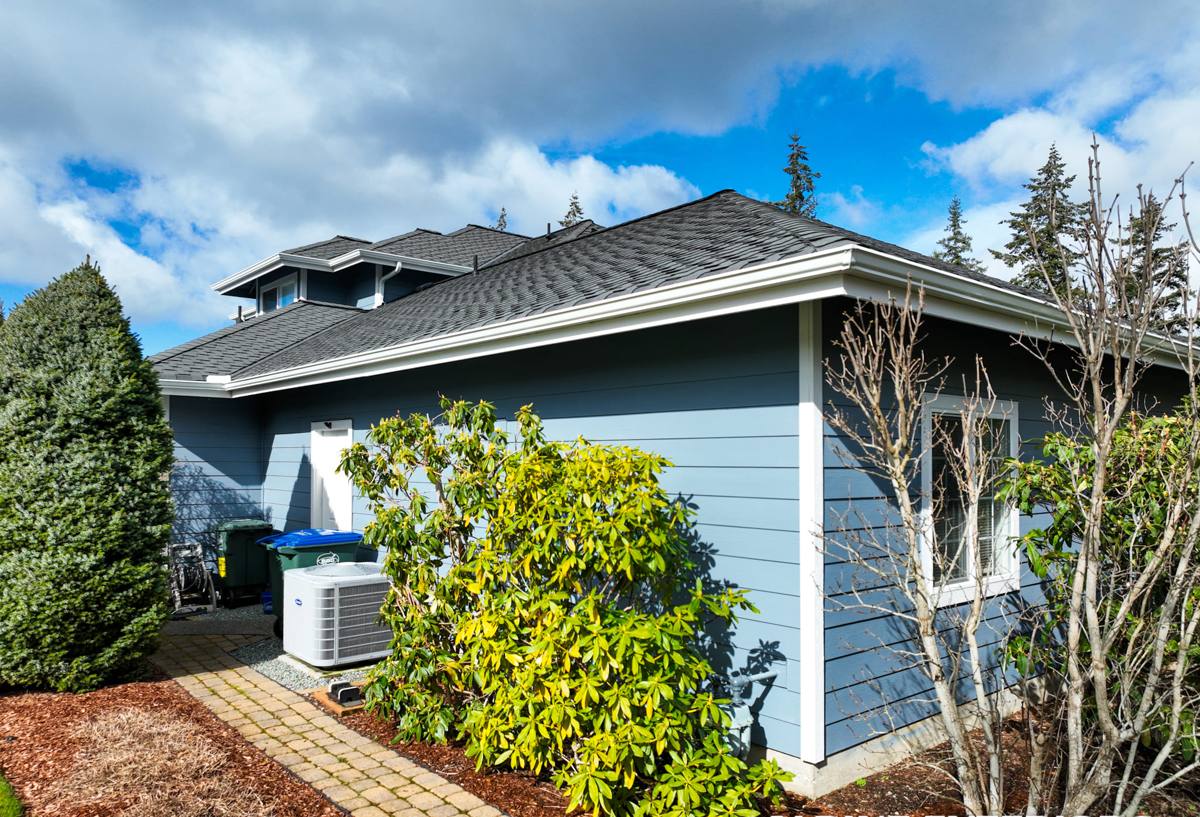
What Bellingham's Climate Does to an Asphalt Shingle Roof
Salt Air and Slow Material Fatigue
Proximity to the bay means a steady presence of moisture-laden, salt-tinged air moving across roof surfaces, not just during storms. That kind of sustained exposure works on fasteners, flashing metal, and lower-grade shingle granules faster than it would in an inland climate. It's a slow, quiet kind of wear that usually isn't obvious from the ground until a roof is already several years past where it should have been re-evaluated.
Wind-Driven Rain
Rain in this part of Whatcom County often arrives at an angle, driven by wind off the water rather than falling straight down. That matters at every roof penetration, valley, and eave, because a shingle and flashing detail that would perform fine in a calmer region can still let water track underneath here, specifically because the wind is pushing it uphill under laps and around fasteners instead of letting gravity carry it straight off the roof.
A Long Moss Season
Mild temperatures, tree cover, and near-constant dampness add up to extended moss and algae growth on shaded and north-facing roof planes across Bellingham, including Sunnyland's tree-lined residential streets. Moss doesn't just look bad. It holds moisture against the shingle surface, works its way under tabs as it grows, and can lift shingles enough to let water underneath during the next hard rain. Left long enough, it shortens the roof's real service life regardless of what the shingle warranty says on paper.
What a Correctly Installed Asphalt Shingle Roof Needs Here
Buying a good shingle is only part of the job. In this climate, the installation detail underneath the shingle is often what determines whether a roof performs for its full expected life or starts leaking a decade early.
Underlayment and Ice-and-Water Protection
A synthetic underlayment rated for sustained moisture exposure, combined with self-adhering ice-and-water shield membrane at eaves, valleys, and roof penetrations, gives the roof a second line of defense when wind-driven rain gets past the shingle surface. In a climate this consistently wet, that second layer isn't optional extra protection, it's a working part of how the roof is supposed to shed water.
Ventilation That Actually Balances
Intake at the eaves and exhaust at the ridge need to work together as a matched system, not as separate details installed without regard for each other. Poor attic ventilation traps moisture underneath the roof deck, which accelerates deck rot, shortens shingle life from below, and can feed the same moss and algae growth the climate is already pushing from above.
Flashing at Every Transition
Chimneys, skylights, sidewalls, and roof-to-wall transitions are where the large majority of roof leaks actually originate, not in the open field of shingles. Correctly formed step flashing, counterflashing, and valley metal, installed and sealed to the actual conditions of the roof rather than a generic template, is what keeps wind-driven rain from finding its way in at those points.
Fastening for Wind Exposure
Correct nail placement, count, and pattern matter more in a region that regularly sees wind-driven storms off the water. Under-fastened or improperly placed nails are a common reason shingles lift or blow off in a wind event that a properly fastened roof would have shrugged off without damage.
Signs Your Sunnyland Roof Needs Attention
- Moss or dark algae streaking on north-facing or shaded roof planes, especially if it returns quickly after cleaning
- Granules collecting in gutters or at the base of downspouts, a sign the shingle surface is wearing down
- Curling, cupping, or cracked shingle tabs, particularly on slopes with the most sun and weather exposure
- Soft or spongy spots underfoot on the roof deck, which can indicate trapped moisture below the shingles
- Daylight visible through the attic roof deck, or water staining on attic sheathing or insulation
- Shingles lifted or missing after a windstorm, even if no active leak has shown up yet
- Rusty or visibly deteriorating flashing around chimneys, skylights, or sidewalls
- A roof that's simply reaching the back half of its expected service life without a recent inspection
Our Asphalt Shingle Roofing Process
1. Inspection and Honest Assessment
We walk the roof, check the attic from below, and look at flashing, ventilation, and deck condition, not just the shingle surface. We'll tell you plainly whether you're looking at a repair, a partial re-roof, or a full replacement, and why.
2. Tear-Off and Deck Evaluation
Old shingles and underlayment come off down to the deck, which is the only way to actually see what's happening underneath. Any soft, rotted, or moisture-damaged decking gets identified and replaced before anything new goes down, since covering a compromised deck with new shingles just hides the problem for a future owner to find.
3. Underlayment, Ice-and-Water Shield, and Flashing
We install underlayment and ice-and-water membrane rated for this climate's moisture load, then form and install new flashing at every transition point rather than reusing old, weathered flashing metal.
4. Shingle Installation
Shingles go down with fastening patterns matched to the manufacturer's high-wind specification, which is the standard we hold ourselves to given how regularly this area sees wind-driven storms off the water.
5. Ventilation Check and Final Walkthrough
We confirm intake and exhaust ventilation are balanced before calling the job finished, then walk the roof and the site with you so you know exactly what was done and why.
Shingle Options: What We Install and Why
Asphalt shingles aren't all built the same, and in a climate this wet, the difference between a builder-grade three-tab shingle and a properly rated architectural shingle shows up faster here than it would in a drier region.
| Shingle Type | Typical Lifespan | How It Handles This Climate |
|---|---|---|
| Three-tab asphalt | 15–20 years | Lower cost, but thinner profile and lighter wind rating make it more vulnerable to lifting in wind-driven storms and faster to show wear from moss and moisture |
| Architectural (laminate) asphalt | 25–30 years | Heavier, multi-layer construction sheds wind-driven rain better and holds up longer under sustained moss and algae exposure |
| Algae-resistant architectural shingles | 25–30 years | Copper-infused or algae-resistant granules slow moss and algae growth on shaded planes, which matters given how long the growing season runs here |
| Impact-rated or high-wind architectural | 25–30+ years | Higher wind rating and reinforced construction suited to a coastal wind-driven rain pattern, at a higher material cost |
We default to architectural shingles with algae-resistant granules for most Sunnyland homes, since the extra upfront cost over a three-tab shingle is usually small relative to the added years of service life in a climate this consistently wet and shaded.
Living With Moss: What Ongoing Roof Care Actually Looks Like
No shingle roof in this climate stays moss-free forever without some ongoing attention, and any contractor who tells you otherwise is overselling the product. Algae-resistant granules slow growth, they don't stop it permanently. A reasonable maintenance rhythm for a Sunnyland roof includes periodic soft-washing to remove moss and algae before it works under the tabs, keeping tree limbs trimmed back from shaded roof planes to reduce debris and shade buildup, and clearing gutters and valleys regularly so water has a clear path off the roof instead of pooling against shingle edges. None of this is difficult, but skipping it for several years in a row is one of the more common reasons a roof that should have lasted 25 years starts leaking at 15.
Cost Factors for Asphalt Shingle Roofing in Sunnyland
| Factor | What It Affects | Why It Matters Here |
|---|---|---|
| Roof size and pitch | Total material and labor | Steeper pitches and more complex rooflines take longer to work safely and use more underlayment and flashing detail |
| Tear-off vs. layover | Labor scope and deck access | A full tear-off is the only way to catch hidden moisture damage common under older roofs in this climate, and it's what we recommend in nearly every case |
| Deck condition | Repair costs before new roofing goes on | Years of trapped attic moisture or slow leaks can rot sheathing before it's ever visible from outside |
| Shingle grade selected | Material cost and expected lifespan | Algae-resistant architectural shingles cost more upfront but hold up longer against sustained moss and moisture exposure |
| Number of penetrations and valleys | Flashing material and labor time | Each chimney, skylight, and valley is a point wind-driven rain can exploit if flashing isn't done correctly |
| Site access and tree cover | Labor time and setup | Mature trees and tighter lots common in established Bellingham neighborhoods can add staging time and cleanup |
Real numbers depend on the specific roof, which is why we walk the property and inspect the attic before quoting instead of pricing off square footage alone.
Why a Crew That Already Works Sunnyland Matters
Roofing crews that mostly work drier, inland climates sometimes bring installation habits, ventilation assumptions, and shingle grade recommendations that don't quite fit a coastal Whatcom County roof. A crew that already works Sunnyland and the surrounding Bellingham neighborhoods knows which roof planes tend to hold moss longest, understands how wind off the bay behaves against a given roofline, and isn't guessing at local permitting or inspection expectations for the first time on your job. That familiarity doesn't replace correct installation technique, but it does mean fewer surprises, and a roof that's actually built for the weather it's going to face rather than a generic national spec.
If you're looking at moss buildup, granule loss, an aging roof, or storm damage on a Sunnyland home, we're glad to take a look and give you an honest read on where things stand. Reach out for a free, no-pressure estimate using the form below.