 Bellingham Siding
 Composite Decking for Birchwood Homes
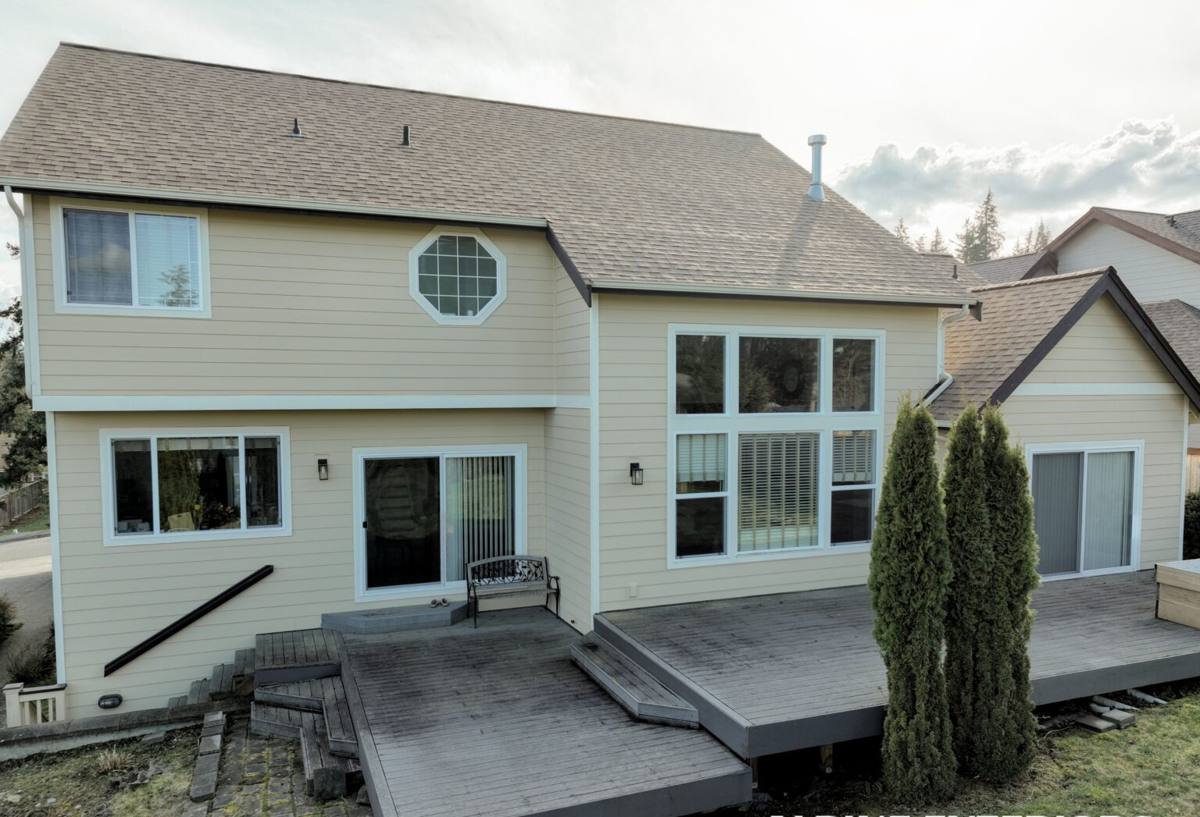
Birchwood is one of the leafier, more established pockets of Bellingham, and a lot of the decks here are older wood structures that have been fighting the same battle for years: salt-laden air off the Sound, long stretches of driving rain through fall and winter, and a moss season that seems to start earlier every year. If you're weighing a deck replacement or a new build in this neighborhood, composite decking is worth a serious look — not because it's trendy, but because it's genuinely better suited to what Whatcom County weather does to an outdoor structure over a decade or two.
This page covers what Birchwood homes specifically need from a composite deck, what a correctly built one involves, and how we approach the work when we're on-site here.
What Bellingham's Climate Actually Does to a Deck
It's easy to underestimate how hard the Pacific Northwest is on exterior wood surfaces, mostly because the damage is slow and cumulative rather than sudden. A few things stack up over time in this part of Whatcom County:
- Salt air and moisture combine. Bellingham's proximity to Puget Sound means airborne salt settles on exterior surfaces, and that salt holds moisture against wood and fasteners longer than dry inland air would.
- Rain volume, not just rain frequency. Our wet season isn't a handful of downpours — it's months of steady, driving rain that finds every gap in a ledger board, every unsealed cut end, and every low spot where water can pool instead of shedding.
- Moss and algae get a long runway. Cool, damp, shaded conditions for much of the year are ideal moss-growing weather. On a wood deck, moss doesn't just look bad — it holds moisture against the board surface and accelerates rot underneath it.
- UV exposure during the dry months. Summers here are shorter than in other parts of the country, but the UV is still enough to gray and check unprotected wood, especially on south- and west-facing decks.
None of this is unique to Birchwood, but it's worth saying plainly: a deck built or maintained the way you'd build one in a dry climate will underperform here. The materials and details have to account for our actual conditions.
Why Composite Makes Sense in This Climate
Composite decking — boards made from a blend of wood fiber and recycled plastic, most of it now capped with a protective polymer shell — was developed largely to solve the problems that wood decks run into in wet, humid climates. That makes it a good fit for a neighborhood like Birchwood, where moisture exposure is more or less constant for half the year.
The practical advantages for a coastal, rainy climate:
- Capped composite boards don't absorb water the way wood does, so they're far less prone to cupping, splintering, or rot at fastener points.
- They don't need annual staining or sealing to hold up against rain and UV — a real time and cost savings over a wood deck's lifespan.
- Surface texture on quality composite boards is engineered to shed water and resist algae growth better than bare wood, though it still needs occasional cleaning (more on that below).
- Color and finish are consistent board to board and don't gray or silver the way untreated wood does within a few seasons.
Composite isn't maintenance-free — no exterior decking product truly is in this climate — but it shifts the maintenance burden from "protect the wood every year or it fails" to "clean it periodically and it keeps performing."
Where Wood Still Has a Place
We're not going to tell you wood decking is a bad product — it isn't, and plenty of homeowners prefer the look and lower upfront cost. Our honest professional take is that wood decks in this climate need a real maintenance commitment (annual cleaning, periodic sealing, prompt repair of any soft spots) to reach their full lifespan. If you want that lower material cost and are willing to keep up with the upkeep, wood is a legitimate choice. If you'd rather spend that annual maintenance time doing something else, composite is the better fit.
Comparing Your Decking Options
| Factor | Wood (cedar/pressure-treated) | Capped Composite | PVC |
|---|---|---|---|
| Moisture resistance | Moderate — needs sealing | High | Very high |
| Moss/algae resistance | Low without regular cleaning | Moderate to high | High |
| Annual maintenance | Cleaning + sealing/staining | Periodic cleaning only | Minimal cleaning |
| Upfront material cost | Lowest | Mid-range | Highest |
| Typical lifespan (PNW conditions) | 10-20 years with upkeep | 25-30+ years | 25-30+ years |
| Look/feel | Natural wood grain | Wood-look, wide color range | More uniform, plastic feel |
Most of the composite decks we install for Birchwood homeowners land in the middle of this comparison intentionally — better moisture and moss performance than wood, without the higher cost of full PVC systems. We'll walk through actual board options and pricing once we've seen your site and talked through what matters most to you.
What a Correct Composite Deck Installation Actually Involves
The decking boards themselves get most of the attention, but board quality only matters if everything underneath and around them is done right. This is where a lot of deck problems in wet climates actually start — not with the surface material, but with the structure and details beneath it.
Substructure and Framing
Composite boards are heavier than wood and behave differently under load and temperature swings, so joist spacing and framing need to match the manufacturer's specifications for that specific product — not just "what worked for the last wood deck." We check existing framing on replacement projects for rot or undersized members before any new decking goes down; covering up a compromised substructure with new boards just delays a bigger problem.
Ledger and Flashing Details
Where a deck attaches to the house is the single most common source of water intrusion into the structure itself. Correct ledger flashing — installed so water is directed out and away from the house wall, not trapped behind the ledger board — matters more in a climate with months of sustained rain than almost anywhere else. This is not a place to cut corners.
Drainage and Airflow Underneath
A deck that traps moisture underneath it, with no airflow and nowhere for water to go, will have problems no matter what decking material sits on top. Proper grading beneath the deck, gaps for airflow, and hardware chosen for wet-climate durability all matter.
Fasteners and Hardware
Salt air accelerates corrosion on standard fasteners. We use hardware rated for coastal and wet-climate exposure, and hidden fastener systems where appropriate, both for a cleaner finished look and to avoid the surface staining that corroding screws can cause on composite boards over time.
Our Process, Start to Finish
- On-site assessment. We look at your existing deck or build site, check framing and ledger conditions if applicable, and talk through how you actually use the space.
- Product and layout selection. We go over composite board options, color, railing systems, and layout, with honest input on what fits your budget and how the space sits relative to sun, shade, and drainage.
- Written estimate. Clear scope, materials, and cost — no surprise add-ons once work is underway.
- Permitting. We handle the permit process where required for your project and jurisdiction.
- Demo and structural work. Removal of the old deck if applicable, framing repair or new substructure build, and correct ledger flashing.
- Decking, railing, and finish work. Composite board installation, railing and stair systems, and final detailing.
- Walkthrough. We go over the finished deck with you, including basic care guidance specific to the product installed.
Living With a Composite Deck Through Moss Season
Even a well-built composite deck needs a bit of seasonal attention in a climate like ours. It's a much lighter lift than wood deck maintenance, but skipping it entirely will let moss and grime build up over multiple wet seasons.
- Sweep debris (leaves, needles, seed pods) off the deck regularly, especially in fall — trapped organic matter holds moisture against the board surface and feeds moss growth.
- Rinse the deck periodically through the wet months, and give it a proper wash with a soft-bristle brush and a composite-safe cleaner once or twice a year.
- Avoid high-pressure washing directly into board surfaces or seams — it can force water into areas it shouldn't be and, on some products, damage the cap layer.
- Check that gaps between boards stay clear so water continues to drain through rather than pooling.
- Keep gutters and downspouts near the deck clear so runoff isn't dumping extra water directly onto the deck surface.
- Trim back overhanging branches where practical — less shade and leaf litter means less moss pressure over time.
Why It Matters to Hire a Crew That Already Works This Area
Composite decking installation isn't dramatically different from one Whatcom County neighborhood to the next, but local build conditions do vary — lot grading, tree cover, sun exposure, and how close a given property sits to the water all factor into how a deck should be built and where drainage and flashing details need extra attention. A crew that regularly works Bellingham neighborhoods like Birchwood has already seen how local conditions play out on real decks over multiple wet seasons, not just in a manufacturer's install guide.
That local experience also means straight answers: which board lines actually hold up well here, what railing hardware corrodes too fast near the water, and where a "standard" install detail needs to be adjusted for our climate rather than followed exactly as written for a drier region.
Get an Estimate for Your Birchwood Deck Project
If you're considering a new composite deck or replacing an aging wood deck at your Birchwood home, we're happy to take a look and give you a straightforward, no-pressure estimate. Use the form below to get started, and we'll walk through your options based on your home, your budget, and what actually holds up in this climate.