 Bellingham Siding
 Why Birchwood Decks Wear Out Faster Than the Warranty Sticker Suggests
Most decking products are rated and marketed using national averages that don't reflect what a deck actually goes through in Bellingham. In Birchwood, a deck sits under a low, wet Pacific Northwest sky for eight or nine months of the year, gets a dose of salt-laden air off the Bellingham Bay side of Whatcom County, and then spends its driest months hosting barbecues and furniture that trap moisture underneath. None of that is unusual for this area — it's just what decks here deal with, and it's why a deck that would last two decades in a dry inland climate can start failing structurally in Birchwood in half that time if it wasn't built or maintained with our conditions in mind.
Salt air accelerates corrosion on fasteners, brackets, and any exposed metal hardware. Driving rain, especially when it comes in sideways off a windy front, gets pushed under flashing and behind ledger boards instead of simply running off the surface the way it would in a calmer climate. And Whatcom County's long moss season — often stretching from fall through spring — means any board that doesn't drain and dry quickly becomes a growing surface for moss and algae, which hold moisture against the wood and make the surface dangerously slick.
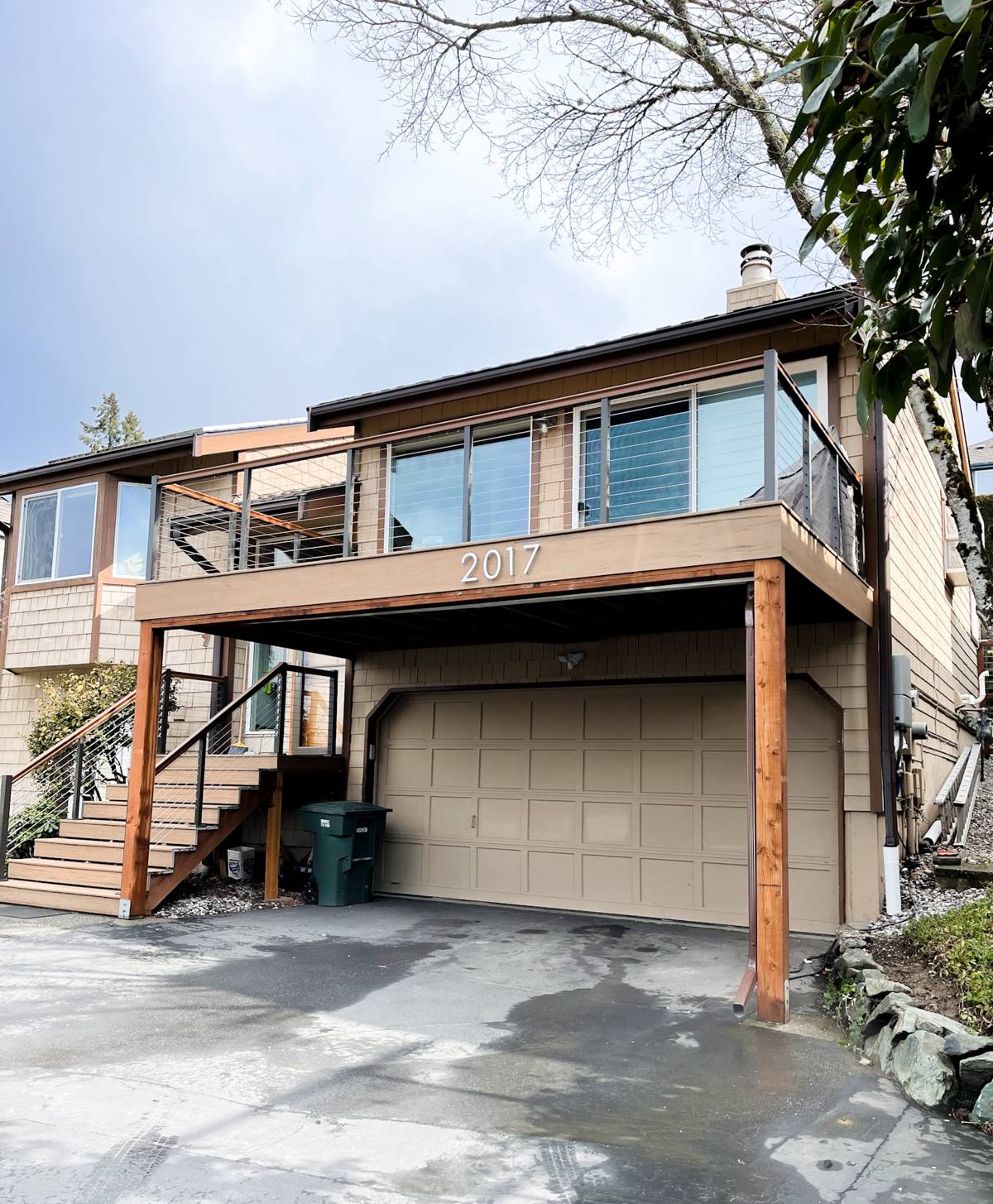
Repair or Replace? How We Make That Call
Not every tired-looking deck needs a full tear-off. We've talked plenty of Birchwood homeowners out of a full replacement when the framing was sound and the problems were cosmetic or limited to the surface boards. But there's a point where patching becomes false economy, and it usually comes down to what's happening below the decking, not what you can see from the top.
- Soft, spongy, or spring-loaded spots when you walk across the deck
- Rust streaking or visible corrosion around joist hangers and structural screws
- A ledger board that's separating from the house, or gaps behind the flashing
- Posts or footings that shift, rock, or show rot at the base
- Railings that flex noticeably when you lean on them
- Boards that have cupped, split, or delaminated across most of the surface, not just a few
- A deck built before current flashing and fastener standards were common practice
If the framing checks out, we'll tell you that and price a resurfacing instead. If the structure is compromised, resurfacing over it just hides a safety problem under new boards — and that's not a job we'll do, regardless of what it would save on the estimate.
What a Correct Deck Replacement Actually Involves
A deck replacement done right is mostly invisible once it's finished — the parts that matter most are underneath. Homeowners often assume the job is about picking decking material, but the material is the easy decision. The framing, flashing, and connections are what determine whether the deck holds up through another decade of Whatcom County winters.
Ledger and Flashing
Where the deck attaches to the house is the single most common failure point we see in this climate. Proper flashing — installed so water sheds away from the house rather than behind the ledger board — is non-negotiable. This is also where driving rain does the most damage over time if it wasn't detailed correctly the first time.
Framing and Fasteners
We use structural connectors and fasteners rated for exterior, corrosion-prone environments, not standard interior-grade hardware. Given the salt air exposure common in this part of Whatcom County, this is one area where cutting corners shows up early as rust and premature weakening.
Footings and Posts
Footings need to sit below frost depth and bear on stable, well-drained soil. Post bases should keep wood off standing water and off direct soil contact, both of which shorten the life of the structure fast in a climate that stays damp for most of the year.
Drainage and Airflow Underneath
A deck that can't breathe underneath holds moisture, which feeds rot and moss. Proper spacing, grading beneath the deck, and joist protection all matter more here than they would in a drier region.
Choosing Decking Material for a Birchwood Climate
There's no single "best" decking material — there's a best material for your budget, your maintenance appetite, and how much moisture and salt exposure your specific spot in Birchwood gets. Here's how the common options actually compare once you factor in our climate, not a national average.
| Material | Moisture & Moss Behavior | Maintenance | Typical Lifespan Here |
|---|---|---|---|
| Pressure-treated wood | Absorbs water, needs to fully dry between rain events; prone to moss if not cleaned | Annual cleaning and periodic sealing/staining | 10–15 years with upkeep |
| Cedar | Naturally moisture- and insect-resistant, but still needs sealing to fight graying and moss | Sealing every 1–2 years for best appearance and protection | 15–20 years with upkeep |
| Capped composite | Doesn't absorb water like wood; moss and algae can still grow on the surface and need occasional washing | Occasional cleaning, no sealing or staining | 25+ years |
| PVC decking | Fully moisture-resistant, best resistance to salt air and standing water exposure | Lowest maintenance of the common options | 25–30+ years |
We don't push homeowners toward the most expensive option by default. A well-built cedar or pressure-treated deck, sealed and maintained on schedule, is a perfectly sound choice for a lot of Birchwood homes. Where composite or PVC earns its higher upfront cost is on decks that get heavier rain exposure, sit low to the ground with limited airflow, or belong to homeowners who'd rather not sand and reseal every couple of years. We'll walk through the honest trade-offs for your specific deck rather than defaulting to whatever has the best margin.
Railings, Stairs, and Code Requirements
Replacement is also the right time to bring railings and stairs up to current code, especially on older Birchwood homes where the original deck predates current guardrail height and baluster spacing requirements. This matters both for safety and for resale — an out-of-code railing is a common flag on home inspections. We handle permitting and inspection scheduling as part of the replacement so you're not left chasing paperwork after the crew has already moved on.
Our Replacement Process
- On-site assessment — we inspect the existing structure, footings, ledger connection, and framing before quoting anything, so the estimate reflects what your deck actually needs.
- Written estimate — a clear breakdown of scope, material options, and cost, with no vague allowances buried in the fine print.
- Permitting — we pull the required permit and schedule inspections so the finished deck is fully compliant, not just finished.
- Tear-off and structural work — old decking, framing issues, and any compromised posts or footings are addressed before a single new board goes down.
- Flashing and waterproofing — detailed to shed water away from your home, built for the rain patterns this area actually sees.
- Decking, railings, and stairs — installed to your chosen material and layout, with fastening appropriate for our climate.
- Final walkthrough — we go over the finished deck with you, including basic care guidance specific to the material you chose.
Living With Your New Deck: Moss and Moisture Management
Whatever material you choose, a few habits go a long way in Whatcom County's wet stretches. Keep gutters and downspouts near the deck clear so runoff isn't dumping directly onto or under it. Sweep leaves and debris off the surface regularly during fall, since trapped organic matter is what moss needs to get started. Rinse the surface periodically, and if you notice green film forming in shaded corners, address it early rather than letting it spread — it's far easier to clean off a small patch than to deal with slick boards across the whole deck. Composite and PVC owners aren't exempt from this; those surfaces resist rot but not surface moss, so an occasional wash still matters.
Why a Crew That Already Works Birchwood Matters
Deck-building fundamentals don't change from town to town, but the details that make a deck last do. A contractor who works regularly in Birchwood and the surrounding Bellingham area already knows which fastener and flashing choices hold up against our salt air and rain patterns, understands Whatcom County's permitting process, and isn't learning the local climate's failure points on your project. That familiarity shows up in fewer callbacks and a deck that's still solid well past the point where a generic build starts showing problems.
If you're not sure whether your current deck needs a full replacement or just a repair, we're glad to take a look and give you a straight answer either way. Reach out for a free, no-pressure estimate — use the form below to get started.