 Bellingham Siding
 Deck Replacement in Columbia: Why the Climate Changes the Calculus
Columbia sits close to the water, and that proximity to Bellingham Bay shapes what a deck goes through year to year. Salt-tinged air, long stretches of driving rain, and a moss season that can run from fall through spring all put a different kind of stress on outdoor structures than you'd see further inland. A deck that would hold up fine in a dry climate can fail early here if it wasn't built — or replaced — with those specific conditions in mind.
Deck replacement is a bigger decision than a simple board swap. It's a chance to correct whatever the original build got wrong, upgrade the parts of the structure that don't hold up to Whatcom County weather, and end up with something that will actually last the next 20-plus years instead of needing patchwork repairs every couple of seasons.
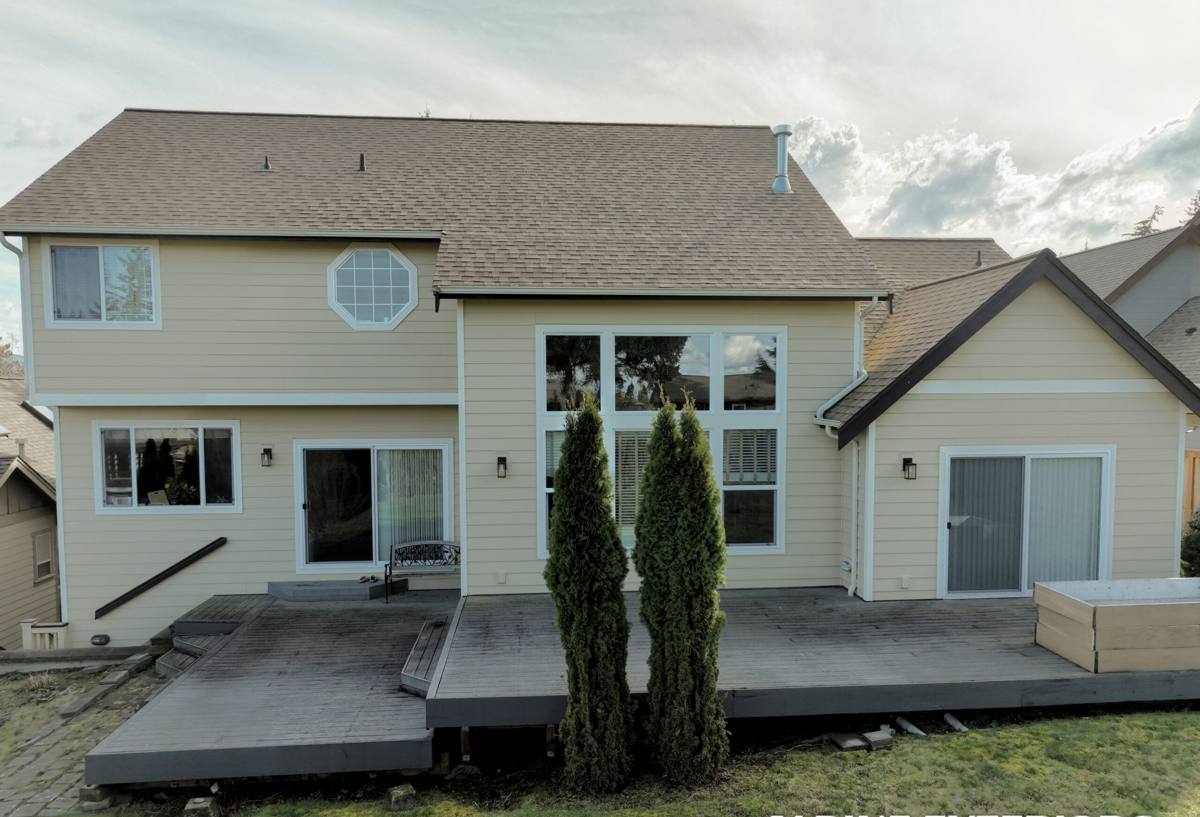
Signs Your Columbia Deck Has Reached the End of Its Life
Repair makes sense when the problem is isolated. Replacement makes sense when the damage is systemic — when the structure itself, not just the surface, has been compromised. Here's what usually tips a deck from "repairable" to "replace it":
- Soft, spongy, or spring-loaded decking boards, especially near the house or along the perimeter
- Visible rot or dark staining at the ledger board where the deck attaches to the house
- Persistent green or black moss growth that returns within weeks of cleaning
- Rusted, corroded, or failing fasteners and hardware — a common issue this close to the bay
- Posts or footings that feel loose, shift underfoot, or show cracking at ground level
- Railings that wobble or don't meet a firm push test
- A deck more than 20–25 years old that has never had structural components replaced
If you're only seeing one or two of these, a repair might buy you time. If you're seeing several at once, that's usually a sign the whole structure is aging out together — which is exactly when replacement becomes the more honest recommendation, not just the more profitable one.
What Salt Air, Driving Rain, and Moss Season Actually Do to a Deck
Salt Air and Metal Fasteners
Even at a distance from the water, salt-laden air accelerates corrosion on any hardware that isn't rated for it. Standard fasteners, brackets, and nails can start rusting years before the wood around them shows real damage. Once a fastener corrodes, it loses grip strength — and a deck is only as strong as the connections holding it together.
Driving Rain and Water Intrusion
Wind-driven rain doesn't behave like a gentle sprinkle. It gets pushed sideways, up under boards, and into joints that were only ever designed to shed water falling straight down. Over time this drives moisture into end grain, ledger connections, and post bases — the exact spots where rot starts and is hardest to spot from the surface.
Moss Season and Trapped Moisture
A long moss season means extended stretches where a deck surface stays damp instead of drying out between rains. Moss holds moisture against the wood (or against composite decking's surface layer), which slows drying further and creates a persistent freeze-thaw and rot cycle through the wetter months. It's also a slip hazard on stairs and walking surfaces.
None of these issues are dramatic on their own. Together, over a decade or two, they're the reason decks in this area age faster than the manufacturer's brochure suggests.
Choosing the Right Decking Material for This Climate
There's no universal "best" decking material — there's a best fit for your budget, maintenance appetite, and how exposed your particular deck is to rain and moss. Here's how the common options compare for a Columbia property specifically:
| Material | Moisture Resistance | Moss/Algae Resistance | Maintenance |
|---|---|---|---|
| Pressure-treated lumber | Good if properly sealed and re-sealed | Moderate — needs regular cleaning | Annual staining/sealing recommended |
| Cedar | Naturally decent, degrades without upkeep | Moderate | Periodic sealing; ages gray if left untreated |
| Composite decking | Very good — doesn't absorb water like wood | Good, though surface can still grow moss without airflow | Occasional washing, no staining/sealing |
| PVC/capped polymer | Excellent — fully water-resistant core | Good with proper cleaning | Lowest — rinse as needed |
We don't push any one product across every job. A pressure-treated deck with proper flashing, drainage, and fastener selection can perform very well here for a fraction of the cost of composite or PVC — the trade-off is more upkeep on your end. Composite and capped-polymer products cost more up front and reduce maintenance, but they still need correct structural framing and ventilation underneath to avoid trapping moisture. The right call depends on how much yearly maintenance you actually want to take on.
What a Correct Deck Replacement Actually Involves
A deck is only as good as what's underneath the decking boards. A proper replacement addresses the whole system, not just the visible surface:
- Ledger board and flashing: The connection to the house needs correct flashing and waterproofing — this is the single most common failure point on older decks in wet climates.
- Footings and posts: Footings should be sized and set to current code depth, with posts protected from standing water at the base.
- Joist spacing and hardware: Corrosion-resistant, rated hardware matters more here than in a dry inland climate — this is not a place to save money on fasteners.
- Drainage and airflow: Decks need a path for water to move away from the structure and airflow underneath to let framing dry out between rain events.
- Surface material and fastening pattern: Whatever decking you choose, gapping and fastening need to account for wood movement and water shedding, not just appearance.
- Railings and stairs: Structural connections here get inspected and rebuilt to current code, not just cosmetically refreshed.
A deck that only replaces the boards on top of a compromised frame is a deck that will need attention again in a few years. Real replacement means the framing gets evaluated and rebuilt where needed, not just covered up.
Our Process for Columbia Deck Replacements
- On-site assessment: We look at the existing deck's framing, ledger connection, footings, and hardware condition, not just the surface boards.
- Honest scope and estimate: You get a clear picture of what's structural, what's cosmetic, and what your material options actually cost — no pressure toward the most expensive option.
- Permitting: We handle the permit process where required so the finished structure is inspected and code-compliant.
- Demolition and disposal: Old decking, framing, and hardware are removed and hauled off — you're not left with a pile of debris.
- Structural rebuild: Ledger flashing, footings, posts, and framing are corrected or replaced to hold up to local rain and moisture exposure.
- Decking, railing, and finishing: Your chosen material goes down with attention to fastening, gapping, and drainage details that matter for this climate.
- Final walkthrough: We go over the finished deck with you before calling the job done.
Permits, Code, and Whatcom County Considerations
Deck replacement in Bellingham typically requires a permit when the work involves structural changes — new footings, altered framing, or changes to railing height and guard spacing. Inspectors are checking for things like proper ledger attachment, footing depth, and railing safety, all of which matter more in a wet climate where a poorly built connection fails faster. Skipping permitting on a structural rebuild isn't just a compliance risk — it also means no third-party check that the ledger flashing and footings were done correctly, which are exactly the details that determine whether a deck lasts 10 years or 30.
What Deck Replacement Costs in This Area
Costs vary with size, material, and how much structural work is needed — but the main cost drivers are consistent across most Columbia projects:
| Cost Factor | Why It Matters |
|---|---|
| Deck size and layout | More square footage and multiple levels or stairs increase material and labor |
| Decking material chosen | Pressure-treated is the most affordable; composite and PVC cost more up front but need less upkeep |
| Condition of existing framing | Rotted joists, posts, or footings add rebuild scope beyond a simple board swap |
| Ledger and flashing repair | Water damage at the house connection often means additional siding or sheathing repair |
| Railing and stair requirements | Code-compliant railings and stairs add cost, especially on elevated decks |
| Permitting | Structural replacements generally require a permit and inspection |
We won't quote a number here that means anything without seeing your actual deck — but we will give you a written estimate that breaks down exactly what you're paying for, with no surprise add-ons once the work starts.
Why Local Experience in Columbia Matters
A crew that already works in this neighborhood knows what the bay-adjacent exposure, the wetter shoulder seasons, and the long moss window actually do to a deck over time — not from a manual, but from having rebuilt decks that failed for exactly those reasons. That means fewer surprises during the estimate, fastener and flashing choices that are already calibrated to this climate, and a build that's sized to actually hold up here rather than to a generic national standard. It also means we're not guessing at permitting requirements or inspection expectations — we've been through that process locally before.
If your Columbia deck is showing its age, we're happy to take a look and give you a straight, no-pressure estimate — free of charge, with no obligation to move forward. Fill out the form below and we'll get in touch.