 Bellingham Siding
 James Hardie Siding for the Columbia Neighborhood
Columbia is one of Bellingham's older, established neighborhoods, with a housing stock that spans everything from early-century homes to more recent infill construction, most of it within a few minutes of the water and Whatcom Creek. That mix of age and proximity to the bay means siding here takes on a specific set of jobs: it has to hold up to salt-tinged marine air, shrug off wind-driven rain that rarely falls straight down, and resist a moss season that, on shaded lots and tree-lined streets, can run most of the year. We install James Hardie fiber cement siding exclusively, and on a neighborhood like Columbia, that choice is less about brand preference and more about which material actually does what this climate demands of it, year after year, without the homeowner having to think about it.
This page is about one thing: James Hardie siding, installed correctly, on homes in Columbia. Not a general siding overview, and not a sales pitch for every product on the market — just what this specific neighborhood's climate requires, what a correct Hardie install involves, and how we approach these projects when we're working a few blocks from Whatcom Creek instead of somewhere inland.
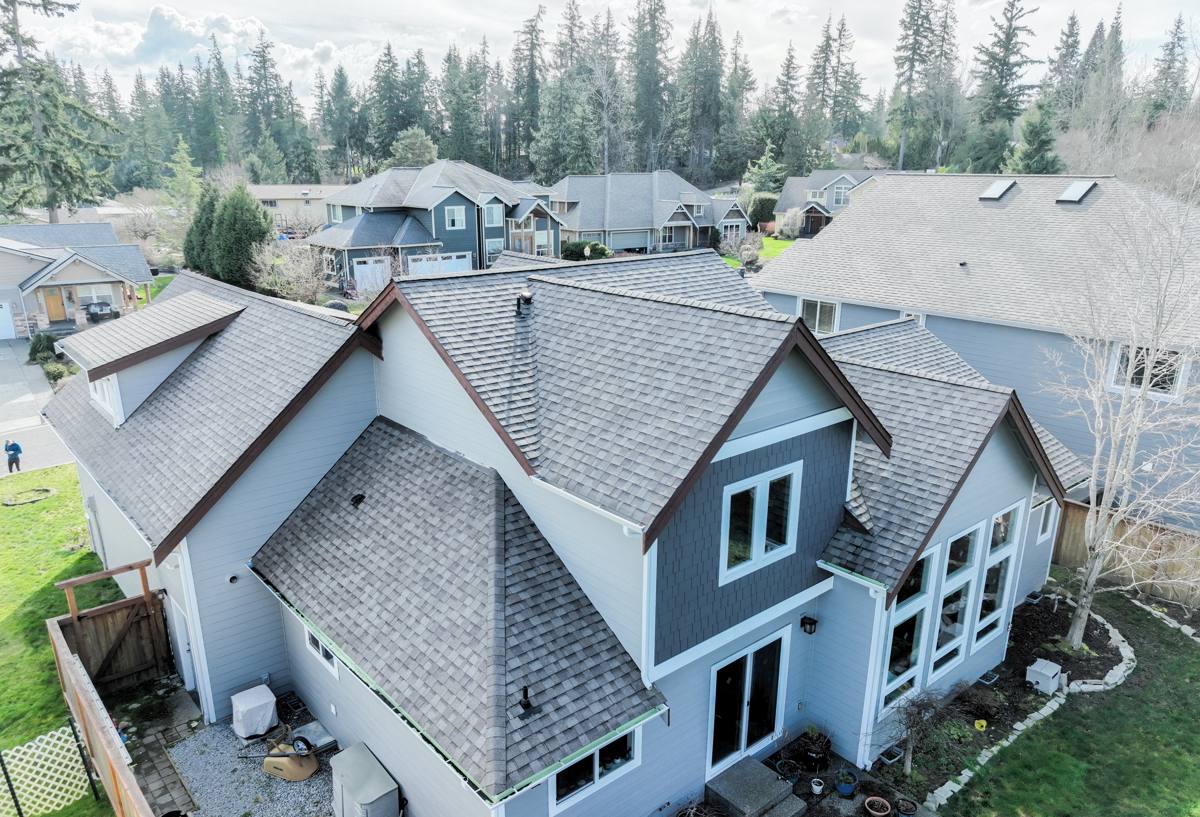
What Columbia's Climate Actually Does to a Wall
Salt Air and Slow Corrosion
Being close to Bellingham Bay means Columbia homes sit in a steady drift of salt-tinged air, even when the water itself is out of sight. Salt air is hard on anything metal — fasteners, flashing, trim hardware — and it's hard on siding materials that rely on paint film or surface coatings to keep moisture out. Coatings that are marginal to begin with tend to break down faster here than they would twenty miles inland, which is part of why fastener spec and flashing detail carry more weight on a Columbia project than they might on a home further from the water.
Wind-Driven Rain, Not Just Rain
Bellingham gets a lot of rain, but the detail that matters more for siding is how it arrives. Wind off the bay pushes rain sideways into walls rather than letting it fall straight down and run off, which means horizontal laps, seams, and butt joints all take on water pressure a calmer climate wouldn't put on them. A siding system that's only been tested against straight-down rain can look fine in a showroom and still underperform on an exposed Columbia wall.
A Long, Real Moss Season
Shaded lots, mature trees, and north-facing walls are common throughout Columbia, and all three combine to keep certain wall sections damp for much longer stretches than sun-exposed ones. That dampness is exactly what moss, algae, and mildew need to take hold. Once moss gets a foothold on a wall, it holds moisture against the surface even longer, which accelerates whatever damage the material was already prone to.
Older Homes, Original Wall Assemblies
Because Columbia has a fair number of older homes, siding replacement here often means working with wall assemblies that predate modern house wrap, drainage planes, and flashing standards. That's not a problem in itself, but it does mean a tear-off is a chance to correct decades-old moisture pathways — and a project that skips that step just buries the same issues under new material.
Why We Standardized on James Hardie for This Kind of Exposure
We don't install LP SmartSide, vinyl siding, Cemplank, Allura, primed spruce, or cedar. Those are legitimate products, and other contractors install them competently — we simply made a professional decision that on homes facing this combination of salt air, driving rain, and prolonged dampness, standing behind one material system we trust completely serves Columbia homeowners better than offering a menu of cheaper alternatives that shift maintenance risk onto them down the road.
| Material | Behavior in Salt Air & Driving Rain | Moss/Moisture Resistance | Realistic Lifespan Here |
|---|---|---|---|
| James Hardie fiber cement | Dimensionally stable; won't rot, warp, or corrode from within | Factory finish resists staining; doesn't feed moss the way wood-based products can | 30+ years with correct install |
| LP SmartSide (engineered wood) | Wood-strand core is more sensitive to sustained moisture at cut edges and joints | Needs consistent edge sealing to keep moisture out over time | 15-25 years, climate-dependent |
| Vinyl | Panels can distort in sun/cold cycling; seams aren't rigid | Doesn't feed moss, but hidden moisture behind panels is hard to spot | 20-30 years, variable |
| Cedar | Absorbs water readily without regular sealing; salt air accelerates weathering | Prone to moss and mildew without ongoing maintenance | 15-25 years with consistent upkeep |
The core reason James Hardie holds up better in this specific environment is that fiber cement doesn't expand, contract, or absorb moisture the way wood-based products do. That matters most exactly where Columbia's climate is hardest on siding: at seams, cut edges, and fastener penetrations. The factory-applied ColorPlus finish adds another layer of protection most field-painted materials don't have — the color and the moisture barrier are baked on at the factory under controlled conditions, not applied by hand on a ladder in variable weather.
James Hardie Product Lines and What Fits a Columbia Home
James Hardie makes several distinct product lines, and picking the right one for a given home depends on the house's style, exposure, and what the homeowner wants it to look like — not just on what's cheapest per square foot.
- HardiePlank lap siding — the most common choice for Columbia's mix of traditional and updated homes; available in several exposure widths and both smooth and cedar-textured finishes
- HardiePanel vertical siding — used for modern facades or as an accent alongside lap siding, common on newer infill builds in the neighborhood
- HardieShingle — a fiber cement alternative to traditional cedar shingle siding, popular on Craftsman and cottage-style homes
- HardieTrim — matching trim boards that finish out corners, window and door surrounds, and fascia so the whole exterior is one coordinated, low-maintenance system
James Hardie also engineers its products by climate zone under the "HZ" system — HZ5 for regions with more freeze-thaw exposure, HZ10 for milder, wetter coastal climates like ours. Getting the right HZ formulation matched to Whatcom County's specific weather pattern is a detail that's easy to overlook but affects how the product performs over decades, not just how it looks on day one.
What a Correct Hardie Install Actually Involves
James Hardie siding is only as good as the installation behind it. The material itself is engineered to handle this climate, but a rushed or generic install can undercut that engineering just as easily on Hardie as on any other product. A correct install includes:
- House wrap or weather-resistive barrier installed and properly lapped before any siding goes up
- A drainage gap or rainscreen behind the siding so moisture that gets past the surface has somewhere to go instead of sitting against the wall
- Corrosion-resistant fasteners, correctly sized and spaced per James Hardie's published installation requirements for this climate zone
- Proper clearance between siding and grade, decks, roofs, and other transitions so water doesn't wick up into the material
- Correctly lapped, sealed flashing at every window, door, and corner — the points where most real-world siding failures actually start
- Factory-cured ColorPlus finish preserved by cutting boards face-down and priming any field-cut edges before they go on the wall
- Caulking used only where Hardie's spec calls for it, not as a substitute for proper flashing and lapping
Skip any one of these steps and a wall can still look right for a season or two. The consequences — moisture intrusion at flashing points, staining at seams, paint failure at cut edges — take a few wet seasons to show up, which is exactly why they're easy for a corner-cutting install to get away with until it's the homeowner dealing with the repair bill.
Our Process for a Columbia Siding Project
Walkthrough and Assessment
We start by walking the specific home — which walls take the most weather directly, which stay shaded and slow to dry, and whether the existing wall assembly has moisture issues that need addressing before new siding goes up. On an older Columbia home, this step often surfaces things a homeowner didn't know were there.
Product and Detail Plan
We work out which Hardie product line fits the home's style and exposure, plan trim and corner details, and map out how the new siding will meet windows, rooflines, and existing trim before any material gets cut. Deciding these details on paper avoids field improvisation, which is where corners tend to get cut on a rushed job.
Installation to Manufacturer Spec
Every fastener, gap, and flashing lap follows James Hardie's published requirements for this climate zone, not a generic national standard. That's what keeps the manufacturer's warranty valid and what actually determines whether the wall performs for decades instead of years.
Final Walkthrough
We walk the finished job with you, explain what little maintenance Hardie siding actually needs, and make sure you know what a correctly installed wall looks like so you can check it yourself down the road if you ever want to.
Why a Crew That Already Works Columbia Matters
Siding performance in a neighborhood like Columbia comes down to judgment calls a spec sheet can't make for you: how much rainscreen gap actually earns its keep on a shaded, tree-covered wall versus a sun-exposed one; which orientations need extra flashing attention because of how wind pushes rain off the bay; how fastener corrosion resistance should be specified differently here than it would be twenty miles inland. A crew that's installed James Hardie siding across Bellingham and through Columbia specifically, across multiple wet seasons, has already made those calls enough times to get them right without guesswork. That's the difference between a wall that still looks and performs the same in twenty years and one that's showing seam staining and soft trim by year five.
Cost Factors for a Columbia Hardie Project
James Hardie siding costs more upfront than vinyl and is generally in a similar range to engineered wood products, though it outlasts both when installed correctly. A few things move the price on a given Columbia home beyond base square footage:
| Factor | Why It Matters |
|---|---|
| Product line and texture | HardieShingle and custom trim details cost more in material and labor than standard lap |
| Existing wall condition | Rot, old moisture damage, or outdated house wrap found during tear-off needs correcting before new siding goes on |
| Number of windows, doors, and corners | Every opening and transition needs its own flashing and trim work |
| Wall height and access | Multi-story walls or tight lot access can add labor time |
| Color and finish choice | Factory ColorPlus finishes vary slightly in cost by color and sheen |
We'll walk your specific home and give you real numbers rather than a rough estimate based on square footage alone — two homes with similar footprints in Columbia can land at very different price points depending on wall condition, opening count, and access.
Maintenance and What the Warranty Actually Covers
One of the practical advantages of James Hardie in a climate like this is how little upkeep it asks for compared to wood-based sidings. There's no periodic repainting cycle to plan around — the ColorPlus finish is engineered to hold color for years — and fiber cement doesn't feed moss or mildew growth the way untreated or under-sealed wood products can. Realistic maintenance is mostly a matter of an occasional rinse to keep salt residue and organic growth from building up on shaded walls, and a visual check after major storms to confirm flashing and trim are still tight. James Hardie backs its products with a transferable limited warranty, and correct installation to their published specifications is what keeps that warranty intact — another reason installation quality matters as much as the material itself.
If you're weighing siding options for a home in Columbia, we're happy to walk the property, talk through what your specific walls need given their exposure and age, and give you a straightforward, no-pressure estimate. There's a form below — reach out and we'll set up a time to take a look.