 Bellingham Siding
 Siding Repair for Cordata Homes
Cordata sits in north Bellingham, close enough to the water to catch salt-laden air off the Sound and far enough inland to sit under mature tree cover in a lot of its neighborhoods. That combination is tougher on exterior siding than either condition alone. Salt air accelerates corrosion on fasteners and trim metal, driving rain off Bellingham Bay pushes moisture sideways into seams and laps, and shaded, damp lots keep siding wet longer after every storm — which is exactly what moss and algae need to take hold. If you own a home in Cordata, your siding is working harder than siding in a drier, sunnier part of the state, and repairs need to account for that.
This page covers what siding repair actually looks like when it's done right in this specific climate, how we decide between a repair and a replacement, and why it matters to hire a crew that already knows how Whatcom County weather treats a house.
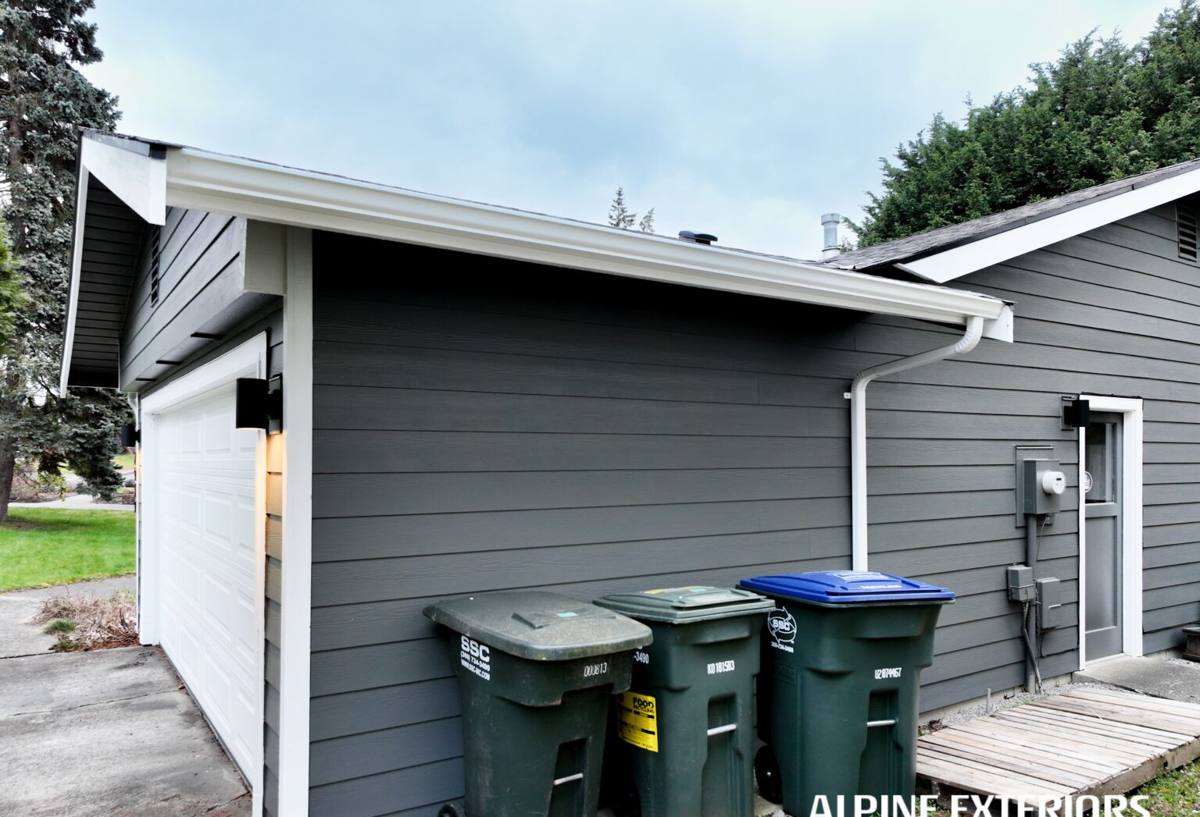
What Causes Most Siding Damage in Cordata
Moisture Intrusion
Bellingham's rain doesn't just fall — a lot of it comes in sideways during winter storms. That driving rain finds any weak point in a siding system: a failed caulk joint, a nail that backed out, a butt seam that was never properly flashed. Once water gets behind the siding, it doesn't dry out quickly in our humidity, and that's when you get rot in the sheathing, staining, and soft spots that are more expensive to fix the longer they sit.
Moss, Algae, and Organic Growth
Whatcom County's moss season runs long — realistically most of the year on shaded north- and west-facing walls. Moss holds moisture directly against the siding surface, which is a problem whether you have wood, engineered wood, or fiber cement. On older or lower-quality siding, sustained moss coverage can accelerate surface breakdown and paint failure. Even on siding that's holding up structurally, moss buildup traps grime and makes a house look neglected.
Salt Air and Fastener Corrosion
Proximity to Bellingham Bay means airborne salt is part of the environment here, even a few miles inland. Over years, that air can corrode uncoated or lower-grade fasteners and trim flashing faster than you'd see in an inland Washington town. When a repair only replaces the visible siding and reuses corroded fasteners or flashing, the same failure shows up again in a season or two.
Impact and Age-Related Damage
Wind-driven branches, ladders, lawn equipment, and simple age all take a toll too. Cracked boards, dented panels, and caulk that's shrunk and pulled away from trim are common on homes that are otherwise in decent shape — these are usually the most straightforward repairs.
Signs Your Siding Needs Repair
Most siding problems give warning signs well before they become structural. Walk your exterior a couple of times a year and look for:
- Soft, spongy, or bulging spots when you press on the siding
- Visible cracks, splits, or missing sections
- Paint that's peeling, bubbling, or flaking in a localized area rather than uniformly
- Dark streaking, green or black growth, or persistent moss patches
- Gaps where caulking has shrunk away from trim, corners, or window and door edges
- Rust streaks below fasteners or metal flashing
- Warping or visible waves in a wall plane
- A musty smell or unexplained moisture on the interior wall facing that section of siding
Any one of these on its own might be minor. Several together, or anything near a window, door, or roofline transition, is worth having looked at before the next rainy season.
What a Correct Repair Actually Involves
A siding repair that only addresses what's visible from the ground is a temporary fix. Done correctly, repair work in a climate like Cordata's means checking three layers, not one:
1. The Siding Itself
Damaged boards or panels get removed and replaced — not just caulked over. If we're patching fiber cement, we cut back to sound material and use proper overlap or a flush butt joint with a back-flashed seam, not a bead of sealant bridging a gap.
2. The Water-Resistive Barrier and Flashing
This is the layer most repairs skip, and it's the one that actually keeps water out of the wall assembly. If the housewrap or flashing behind the damaged siding is torn, missing, or was never installed correctly, replacing the siding without fixing that barrier just sets up the same failure again.
3. Fasteners and Trim
Given the salt exposure in this area, we use corrosion-resistant fasteners on repair work, not whatever was on hand. Trim boards and corner pieces get the same scrutiny as the field siding — trim is often where rot starts because it holds moisture at end grain and joints.
We also match repairs to the existing product wherever that's genuinely possible. If your home already has James Hardie fiber cement siding, we can typically source a matching profile and, where the finish allows, a close ColorPlus match. If your home has a different siding material and the damage is limited, we'll tell you honestly whether a like-for-like patch makes sense or whether it's a losing battle — more on that below.
Repair or Replace? How We Decide
Not every damaged wall needs full replacement, and not every repair is worth doing instead of replacing. We look at the extent of the damage, the age and condition of the surrounding siding, and what's happening behind it before recommending either path.
| Factor | Repair Usually Makes Sense | Replacement Usually Makes Sense |
|---|---|---|
| Extent of damage | Isolated to one or two boards or a small section | Spread across multiple walls or a full elevation |
| Underlying sheathing | Dry and sound once opened up | Soft, rotted, or showing long-term moisture damage |
| Age of existing siding | Relatively recent, still structurally sound overall | Near or past its expected service life |
| Material match | Matching product/profile is available or the difference is minor | Product is discontinued, incompatible, or a poor long-term match |
| Pattern of failure | One-time event: impact, single failed seam, isolated moss | Recurring moisture problems across the wall assembly |
We'll always give you a straight answer here. If a small patch will genuinely hold up, we're not going to push you into a bigger job than you need. If the damage points to a systemic problem, we'd rather tell you that up front than sell you a repair we don't expect to last.
Our Repair Process
- Inspection. We look at the visible damage and check what's around it — trim, flashing, adjacent seams, and anywhere water could be tracking from a different source, like a gutter or roof valley.
- Opening it up. Where there's any sign of moisture intrusion, we remove enough siding to see the actual condition of the barrier and sheathing behind it, rather than guessing from the surface.
- Addressing the cause, not just the symptom. If a flashing detail failed, we fix the flashing. If a gutter has been dumping water onto a wall, we'll flag that too — a great repair job downstream of an ongoing water source won't hold.
- Repair or replace the affected material. Matching product where possible, correct fastening, correct sealant at the right joints — not sealant used as a substitute for flashing.
- Finish and cleanup. Paint or caulk touch-up where needed, and the site left clean.
Why a Crew That Already Works in Cordata Matters
Siding repair isn't one-size-fits-all across Washington. A crew used to drier east-side conditions can miss what matters here: how far driving rain pushes water up under a lap in a Bellingham storm, how long moss actually takes to re-establish on a shaded wall a few blocks from the Bay, or which fastener grade actually holds up to salt air over years, not months. Working regularly in Cordata and the surrounding Bellingham neighborhoods means we're not learning the local climate on your house — we already know what tends to fail here and why, and we build repairs to hold up against those specific conditions rather than generic ones.
It also means faster, more accurate estimates. We're not guessing at how Whatcom County weather will treat a repair — we've seen how it plays out on homes very similar to yours.
What We Use for Repairs
We install James Hardie fiber cement siding exclusively, and that shapes how we approach repair work too. Hardie's HZ5 product line is engineered specifically for wetter, harsher climates like ours, and its ColorPlus factory finish is formulated to hold color and resist the kind of moisture and moss exposure that's routine in Cordata. When we're repairing existing Hardie siding, we can typically match both the profile and, in many cases, the finish closely enough that the repair blends in rather than standing out.
When a home has a different siding material — vinyl, LP SmartSide, cedar, or an older fiber cement product — we'll still repair what can reasonably be repaired. But if the damage is extensive enough that we're talking about replacing a full wall or more, we'll be upfront that our standard for new material is James Hardie, and we can walk you through why: it's non-combustible, it's built for exactly the wet, mossy conditions Cordata deals with every winter, and it carries a strong transferable warranty. We won't talk you into a full replacement you don't need just to sell Hardie — but if you're already there, it's worth knowing what your options are.
Get a Straight Answer on Your Siding
If you're seeing soft spots, moss buildup, cracked boards, or gaps in your siding in Cordata, it's worth having someone look at it before another wet Bellingham winter makes the problem bigger. We'll give you an honest read on whether it's a repair or something more, with no pressure either way. Reach out for a free estimate and we'll take a look.