 Bellingham Siding
 Why Edgemoor Decks Wear Differently
Edgemoor sits close enough to Bellingham Bay and the Salish Sea that salt-laden air is a constant part of the equation, not an occasional visitor. Combine that with Whatcom County's long wet season and the tree cover that gives the neighborhood its character, and you get a deck environment that's tougher on wood and fasteners than most inland Bellingham lots. We've repaired enough decks in this pocket of town to know the failure patterns are consistent: rot at ledger boards and post bases, corroded hardware, and moss or algae buildup that holds moisture against the surface long after a storm has passed.
None of this means a deck in Edgemoor is doomed to constant repair. It means the repair has to account for salt exposure, drainage, and shade in ways a generic patch job doesn't. That's the difference between a repair that lasts one season and one that lasts a decade.
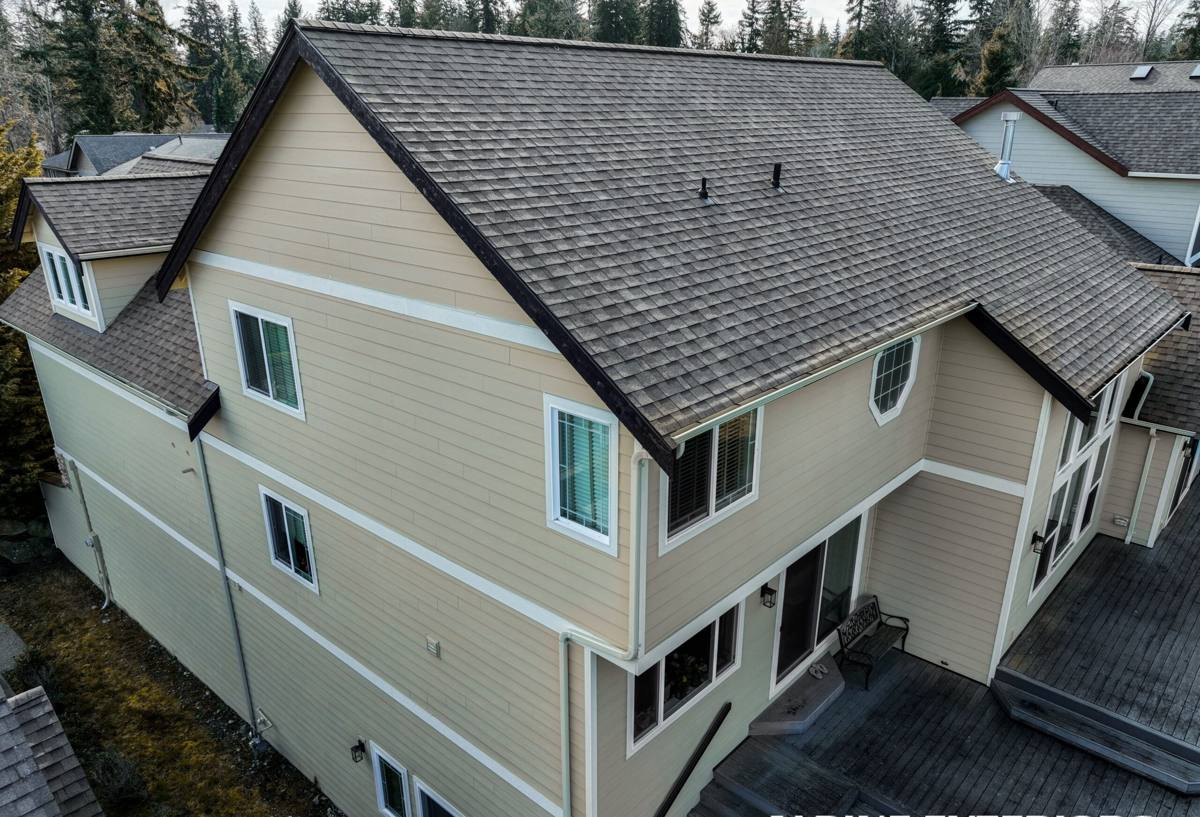
What Salt Air, Rain, and Moss Actually Do to a Deck
Salt Air and Metal Fasteners
Salt-laden coastal air accelerates corrosion in nails, screws, joist hangers, and structural connectors. Once a fastener starts to rust, it loses grip strength long before it looks obviously bad — you often can't tell from the surface. Corroded joist hangers and ledger bolts are one of the most common structural issues we find on decks near the water, and they're rarely visible without pulling back decking or inspecting from underneath.
Driving Rain and Water Intrusion
Whatcom County's rain doesn't just fall straight down — wind-driven rain gets pushed sideways into ledger connections, under flashing, and into any gap where end grain is exposed. Wood absorbs water fastest through its end grain, which is exactly where deck boards meet the house, where posts meet footings, and where stair stringers meet the ground. Repeated wetting and drying in these spots is what starts rot, even on decks that look fine from a few feet away.
Moss, Algae, and the Long Wet Season
Bellingham's moss season runs long, and a shaded deck under mature trees — common in Edgemoor — can stay damp for days after a single rain. Moss and algae aren't just cosmetic. They hold moisture against the board surface, make the deck slippery and dangerous underfoot, and, left unaddressed, contribute to surface decay and slick spots that are a real fall hazard on stairs and ramps.
Signs Your Deck Needs Repair, Not Just Cleaning
- Soft or spongy spots when you walk across the deck, especially near the house or at board ends
- Visible gaps, rust streaks, or cracking around joist hangers and structural screws
- A ledger board that looks separated, discolored, or damp-stained where the deck meets the house
- Wobble or movement in the railing when you push against it
- Persistent moss or dark staining that comes back within weeks of cleaning
- Stair stringers that flex, creak, or show soft wood at the base
- Fasteners that are rusted, backed out, or missing entirely
If any of these sound familiar, it's worth having a professional look at the structure underneath, not just the visible boards. Surface staining and moss are usually the early warning; the structural issues are what actually need repair.
What a Correct Deck Repair Actually Involves
A lot of deck "repair" in this region is really just board replacement — swap the bad boards, call it done. That approach misses the underlying cause almost every time. Our process starts by identifying why a section failed before we decide how to fix it.
1. Structural Inspection First
We check the ledger board connection, post bases, joist hangers, and any load-bearing hardware before touching the decking itself. In a salt-air environment, hardware condition matters as much as wood condition — a repair that reuses corroded fasteners is a repair that's already failing.
2. Address the Moisture Source
Rotten boards are a symptom. If water is pooling because of poor drainage, missing flashing, or a ledger connection that's letting water track behind it, replacing boards without fixing that source just buys a year or two before the same spot fails again.
3. Match Materials to Function, Not Just Looks
Structural members (ledgers, joists, posts, stringers) need to hold up under load and moisture cycling. Decking and railings need to handle foot traffic, UV, and the coastal air without becoming slick or brittle. We select fasteners and hardware rated for corrosion resistance appropriate to this environment — using standard interior-grade hardware near the water is one of the most common shortcuts that leads to repeat repairs.
4. Rebuild for Drainage and Airflow
Where moss and standing water have been a recurring problem, we look at whether board spacing, slope, or nearby vegetation is trapping moisture, and adjust what we can during the repair rather than just replacing like-for-like.
Repair vs. Replacement: How We Decide
| Situation | Usually Repairable | Usually Needs Replacement |
|---|---|---|
| Isolated soft boards, structure sound underneath | Yes | No |
| Rot at ledger board or multiple joists | Sometimes — depends on extent | Often, if rot has spread |
| Corroded hardware, wood still solid | Yes | No |
| Railing posts loose or rotted at the base | Sometimes | Often, if multiple posts affected |
| Widespread soft decking across most of the surface | No | Yes |
| Deck is over 20-25 years old with recurring issues | Case by case | Often more cost-effective long term |
We'll tell you honestly which category your deck falls into. There's no benefit to us talking a homeowner into a full rebuild when a targeted repair will hold, and there's no benefit to patching a deck that's going to need the same fix again next winter.
What This Costs — Broad Ranges, No Surprises
Every deck is different, so exact pricing depends on square footage, how much structural work is involved, and material choice. In general terms:
- Minor repairs (a few boards, hardware swaps, railing tightening) tend to be the least expensive and quickest to schedule
- Moderate repairs involving ledger or joist work cost more because they require opening up the deck structure, not just the surface
- Larger repairs approaching a partial rebuild start to compete with full replacement cost-wise, which is exactly why an honest repair-vs-replace assessment matters up front
We give firm numbers after seeing the deck in person — not before. Anyone quoting a full repair price over the phone without inspecting the structure is guessing.
Our Process for Edgemoor Deck Repairs
- On-site inspection. We look above and below the deck — structure, hardware, ledger connection, and drainage — not just the board surface.
- Honest assessment. We tell you what's actually wrong, what's cosmetic, and what's structural, in plain terms.
- Written scope and estimate. You know what's being repaired and why before any work starts.
- Repair work. We replace what needs replacing, correct the moisture or drainage issue causing the damage, and use fasteners and hardware suited to coastal exposure.
- Final walkthrough. We check the repair with you and point out any maintenance that will extend its life.
Maintenance That Extends a Repair's Life in This Climate
- Clean moss and algae off the deck surface and stairs at least once during the wet season, not just in spring
- Keep gutters and downspouts clear so runoff isn't draining directly onto or under the deck
- Trim back vegetation that's shading the deck and keeping it damp longer than it needs to be
- Check railings and stair stringers for movement once a year — catching a loose post early is a small fix; catching it late often isn't
- Reseal or refinish exposed wood on the schedule the product calls for — coastal air shortens the practical life of most finishes compared to inland conditions
Why Local Experience Matters for This Job
A deck repair crew that doesn't work this area regularly will treat every job as generic — same materials, same fastener specs, same assumptions about drainage, regardless of where the house sits. A crew that works Edgemoor and the surrounding Bellingham neighborhoods on a regular basis already knows which failure patterns show up near the water versus further inland, which hardware holds up and which doesn't, and how much the tree cover in this part of town affects a deck's drying time after a storm. That experience shows up in fewer callbacks and repairs that actually last through the next wet season, not just look fine on move-out day.
It also matters for something less obvious: knowing what's normal wear versus what's an early warning sign specific to this climate. A ledger board that would raise no concern in a dry inland town can be a real problem near the bay, and a crew unfamiliar with the area may not know to check it as closely.
Get an Honest Look at Your Deck
If your deck in Edgemoor has soft spots, persistent moss, loose railings, or you just want a professional opinion before another wet Whatcom County winter, we're happy to take a look. The estimate is free, there's no pressure, and you'll get a straight answer about what's actually needed — repair, partial rebuild, or just better maintenance. Fill out the form below and we'll schedule a time to come take a look.