 Bellingham Siding
 Why Decks Fail Faster in Ferndale Than the Brochures Admit
Ferndale sits close enough to the water and open farmland that decks here take a beating most inland homes never see. Salt-laden air drifts in off the bay and the Strait, driving rain comes in sideways during fall and winter storms, and a long, damp moss season keeps every horizontal surface wet for months at a time. That combination is hard on fasteners, hard on ledger boards, and hard on any decking material that wasn't chosen with this climate in mind.
Most deck failures we see in Whatcom County aren't dramatic collapses. They're slow: a ledger board that's been quietly rotting behind the siding, joists that have gone soft under decking that still looks fine on top, or fasteners that have corroded to the point where the boards are barely held down. By the time it's visible, the structure underneath has usually been compromised for a while.
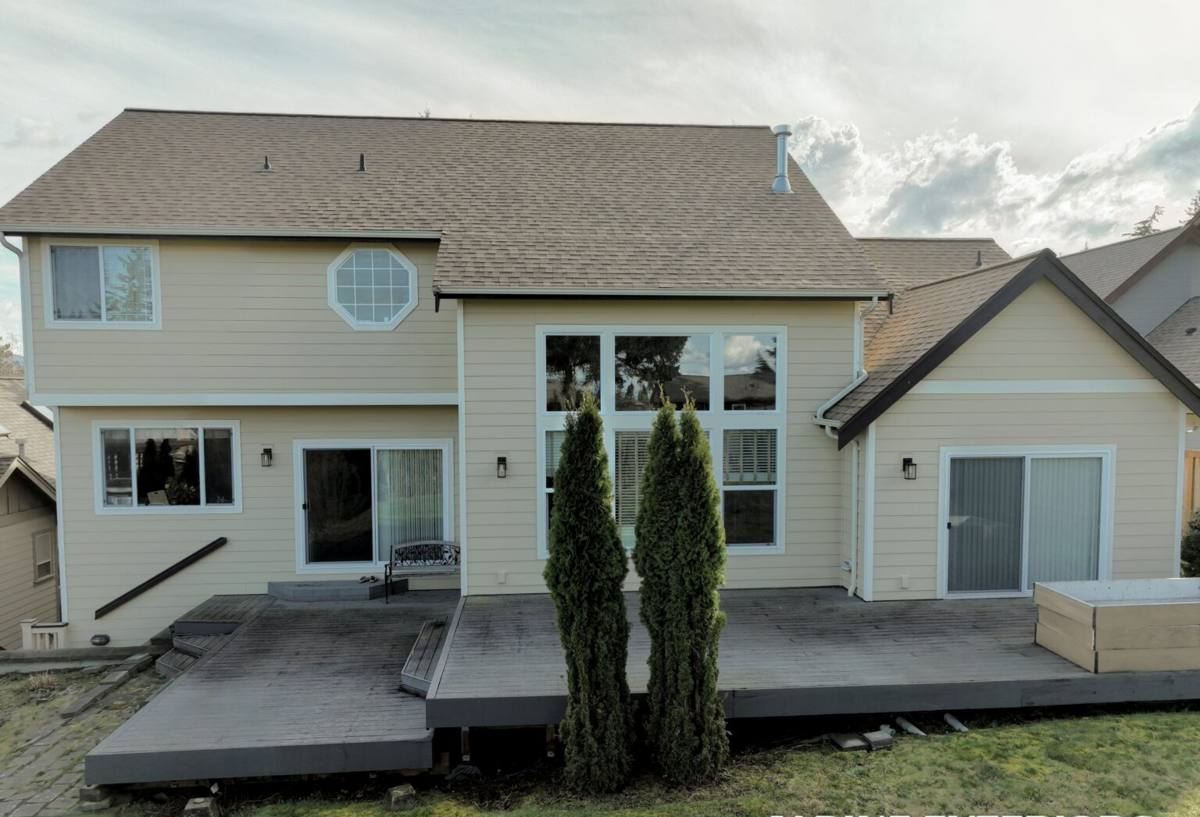
Signs a Ferndale Deck Needs Replacement, Not Just Repair
Repair makes sense when the problem is isolated. Replacement makes sense when the damage is systemic — which is common once a deck gets past 15-20 years in this climate, especially if it was built with untreated hardware or minimal flashing.
- Soft or spongy spots anywhere in the decking, not just at the obvious wear points
- Rust streaks running down from fasteners or metal connectors
- Gaps or movement where the ledger board meets the house
- Persistent moss or black staining that comes back within weeks of cleaning
- Wobble in the railing posts or stairs when you put weight on them
- Visible daylight or rot where support posts meet footings
- A deck that was never properly flashed where it attaches to the house
If you're seeing two or more of these, you're usually looking at a structural issue, not a cosmetic one. Patching boards on top of a compromised frame just hides the problem for another season.
The Ledger Connection Is Usually the Real Story
The ledger board — where the deck attaches to the house — is the single most common failure point we find, and it's almost always a flashing problem. Water gets behind the ledger, has nowhere to go, and sits there. In a climate with as much driving rain as Whatcom County gets, an unflashed or poorly flashed ledger doesn't fail eventually — it fails on a schedule.
What a Correct Deck Replacement Actually Involves
A deck replacement done right isn't just new boards on the old frame. It starts from the ground up:
- Full tear-off — removing decking, railings, and framing down to whatever is still sound, usually just the footings if they're in good shape
- Footing and post inspection — checking depth, condition, and whether they meet current code for the load and span
- Proper ledger flashing — a continuous flashing detail that sheds water away from the house, not just a bead of caulk
- Corrosion-resistant hardware — joist hangers, screws, and structural connectors rated for ground contact and coastal exposure
- Correct joist spacing for the decking material you choose, since composite and PVC products often need tighter spacing than traditional lumber
- Drainage consideration underneath — grading or gaps that let water and moss-feeding moisture move away instead of pooling
- Decking and railing installation to code, with attention to gapping for wood movement and drainage
Skip any one of these steps and you've built a deck that looks finished but has the same failure points as the one you tore off — just newer.
Choosing a Decking Material for This Climate
There's no single "best" decking material — there's a best material for your budget, your maintenance appetite, and how much salt air and rain your particular lot gets. Here's how the common options actually compare once you factor in Whatcom County's weather:
| Material | Moisture Behavior | Maintenance | Typical Lifespan | Relative Cost |
|---|---|---|---|---|
| Pressure-treated lumber | Absorbs water, prone to cupping and checking if not sealed regularly | Annual cleaning and re-sealing recommended | 10-15 years in this climate | Lowest upfront |
| Cedar | Naturally rot-resistant but still needs sealing against constant damp | Sealing every 1-2 years, moss cleaning | 15-20 years with upkeep | Mid-range |
| Capped composite | Resists moisture absorption, shell keeps moss from getting a foothold as easily | Occasional washing, no sealing | 25-30+ years | Higher upfront |
| PVC decking | Fully synthetic, no wood fiber to absorb water or feed rot | Lowest — soap and water | 25-30+ years | Highest upfront |
We don't push one product on every job. A pressure-treated deck that's properly flashed, fastened, and maintained can serve a Ferndale home well for over a decade. But if you want to spend less time scrubbing moss off boards every spring, a capped composite or PVC product earns its higher price back in avoided maintenance over the life of the deck.
A Note on Fasteners and Hardware
This is where we won't cut corners regardless of decking material. Standard galvanized fasteners corrode faster in coastal air than most homeowners expect. We use stainless steel or coated fasteners rated for the exposure, and structural hardware sized for the actual load — not just whatever's cheapest at the yard. It's a small line item on the estimate and the single biggest factor in how long the frame underneath lasts.
Our Process, Start to Finish
We keep the process straightforward because deck replacement doesn't need to be complicated when it's planned properly:
- On-site assessment — we look at the existing structure, footings, ledger condition, and drainage before quoting anything
- Written estimate — clear scope, material options, and honest pricing with no vague allowances
- Permit handling — we pull what's required for your project so you don't have to navigate that alone
- Tear-off and structural rebuild — framing, flashing, and footings brought up to standard
- Decking, railing, and stair installation — built to your chosen material's spec, not a generic template
- Final walkthrough — we go over the finished deck with you before we consider the job done
We don't start decking installation until the framing underneath is right. That order matters more than it sounds — it's the difference between a deck that needs attention again in five years and one that doesn't.
Permits and Local Requirements
Deck replacement projects in Whatcom County often require a permit, particularly when footings, framing, or railings are being rebuilt rather than just the surface boards. Requirements can vary depending on the deck's size, height, and whether it's attached to the house, so we check the specifics for your property rather than assuming. Handling this correctly up front avoids problems later — with resale, insurance, or a future remodel that touches the same structure.
Why a Crew That Already Works Ferndale Makes a Difference
Deck replacement isn't exotic work, but local conditions change what "correct" looks like. A crew that mostly works drier inland climates can build a technically fine deck that still isn't set up for what a Ferndale winter throws at it — not enough attention to ledger flashing, standard hardware instead of corrosion-resistant fasteners, or decking gapped for a climate that doesn't have this much sustained moisture.
Working in and around Bellingham and Whatcom County day in and day out means we're not guessing at how salt air, driving rain, and moss season affect a deck over time — we're seeing it on jobs constantly. That shapes what we recommend and how we build, from the flashing detail at the ledger to the fastener spec on the invoice.
Keeping Your New Deck Ahead of the Weather
Whatever material you choose, a little seasonal attention goes a long way in this climate:
- Sweep debris off the deck regularly so it doesn't trap moisture against the boards
- Clean moss and algae early in the season before it gets a foothold, rather than waiting until it's established
- Check that gaps between boards stay clear so water can drain through instead of pooling
- Re-seal wood decking on a regular schedule rather than waiting until it looks weathered
- Keep an eye on the ledger flashing and caulking where the deck meets the house
None of this is complicated, but skipping it is exactly how a well-built deck starts showing problems years earlier than it should.
If your deck is showing its age or you're just not sure whether it needs repair or full replacement, we're happy to take a look and give you a straight answer. Request a free, no-pressure estimate using the form below and we'll walk the property with you before you decide anything.