 Bellingham Siding
 Siding Repair in Edgemoor: A Different Set of Problems Than New Construction
Edgemoor sits along the wooded bluffs south of downtown Bellingham, close enough to Bellingham Bay that the marine air is a constant presence and shaded enough by mature tree canopy that a lot of exterior wall never gets a full day of direct sun. That combination is exactly what shows up in the siding repair calls we get from the neighborhood: not usually a single dramatic failure, but a slow accumulation of small, specific problems in specific spots on the house. Repairing that kind of damage correctly takes a different mindset than installing new siding on a bare wall. You're not just matching a product, you're diagnosing why that particular section failed while the rest of the wall didn't, and fixing the actual cause instead of just covering it back up.
We work throughout Whatcom County, and Edgemoor's wooded, bluff-top setting near the water is one of the more distinct micro-climates we deal with. Homes here face the same broad regional pattern as the rest of Bellingham, salt-tinged air, rain that gets driven sideways by wind off the bay, and a moss season that can run most of the year. But the tree cover and terrain common to Edgemoor change how and where that damage actually shows up on a wall, which matters when you're deciding whether a repair will actually hold or just buy a season or two before the same spot fails again.
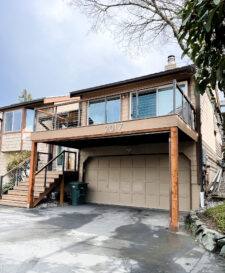
Why Edgemoor Homes Develop Siding Problems
Salt Air and Slow Corrosion
Homes close to Bellingham Bay sit in a steady drift of mildly corrosive, moisture-laden air most of the year, not just during storms. That exposure works slowly on fasteners, flashing, and lower-grade finishes. It rarely announces itself. It shows up years later as rust bleed streaking down from nail heads, caulk that's gone brittle and cracked, or a finish that's chalked and faded well ahead of its expected service life.
Wind-Driven Rain at Joints and Trim
Rain near the bay doesn't just fall straight down, it gets pushed by wind into lap joints, trim seams, and anywhere two building materials meet. A wall that would perform fine well inland can still take on water here specifically because of how wind interacts with the bluff and the open water below it. Repair calls in Edgemoor very often trace back to one of these joints rather than to failure of the siding field itself.
Tree Canopy, Shade, and Moss
Edgemoor's mature tree cover is part of what makes the neighborhood distinct, and it's also a major factor in siding wear. Shaded walls dry slower after every rain event, and in a climate that already stays damp much of the year, that extra drying time is enough to sustain moss and mildew growth that a sunnier wall wouldn't support. The affected areas are usually predictable: north-facing walls, sections tucked behind landscaping, and anywhere a roofline or overhang keeps a patch of siding in near-constant shadow.
Bluff Terrain and Water Movement
A fair number of Edgemoor properties sit on sloped or bluff-adjacent lots, which affects how water moves around the foundation and up the base of exterior walls during heavy rain. On these lots, the lowest courses of siding and the flashing at grade take on more sustained moisture exposure than they would on a flat inland lot, and that's frequently where we find the damage that prompted the repair call in the first place.
What a Correct Siding Repair Actually Involves
A siding repair that actually holds starts with figuring out why that section failed, not just replacing the visible damage. We open the affected area enough to see the sheathing and house wrap underneath before we commit to a repair plan, because siding that looks fine six inches away from a damaged board can still be sitting over wet sheathing that needs to dry out or be replaced before new material goes back on. Patching over a moisture problem instead of solving it is the single most common reason a repair fails again within a year or two.
Matching Existing Material
If your home already has James Hardie fiber cement siding, a well-executed repair should be close to invisible once it's painted or, in the case of ColorPlus factory-finished boards, matched to the existing color line. If your home has a different siding material and a section has failed, we'll talk through whether that spot can be responsibly patched with a compatible material or whether it makes more sense to transition that section, or eventually the whole wall, to Hardie.
Flashing and Water Management Come First
New siding installed over broken or missing flashing will fail again in the same spot, just on a delay. Any repair we do addresses the house wrap and flashing detail underneath as part of the job, not as an afterthought, because that's the layer actually keeping water out of the wall assembly. The visible siding is really the second line of defense.
Fastening and Clearance
Correct nailing pattern, proper lap, and correct clearance from grade and rooflines all affect how long a repair lasts. We follow manufacturer fastening specs on every repair, not just on full installs, because a repair done to a lower standard than a new install is a repair that's likely to be back on our schedule sooner than it should be.
Repair Versus Replacement: How We Make the Call
Not every siding problem in Edgemoor means a full re-side, and we don't push a bigger job than the house actually needs. Isolated impact damage, a section that's failed around a window, or trim that's worked loose can usually be repaired and matched into existing siding without touching the rest of the wall. But there are situations where a targeted repair is really just delaying a larger project, and it's worth being honest about that up front rather than letting a homeowner pay for a patch that won't hold.
| Situation | Usually a Repair | Usually Points to Replacement |
|---|---|---|
| Damage extent | Isolated to one board, corner, or trim section | Spread across multiple walls or an entire elevation |
| Moisture history | Recent, localized intrusion with sound sheathing underneath | Long-term trapped moisture with soft or rotted sheathing |
| Material age | Siding is otherwise within its expected service life | Original material is at or past the end of its realistic lifespan |
| Cause | A single identifiable failure point, like one broken flashing detail | A systemic issue, like missing house wrap across the whole wall |
| Cosmetic match | Repair area can be matched closely enough to blend in | Existing material is discontinued or too weathered to match |
We'll walk the property, open up what needs to be opened to actually see what's going on, and give you a straight answer about which category your house falls into before we talk about scope or cost.
Why Repairs Get Done in James Hardie Fiber Cement
We install and repair with James Hardie fiber cement siding and don't carry a broader product lineup. That standard applies to repair work too, not just new installs. In a climate this consistently wet and this close to salt water, we've found it's simpler and more reliable to stand behind one system we know thoroughly than to stock and warranty patches across several different materials with different moisture behavior and different failure patterns.
- Non-combustible core: Fiber cement doesn't feed a fire the way wood-based siding products can.
- Factory-applied ColorPlus finish: Cures under controlled factory conditions rather than being brushed on site, which holds up better against fading and moisture than field-applied paint, and makes color-matching a repair section more consistent.
- Climate-engineered HZ formulation: Built specifically for regions with heavy sustained moisture, a closer match to Edgemoor's shaded, marine-adjacent conditions than a generic national spec.
- Dimensional stability: Doesn't swell, cup, or warp the way engineered wood can after repeated wet-season moisture cycles, which matters when you're trying to get a patched section to sit flush with the surrounding wall.
- Transferable warranty: Backed by a substantial warranty structure when installed to spec, which we treat as a baseline, not a bonus.
We don't install or repair with LP SmartSide, vinyl, Cemplank, Allura, primed spruce, or cedar as a matter of professional standard. Those are legitimate products and other contractors work with them competently. Our decision comes down to trade-offs we'd rather not ask a homeowner to manage: engineered wood is more sensitive to moisture at cut edges and fastener penetrations than fiber cement; vinyl can warp in direct sun or trap moisture behind the panel if the house wrap wasn't done with real care; cedar and primed spruce both need an ongoing paint or seal schedule that, in a climate this damp, tends to slip and shorten the material's real-world life well below its rated lifespan.
Our Siding Repair Process
- Inspection and diagnosis: We assess the visible damage and look for the underlying cause, not just the symptom, including checking nearby trim, flashing, and roofline intersections.
- Opening the wall: We remove enough surrounding material to see the house wrap and sheathing condition before finalizing a repair plan.
- Substrate repair: Any wet or damaged sheathing gets addressed first. Siding installed over compromised substrate is a repair that won't last.
- Flashing and house wrap correction: We fix or replace the water-management layer at the source of the intrusion, since that's what actually keeps the wall dry going forward.
- Matched siding installation: New material is fastened to spec and matched to the surrounding siding as closely as the situation allows.
- Sealing and finish detail: Joints, seams, and trim are sealed correctly, and any field painting is done to blend with the existing wall.
- Walkthrough: We go over what we found and what we did, including anything worth watching on the rest of the house.
Signs an Edgemoor Home Needs Siding Repair
- Moss or dark staining that returns quickly after cleaning, especially on shaded or tree-covered walls
- Soft or spongy siding near the base of the wall or around window and door trim
- Peeling, bubbling, or chalking paint on a specific section rather than the whole house
- Cracked, chipped, or missing siding after wind or falling debris
- Visible gaps at seams, corners, or trim joints where water can track in
- Rust staining around fasteners or flashing, an early sign of marine air exposure
- A localized musty smell or slight give in the wall near an exterior corner
Repair Cost Factors in Edgemoor
| Factor | What It Affects | Why It Matters Here |
|---|---|---|
| Extent of hidden damage | How much of the wall needs to open up | Shaded, tree-covered walls often hold moisture longer before damage becomes visible from outside |
| Access and site conditions | Labor time and equipment needs | Bluff terrain and mature landscaping common in Edgemoor can add setup and staging time |
| Material match | Whether existing siding can be color- and profile-matched | Older ColorPlus runs and discontinued profiles are harder to match seamlessly |
| Flashing and substrate repair | Scope beyond the visible siding | Wind-driven rain near the bay often causes damage at flashing details, not just the siding field |
| Number of affected areas | Total labor and material | Multiple small repair areas can sometimes cost close to what a single larger repair would |
Real numbers depend on what we find once the wall is open, which is why we give an honest range up front and a firm number after inspection rather than pricing blind off a phone description.
What to Check Before Hiring Anyone for Siding Repair
- Confirm an active Washington state contractor license and current insurance
- Ask whether they'll open the wall to check for hidden moisture damage before quoting a fix
- Ask exactly what siding material they'll use for the repair and why
- Ask how they'll match color and profile to your existing siding
- Get a written scope that specifies flashing and substrate work, not just "patch siding"
Why a Crew That Already Works Edgemoor Matters
A crew that's done repair work in Edgemoor regularly knows where damage tends to concentrate on a shaded, bluff-adjacent lot near the bay: the north wall that never fully dries, the base course closest to grade on a sloped lot, the trim detail that takes the worst of the wind-driven rain. That familiarity means less time spent guessing and more time spent fixing the actual problem the first time. Whatcom County's marine climate isn't uniform from block to block, and a neighborhood like Edgemoor, with its tree cover and terrain, behaves differently than a flatter, more open part of Bellingham. A crew with real repair experience here accounts for that instead of treating every wall the same.
If you're noticing damage, staining, or a soft spot on your Edgemoor home's siding, we're glad to take a look and give you an honest read on what's going on and what it will take to fix it right. Reach out using the form below to schedule a free, no-pressure estimate.