 Bellingham Siding
 Building Decks That Actually Hold Up in Ferndale
Ferndale sits close enough to the water and open farmland that homes here take a different kind of weather beating than decks built further inland. Salt-tinged air off the bay, long stretches of driving rain, and a moss season that can run from October through May all work on a deck's structure and surface at the same time. A deck that's just "built to code" somewhere else in the country often isn't built for this. We've spent years framing, fastening, and finishing decks around Whatcom County, and the lessons learned here are specific: this is where corrosion-resistant hardware stops being optional, where drainage detail under the deck matters as much as the boards on top, and where the wrong fastener choice shows up as rust streaks within a season.
This page is about one job, done right, for one area: new deck construction and major rebuilds for Ferndale homeowners. If you're comparing bids or trying to figure out why one quote costs more than another, the details below explain what separates a deck that lasts fifteen-plus years from one that needs re-decking in five.
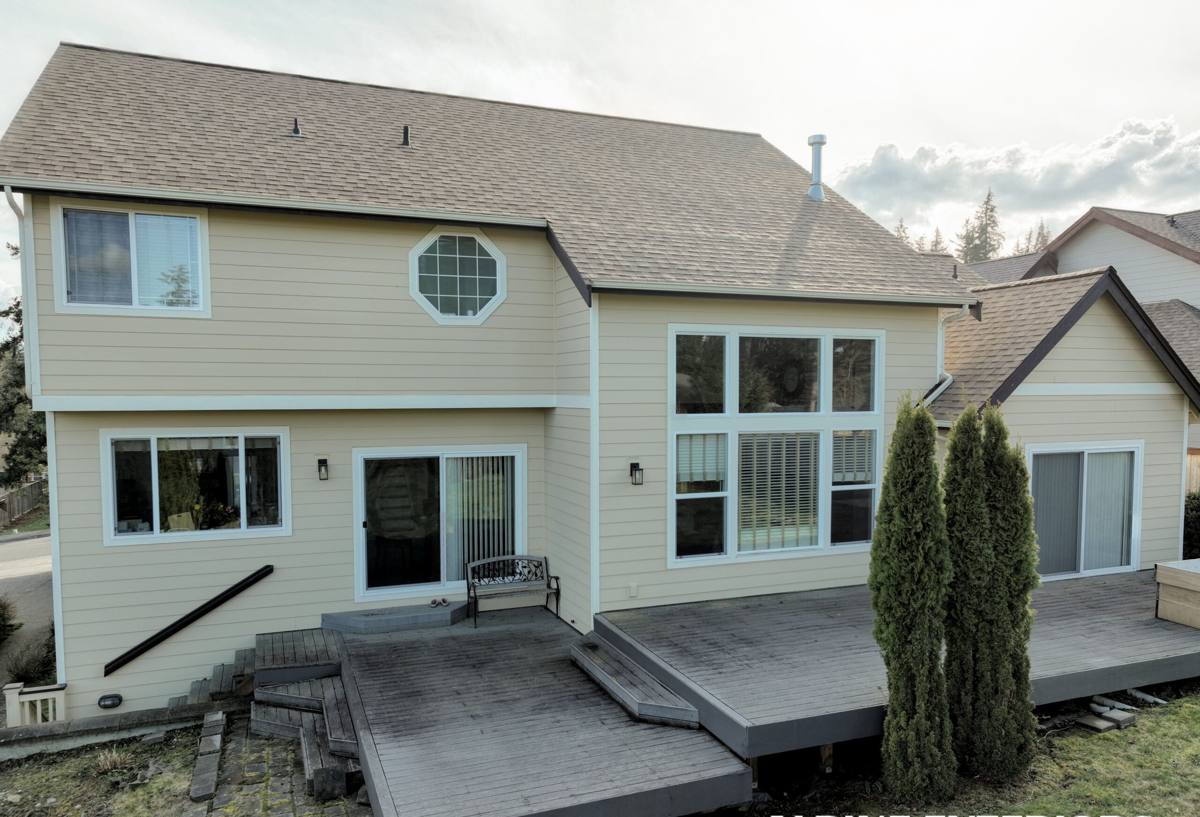
What Ferndale's Climate Actually Does to a Deck
Salt Air and Metal Fatigue
Even a few miles inland from Bellingham Bay, airborne salt reaches exposed structures. It doesn't take standing water to cause corrosion — a persistent damp, salt-laced breeze is enough to attack unprotected fasteners, brackets, and hardware over time. Once corrosion starts at a joist hanger or ledger bolt, it's not a cosmetic problem; it's a structural one, because the connection is exactly where the deck's load-bearing capacity depends on the metal doing its job.
Driving Rain and Water Intrusion
Whatcom County rain rarely falls straight down. Wind-driven rain gets pushed sideways into ledger connections, under railing posts, and into any gap where flashing was skipped or done poorly. A deck ledger board that isn't properly flashed against the house is one of the most common failure points we see in rebuilds — water gets behind the board, the house's rim joist starts to rot, and the problem is invisible until someone notices soft framing or staining on an interior wall.
Moss, Algae, and Surface Wear
Long wet seasons with limited direct sun mean moss and algae take hold fast on any horizontal wood or composite surface that doesn't drain and dry quickly. Beyond looking bad, a mossy deck surface is a slip hazard, and moss root structures can hold moisture against the board long after the rain stops, accelerating wood decay underneath the growth.
What a Correctly Built Deck Requires Here
Framing and structure matter more than the visible decking material, though most homeowners understandably focus on the surface first. Here's what we consider non-negotiable for a Ferndale build:
- Stainless steel or hot-dip galvanized (G185 or better) fasteners and structural hardware — not the standard galvanized coating that's adequate in drier climates but corrodes faster here
- Proper ledger flashing with a drip cap and self-adhering membrane behind it, not just caulk sealing the gap
- Joist tape or a comparable protective barrier over the top of every joist to stop water from wicking into end grain
- Post bases that hold the post above the deck surface, keeping end grain off standing water
- Adequate slope in the decking layout (roughly 1/8" to 1/4" per foot away from the house) so water sheds instead of pooling
- Gapping between boards sized for the specific material, since composite and wood swell and contract differently
- Footings set to local frost and soil requirements, with concrete cured properly before load is applied
Skipping any one of these doesn't necessarily cause an immediate problem — it causes a problem in year three or four, which is worse, because by then the damage is inside the structure.
Choosing Materials: Wood vs. Composite in Whatcom County
Both wood and composite decking can perform well here if they're matched to the site and maintained appropriately. Neither is automatically "the right answer" — it depends on how much upkeep you want to do and what look you're after.
| Factor | Pressure-Treated / Cedar | Composite / PVC |
|---|---|---|
| Moss resistance | Requires regular cleaning and periodic sealing to resist growth | More moss-resistant surface, but still needs cleaning in shaded, damp spots |
| Upfront cost | Lower material cost | Higher material cost |
| Long-term maintenance | Annual or biennial cleaning, sealing/staining | Occasional washing; no sealing or staining needed |
| Appearance over time | Natural wood grain, but grays and can splinter if not maintained | Consistent color, resists graying and splintering |
| Repair approach | Individual boards easy to replace | Board replacement possible but color-matching aged material can be harder |
Where a lot of homeowners run into trouble is assuming composite decking eliminates maintenance entirely. It reduces certain kinds of upkeep — no staining, less splintering — but it doesn't eliminate the need for cleaning in shaded or low-airflow areas where moss and algae still find a foothold. We'll walk through the honest trade-offs for your specific site — sun exposure, tree cover, budget — rather than push one product as universally superior.
Structure First: Framing, Footings, and Fasteners
A deck's substructure is the part nobody sees and the part that determines whether the deck is still safe in ten years. In this climate, we treat the framing package as seriously as the surface material:
Footings are sized and set according to local soil conditions and frost depth requirements, not a generic minimum. Whatcom County's mix of clay-heavy and sandy soils in different spots means what worked on the last job isn't automatically right for yours — we check the site, not assume.
Ledger attachment to the house is one of the highest-stakes connections on the whole structure. It has to be bolted (not just nailed), flashed correctly, and sized for the actual load the deck will carry. This is also where we most often find problems on rebuild jobs — a ledger that was undersized, poorly fastened, or never flashed at all.
Hardware corrosion resistance gets specified for the coastal-adjacent, high-humidity conditions here rather than a generic inland spec. It costs a little more upfront and saves a full rebuild later.
Our Process for Ferndale Deck Projects
- On-site assessment. We look at drainage patterns, sun/shade exposure, existing structure (for rebuilds), soil conditions, and how the deck will actually be used before recommending anything.
- Design and material selection. We walk through layout, decking material, railing style, and any code considerations specific to your lot, with honest cost and maintenance trade-offs for each option.
- Permitting. Deck projects above certain heights or attached to the home typically require a permit through the county or city depending on your exact location. We handle that process rather than leaving it to you.
- Construction. Footings, framing, ledger flashing, decking, and railing installed in sequence, with each stage inspected before moving to the next — especially anything that gets covered up later, like flashing and joist protection.
- Final walkthrough. We go over the finished deck together, including basic care guidance specific to the material you chose.
Maintenance Realities for This Climate
Every deck in Whatcom County, regardless of material, benefits from a seasonal check. It's a short list, but skipping it is how small issues become expensive ones:
- Clear debris and standing water from the deck surface and between boards, especially heading into fall
- Inspect and clean gutters and downspouts near the deck so runoff isn't dumping directly onto or under it
- Check railing posts and stairs for looseness once a year — freeze-thaw cycles and moisture can work fasteners loose over time
- Wash off moss and algae buildup before it has a chance to hold moisture against the surface long-term
- Re-seal or re-stain wood decking on the schedule appropriate for the product (typically every 1-2 years, more often in heavily shaded areas)
Why a Ferndale-Familiar Crew Matters
Deck building isn't exotic work, but building it correctly for this specific climate takes local judgment that a crew unfamiliar with the area doesn't automatically have. Knowing which hardware grade actually holds up here, where moss tends to collect on a given lot orientation, and how the county's permitting and inspection process works for deck projects all come from having done this work in Ferndale and the surrounding communities repeatedly — not from a general contracting background applied to a new region. A crew that's used to building in a drier or more sheltered climate can build a technically sound deck that still underperforms here simply because the details that matter locally weren't part of their normal routine.
We also stand behind the work with a clear warranty on our craftsmanship, separate from whatever warranty the material manufacturer provides — so you know who to call if something needs attention down the road.
Ready to Talk Through Your Deck Project?
Whether you're planning a new deck from scratch or need to replace one that's showing its age, we're happy to walk your property, talk through material options honestly, and give you a straightforward estimate — no pressure, no pushy upsell. Use the form below to get started.