 Bellingham Siding
 Windows in Silver Beach Face a Different Set of Problems Than Windows Inland
Silver Beach sits close enough to the water that homes here take a steady beating from moisture-laden air, wind-driven rain, and long stretches of gray, damp weather that can run for months at a time. That combination doesn't just make old windows drafty — it actively works on the materials they're built from. Wood sashes swell and stick. Aluminum frames sweat and corrode at the corners. Weatherstripping that would last a decade in a drier climate breaks down in half that time here. If you've noticed fogging between panes, a window that won't latch flush anymore, or a cold draft that seems to come from nowhere near the frame, that's not bad luck — it's normal wear for this location, and it's usually a sign the window has already lost most of its efficiency.
We've replaced enough windows in this part of Bellingham to know the failure points are predictable. The question isn't whether salt air, rain, and moss-season humidity will find the weak spot in a window system — it's whether that system was built and installed to handle it in the first place.
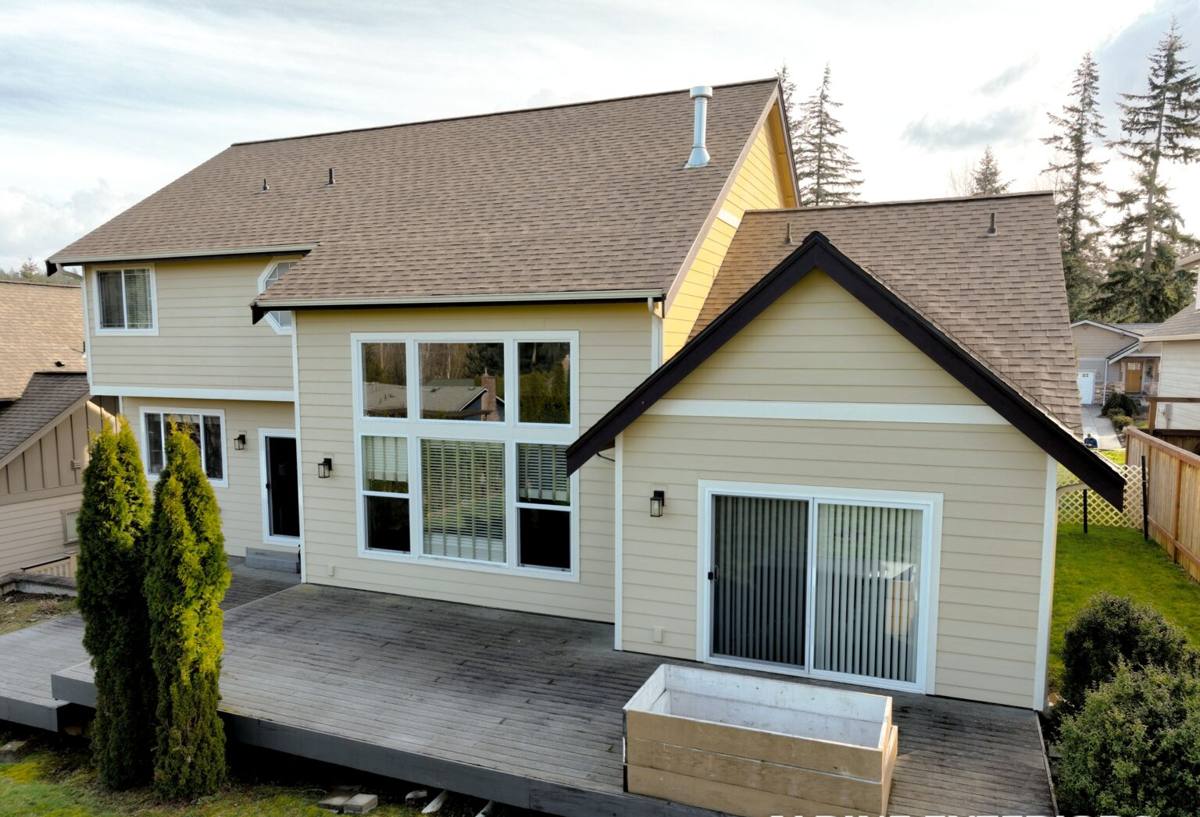
What Silver Beach Homes Actually Need From a Window
Frame Material Matters More Here Than the Spec Sheet Suggests
Every window brand publishes energy ratings, but those numbers are tested under lab conditions, not against a Whatcom County winter. What matters more day to day is how the frame material holds up to repeated wetting and drying cycles over years. Vinyl and fiberglass frames don't rust or rot, and they don't need repainting, which makes them a practical default for most homes in this area. Wood-clad and aluminum options have their place, but they carry maintenance obligations — sealing, painting, corrosion checks — that are easy to underestimate when you're comparing sticker prices instead of ten-year outcomes.
Glass Package: Don't Just Buy "Double Pane"
Double-pane glass is the baseline, not the whole answer. What actually cuts heat loss and condensation risk in a marine climate is the combination of low-E coatings, the gas fill between panes (argon is standard, and worth insisting on), and a warm-edge spacer instead of a bare aluminum one. That last detail is easy to skip and easy to sell around, but it's often the first place condensation shows up on a "good" window that was built to a price point.
Signs Your Silver Beach Home Needs Window Attention Now
- Visible fog or moisture trapped between the panes of a double-pane window — the seal has failed and the gas fill is gone
- Condensation forming on the inside of the glass regularly, especially in bathrooms, bedrooms, or north-facing rooms
- A noticeable draft when standing near a closed window on a windy day
- Wood sills or frames that feel soft, spongy, or show dark staining at the corners
- Difficulty opening, closing, or locking a window that used to operate smoothly
- A visible gap between the window frame and the siding or trim around it
- Rooms near the water side of the house that are noticeably harder to heat in winter
Any one of these on its own might just mean a tune-up. Several at once, especially on the weather-facing side of the house, usually means the window itself is done.
What a Correct Installation Involves
The window unit is maybe half the job. The other half — the part that actually determines whether it performs for the next twenty years — is how it's installed into the wall. This is where a lot of window problems in wet climates actually start, regardless of how good the window itself is.
Flashing and Weatherproofing Come First
Before a new window ever goes into the opening, the rough opening needs to be properly flashed so that any water that gets behind the siding is directed back out, not into the wall cavity. In a climate with as much driving rain as this one sees, skipping or shortcutting this step is the single most common reason a "new" window ends up with rot or mold complaints a few years later. We treat flashing and sill pan details as non-negotiable, not an upsell.
Fit and Sealing
The window has to be shimmed square and plumb, insulated around the frame without over-packing (which can bow the frame and cause it to bind), and sealed on the exterior with a compatible sealant rated for sustained wet exposure. Interior and exterior sealing are both part of the job — one without the other leaves an opening for moisture to get trapped inside the wall where you can't see it.
Trim and Moss-Season Durability
Exterior trim and caulking joints take the brunt of the long wet season here. We detail these so water sheds away from seams instead of sitting in them, which matters more in a climate with an extended moss and algae season than it would somewhere drier.
How Our Process Works for Silver Beach Jobs
- On-site assessment. We look at each window individually — frame condition, sill condition, how the wall is flashed currently, and what's driving the specific problem (age, failed seal, poor original installation, or all three).
- Straightforward recommendation. We'll tell you which windows genuinely need replacing now, which can wait, and which just need a repair — resealing, hardware, or weatherstripping — instead of a full replacement.
- Product selection based on exposure. A window on the water-facing side of the house doesn't need the same spec as one on a sheltered wall. We size the glass package and frame choice to where the window actually sits.
- Proper flashing and installation. Every opening gets flashed and sealed to shed water outward, not just caulked around the edges.
- Final check. We test operation, check the seal, and walk the exterior trim before calling the job finished.
Comparing Frame Options for This Climate
| Frame Material | How It Handles Salt Air & Moisture | Maintenance | Typical Fit |
|---|---|---|---|
| Vinyl | Doesn't rust or rot; stable in wet cycles | Low — occasional cleaning | Most Silver Beach homes, especially budget-conscious full replacements |
| Fiberglass | Excellent — very stable dimensionally in temperature and moisture swings | Low | Homes wanting a longer-term investment or larger window sizes |
| Aluminum | Prone to corrosion and condensation without a thermal break | Moderate to high | Only where a thin sightline is required and the exposure is limited |
| Wood / wood-clad | Handles moisture poorly unless maintained closely | High — regular sealing and inspection | Homes prioritizing a specific interior look, with maintenance budget planned in |
What Drives the Cost of a Window Project Here
Every Silver Beach home is a little different, so we won't quote a number without seeing the job, but the main cost factors are consistent:
- Number of windows and their sizes — larger units and custom shapes cost more than standard sizes
- Frame material chosen (vinyl generally costs less than fiberglass, which costs less than most wood options)
- Condition of the existing opening — if there's rot or damaged sheathing behind the old window, that repair adds to the scope
- Full-frame replacement versus insert replacement (insert reuses the existing frame where it's still sound, and typically costs less, but isn't right for every window)
- Access and site conditions, including second-story or hard-to-reach windows
Broadly, homeowners in this area should expect a wide range depending on these factors — anywhere from a modest per-window cost for a straightforward insert replacement up to a considerably higher figure for full-frame replacement with repair work included. The only way to get a real number is a look at the actual windows and openings.
Why Local Installation Experience Matters
Window installation isn't identical everywhere. A crew that mostly works drier inland regions can install a window competently and still miss the details that matter specifically here — the flashing sequence that accounts for wind-driven rain, the sealant products that hold up through a long wet season without breaking down, the trim details that keep moss and algae from taking hold in joints. We work in Bellingham and the surrounding Whatcom County area regularly, including Silver Beach, and we build every installation around the assumption that the window will face sustained moisture exposure, not occasional rain.
That local pattern recognition is also what makes the assessment honest. We're not guessing which windows are actually failing versus which just look tired — we've seen enough of both in this specific climate to tell the difference.
Get a Straight Answer About Your Windows
If you're dealing with drafts, fogged glass, or windows that just don't feel right anymore, it's worth getting an honest, no-pressure look before deciding what to do. We'll walk through your home's windows, explain what we're seeing, and give you a clear recommendation — replacement where it's needed, repair where it isn't. Use the form below to request a free estimate for your Silver Beach home.