 Bellingham Siding
 Composite Decking Built for South Hill's Climate
South Hill sits up above downtown Bellingham on sloped, tree-lined streets with a mix of older homes and newer builds, many with decks that catch shade for a good part of the day. That combination — elevation, mature tree canopy, and proximity to Bellingham Bay — means decks up here deal with a specific set of problems: driving rain that comes in sideways off the water, salt-tinged air that speeds up corrosion on fasteners and hardware, and a moss season that can run from October well into May. A deck that looks fine in July can be growing a green film by December if it wasn't built with that cycle in mind.
Composite decking has become the default choice for a lot of South Hill homeowners for good reason — but "composite" covers a wide range of products and installation quality, and the difference between a deck that holds up for twenty-five years and one that cups, stains, or loosens within five usually comes down to what's underneath the boards, not the boards themselves.
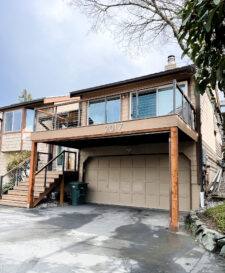
Why Wood Struggles Here — And Where Composite Helps
Whatcom County's wet season isn't just rain volume, it's duration. Wood decking that spends months at a time damp, especially under tree cover that blocks sun and airflow, is where rot, splintering, and moss growth start. Even pressure-treated lumber needs regular sealing to keep up, and most homeowners don't get to it every year like they mean to.
Composite decking, properly installed, holds up better against that cycle because it doesn't absorb water the way wood fibers do and it doesn't need annual staining or sealing. That said, composite isn't maintenance-free — it's maintenance-different. Moss and algae will still grow on any horizontal surface that stays shaded and damp, composite included. The advantage is that composite doesn't rot, split, or need refinishing while you deal with that growth.
What Composite Doesn't Fix by Itself
A composite deck built on a poorly ventilated or under-engineered substructure will still trap moisture underneath, which can lead to problems with the framing even if the boards on top look fine. The material choice only solves part of the equation — the build underneath matters just as much, maybe more.
What a Correct Composite Deck Installation Involves
This is where a lot of decks — composite or otherwise — go wrong, and it's rarely something a homeowner can see once the boards are down. A correct install in a climate like ours means paying attention to details that don't show up in a sales brochure.
Ledger Attachment and Flashing
Most deck failures we see start at the ledger board, where the deck attaches to the house. If that connection isn't properly flashed to shed water away from the wall framing, moisture works its way behind the siding over time. In a region that gets this much sustained rain, ledger flashing isn't optional — it's the single most important detail in the whole project.
Joist Spacing and Substructure
Composite boards flex differently than wood and most manufacturers require tighter joist spacing than a traditional wood deck — commonly 12 inches on center for diagonal or picture-frame board patterns, sometimes 16 inches for standard straight runs. Building to wood-deck spacing standards with composite boards is a common shortcut that leads to bounce, sag, and premature wear at the fastener points.
Ventilation Underneath
Decks built low to the ground or over enclosed foundations need enough airflow underneath to let moisture escape. On sloped South Hill lots this sometimes means adding vents or gaps into skirting rather than closing the underside off completely, which traps damp air against the framing.
Fasteners and Hardware
Given the salt content in coastal air here, we use stainless steel or coated fasteners rated for exposed, moisture-heavy environments rather than standard hardware that can streak or corrode within a few seasons.
Composite Board Types: What's Actually Different
"Composite decking" isn't one product — it's a category, and the differences affect how the deck performs in our climate specifically.
| Board Type | Moisture Behavior | Best Suited For |
|---|---|---|
| Capped composite | Outer polymer shell resists staining and moisture absorption at the core | Most South Hill decks — good balance of durability and cost |
| Uncapped composite | More prone to moisture absorption and surface fading over time | Budget-conscious projects with lower moisture exposure |
| PVC (cellular) | Fully synthetic, no wood fiber to absorb water | Heavily shaded, damp, or ground-level decks where moisture exposure is constant |
For decks under heavy tree cover — common on a lot of South Hill lots — we often steer homeowners toward capped composite or PVC over uncapped boards, simply because the moisture exposure up here is more constant than in drier parts of the state.
Cost Factors Homeowners Should Understand
Composite decking costs more upfront than pressure-treated wood, but the comparison isn't apples to apples once you factor in what wood requires to keep looking decent. Rather than quote a flat number that won't hold up project to project, here's what actually moves the price:
| Factor | Why It Matters |
|---|---|
| Board tier (capped vs. PVC vs. uncapped) | Material cost per square foot varies significantly across tiers |
| Substructure condition | Reframing or reinforcing an existing structure adds labor and material |
| Site slope and access | Sloped South Hill lots often need additional footings, taller posts, or stair runs |
| Railing system | Composite, cable, and metal railings all price differently and affect the overall look |
| Ledger and flashing work | Older homes may need siding removal and repair to flash the ledger correctly |
We'd rather walk a property and give an honest number than throw out a range that doesn't reflect what your specific deck actually needs.
Site-Specific Challenges We Watch For in South Hill
Every neighborhood has its own quirks, and South Hill has a few that show up repeatedly.
- Sloped lots: Many South Hill properties sit on grade changes that require taller posts, additional footings, or stepped framing to keep the deck level and structurally sound.
- Tree canopy shading: Mature trees common to the area keep certain deck sections shaded most of the day, which slows drying time and accelerates moss growth on any surface.
- Older home connections: Homes built decades ago often have ledger attachments that don't meet current flashing standards, which we address during tear-off rather than building over.
- Drainage patterns: Runoff on sloped lots needs to be directed away from the house and the deck's footings, not just off the deck surface.
Our Process, Start to Finish
- On-site assessment: We look at the existing structure (if there is one), the ledger connection, grade, drainage, and sun exposure before recommending materials.
- Honest material recommendation: Based on shade, moisture exposure, and budget, we'll tell you which composite tier actually makes sense for that specific deck — not just the one with the best margin.
- Permitting: Most new decks and deck rebuilds in Whatcom County and the City of Bellingham require a permit, particularly for structural work, guardrails, and stairs. We handle that process rather than leaving it on you.
- Demo and structural work: Removal of the old deck (if applicable), ledger flashing correction, footings, and framing built to composite manufacturer spacing requirements.
- Decking and railing installation: Hidden fastener systems where the board allows, proper end-gapping for thermal movement, and railing installed to code height and load requirements.
- Final walkthrough: We go over the finished deck with you, including what routine care it actually needs going forward.
Maintenance Reality for a Wet, Mossy Climate
Composite decking cuts down on maintenance significantly compared to wood, but "low maintenance" isn't "no maintenance" once you're dealing with a Pacific Northwest wet season. A simple seasonal routine keeps a composite deck looking and performing the way it should.
- Sweep debris and fallen leaves regularly during fall — trapped organic matter holds moisture against the board surface and is the main driver of moss and algae growth.
- Wash the deck surface a couple times a year with a soft-bristle brush and a composite-safe cleaner, rather than a wood cleaner or bleach solution that can affect the cap finish.
- Keep gutters and downspouts near the deck clear so runoff isn't draining directly onto the deck surface or framing below.
- Check railing connections and stair fasteners annually for looseness, especially after the first winter, when materials settle.
- Avoid pressure washing on high settings directly into board seams, which can force water into the substructure rather than clean the surface.
Permits, Codes, and Structural Requirements
Deck work in Bellingham and unincorporated Whatcom County isn't just a matter of picking materials — most projects involving a new structure, guardrails over 30 inches, or attachment to the home require a permit and inspection. Guardrail height, baluster spacing, stair rise and run, and footing depth all have code requirements that vary depending on deck height and soil conditions on sloped lots. Skipping this step, or hiring a crew that skips it, can leave you with a deck that's difficult to sell against during a home inspection later, or worse, one that isn't actually safe.
Why Hire a Crew That Already Works South Hill
A composite deck built to a generic spec sheet doesn't account for what an elevated, tree-covered, rain-heavy site in Whatcom County actually puts it through. Crews who work this neighborhood regularly already know which lots need extra drainage attention, which older homes need ledger work addressed before a single board goes down, and which shaded corners are going to need a different board tier than the sunny side of the same deck. That local pattern recognition is the difference between a deck that needs attention in year three and one that's still solid at year twenty.
If you're considering a composite deck for your South Hill home, we're happy to walk the site, look at what you're working with, and give you a straight assessment — no pressure, no upsell, just what the job actually needs. Reach out using the form below for a free estimate.