 Bellingham Siding
 Why Sunnyland Roofs Wear Out Differently Than Roofs Inland
Sunnyland sits close enough to Bellingham Bay that salt-laden air is a real factor in how roofing materials age here, not just a talking point. Combine that with Whatcom County's driving rain — wind-driven storms that push water sideways and up under shingle edges rather than just straight down — and a moss season that can run eight or nine months out of the year, and you get a roof that's working harder than one in a drier, calmer climate. Metal fasteners corrode faster near the water. Granule loss on asphalt shingles accelerates when moss and algae hold moisture against the surface for weeks at a time. And roofs with even minor ventilation problems tend to show it here first, because there's rarely a long dry stretch to let trapped moisture fully evaporate.
None of this means Sunnyland homes need exotic materials or constant babying. It means the replacement has to be done with this specific climate in mind — correct underlayment, correct ventilation, correct flashing details — rather than treated as a generic tear-off-and-recover job.
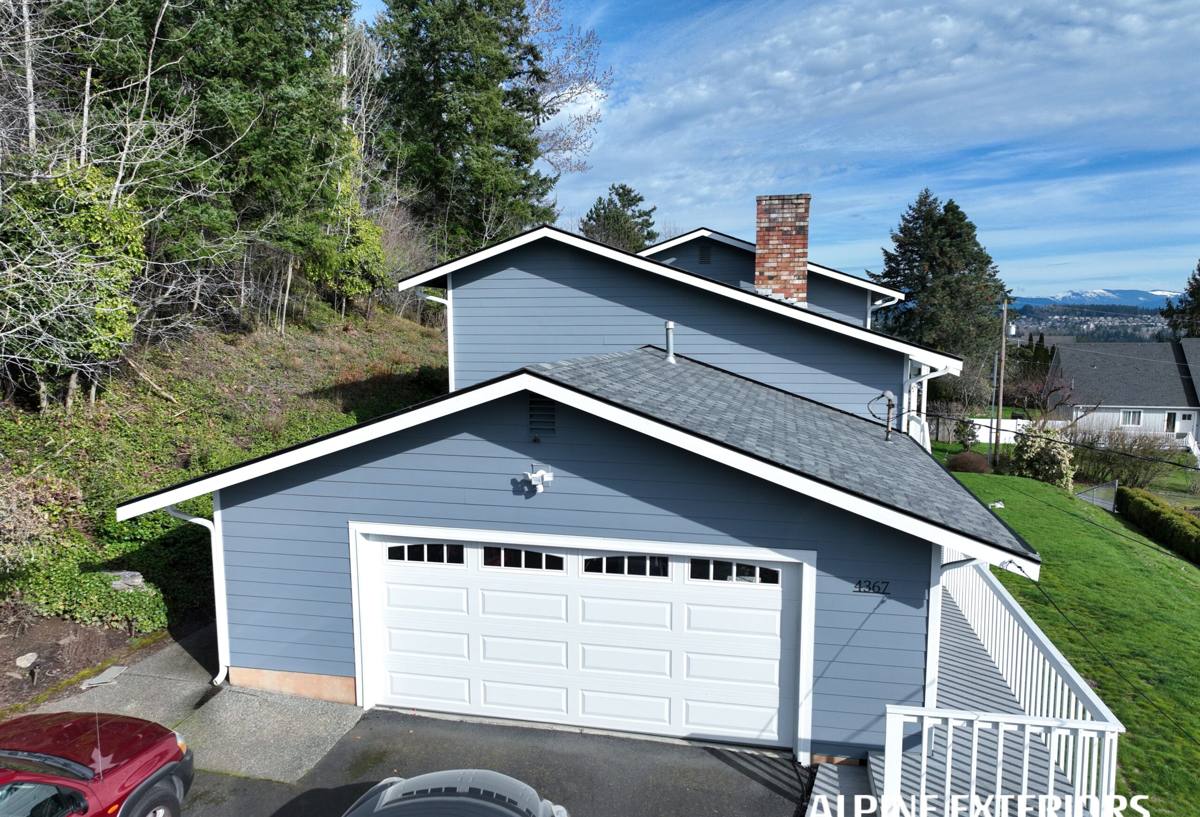
Signs a Sunnyland Roof Needs Replacing, Not Just Repairing
A patch can buy time, but it's not always the right call. Here's how we think about the line between repair and replacement on homes in this neighborhood:
- Granule loss is widespread across multiple slopes, not just one damaged section
- Moss has been growing under the shingle tabs for more than a season, lifting them and breaking the seal
- There's daylight or water staining visible in the attic along the roof deck
- The roof is past 20-25 years old (typical asphalt shingle lifespan) and showing curling or cracking
- Multiple layers of shingles are already present, so a proper repair or re-cover isn't an option
- Flashing around chimneys, vents, or valleys is rusted, separated, or was never installed correctly
If it's one or two of these on a roof that's otherwise sound, a repair is often the honest answer. If it's several at once, especially on a roof already near the end of its expected life, replacement is usually the more cost-effective path — repeated patching on an aging roof in this climate tends to cost more over a few years than doing the job right once.
What a Correct Roof Replacement Actually Involves
A roof replacement is more than swapping old shingles for new ones. In a climate with this much driving rain and moss pressure, the layers underneath the shingles matter as much as the shingles themselves.
Tear-off and deck inspection
We remove the existing roofing down to the deck rather than laying new material over old. This lets us see the actual condition of the plywood or OSB sheathing underneath — soft spots, delamination, or water staining that a re-cover would hide and eventually make worse. Any damaged decking gets replaced before anything new goes down; skipping this step is one of the most common ways a roof fails early.
Underlayment built for driving rain
Standard felt paper works fine in calmer, drier climates, but in a neighborhood exposed to wind-driven rain off the bay, we lean toward synthetic underlayment and ice-and-water shield in the vulnerable spots — eaves, valleys, and around penetrations — where wind can push water backward under standard shingle overlaps.
Ventilation that actually balances
Intake at the eaves and exhaust at the ridge need to work together, not just exist independently. Poor balance traps moist air in the attic, which condenses on the underside of the deck and accelerates rot from the inside — a problem that shows up years later as soft decking, often before it's visible from the ground.
Flashing and moss-resistant details
Flashing around chimneys, skylights, and roof-to-wall transitions is where most leaks actually start, not in the open field of shingles. We also look at where moss tends to establish — north-facing slopes, areas under tree cover — and factor that into material choice and any preventive measures like zinc or copper strips at the ridge, which discourage moss growth as rainwater washes trace metal down the roof face.
Material Options for Whatcom County Homes
There's no single "best" roofing material — the right choice depends on budget, how long you plan to stay in the home, and how much long-term maintenance you want to take on. Here's an honest comparison for this climate:
| Material | Typical Lifespan | Moss/Moisture Behavior | Considerations Here |
|---|---|---|---|
| 3-Tab Asphalt Shingle | 15-20 years | Moderate moss risk; granules shed faster in wet, shaded areas | Lowest upfront cost; shorter warranty structure |
| Architectural (Laminate) Shingle | 25-30 years | Better shedding profile; still needs periodic moss treatment | Best balance of cost and durability for most homes in this area |
| Standing Seam Metal | 40-50+ years | Sheds water and moss debris very well due to slick, sloped panels | Higher upfront cost; some homeowners prefer the look, others don't |
| Cedar Shake | 20-30 years with upkeep | High moisture sensitivity; needs regular maintenance in this climate | We're honest that upkeep demands are significant near the bay |
For most Sunnyland homes, we steer people toward architectural shingles or metal, depending on budget. Cedar shake can look great, but the ongoing maintenance burden — moisture absorption, splitting, moss control — is a real cost that's easy to underestimate when you're only looking at the upfront price.
Our Roof Replacement Process, Step by Step
- On-site assessment: We inspect the current roof, attic ventilation, and decking condition, and take measurements for an accurate quote — not a rough guess.
- Material and scope discussion: We walk through options honestly, including trade-offs, so you're choosing based on facts, not a sales pitch.
- Permitting: Roof replacements in Bellingham typically require a permit; we handle that paperwork so you don't have to track it down yourself.
- Tear-off and deck repair: Full removal of old material, disposal, and replacement of any compromised decking.
- Underlayment, flashing, and ventilation install: The layers that actually determine how the roof performs in wind and rain.
- New roofing installation: Installed to manufacturer spec, which matters for warranty coverage down the line.
- Cleanup and final walkthrough: Site cleared of debris and nails (we run a magnetic sweep), with a walkthrough so you can see the finished work.
Living With Your New Roof: Moss and Salt Air Maintenance
A correct installation dramatically reduces future problems, but no roof in this climate is fully maintenance-free. A little upkeep protects the investment:
- Have gutters cleared at least twice a year — clogged gutters back water up under the roof edge
- Trim back overhanging branches to reduce shade and debris buildup, which slows drying and encourages moss
- Schedule a moss treatment or soft wash every 1-2 years rather than waiting until growth is heavy
- Walk the attic once a year (or have it checked during another service call) to look for early moisture signs
- Address small flashing issues right away — they're inexpensive to fix early and expensive to ignore
Cost Factors for Roof Replacement in Sunnyland
Every roof is different, so we don't quote pricing without seeing the job, but these are the factors that move the number most:
| Factor | Why It Matters |
|---|---|
| Roof size and number of slopes | More square footage and complexity (valleys, dormers, hips) means more labor and material |
| Current layers and deck condition | Extra tear-off or deck repair adds cost that's hard to know until we're on the roof |
| Material choice | Architectural shingle, metal, and cedar carry very different material and labor costs |
| Steepness and access | Steep or hard-to-access roofs require more safety equipment and time |
| Ventilation and flashing upgrades | Bringing older ventilation up to a proper standard is worth the added cost |
Broadly speaking, a full asphalt shingle replacement on an average-sized single-family home in this area tends to fall somewhere in the low-to-mid five figures, with metal roofing running higher. The only way to get a number you can actually plan around is a site visit — square footage alone doesn't tell the whole story.
Why Hiring a Crew That Already Works Sunnyland Matters
Roofing crews that work Bellingham and Whatcom County regularly already understand things that take an outside contractor time to figure out: how wind off the bay behaves against certain roof orientations, which neighborhoods hold onto moss longest because of tree cover and shade patterns, and how the local permitting process actually works. That familiarity shows up in fewer surprises during the job and a roof that's built for the conditions it will actually face, not a generic installation dropped into a coastal Pacific Northwest climate it wasn't really designed for.
It also matters for warranty follow-through. A crew that plans to keep working in the area has every reason to stand behind the installation years down the road — reputation in a community like this one is built over repeat work and referrals, not a single job.
Timing a Roof Replacement Around Bellingham Weather
Roofing can technically be done much of the year here, but drier stretches make for a smoother job and better material performance during installation — adhesive seals on shingles need some dry, warmer weather to bond properly. Late spring through early fall is typically the most favorable window in Whatcom County, though we do work outside that window when conditions allow and the job calls for it. If your roof is showing serious wear, it's worth getting it assessed rather than waiting for a "perfect" season, especially heading into the wetter months when a compromised roof is more likely to develop interior leaks.
If you're noticing moss buildup, granule loss, or an aging roof on your Sunnyland home, we're happy to take a look and give you a straightforward, no-pressure estimate — just fill out the form below.