 Bellingham Siding
 Metal Roofing in Barkley: Built for Bellingham's Climate
Barkley sits close enough to the water and the tree line that its roofs take a specific kind of beating. Salt-laden air off Bellingham Bay works on exposed fasteners and unprotected metal edges year-round. Driving rain, often pushed sideways by wind off the Sound, finds every weak seam and undersized flashing detail. And the long, damp moss season here — stretching from fall through spring in a normal Whatcom County year — turns any roof with poor airflow or shaded exposure into a moss farm within a couple of seasons. Metal roofing, installed correctly for this specific environment, handles all three of those pressures better than most other roofing materials. Installed incorrectly, it can fail in ways that are expensive to fix and hard to spot until water's already inside the structure.
This page is about what a metal roof needs to actually perform in Barkley — not a generic rundown of metal roofing everywhere. The details that matter here are coastal-specific, and they're the details we build our process around.
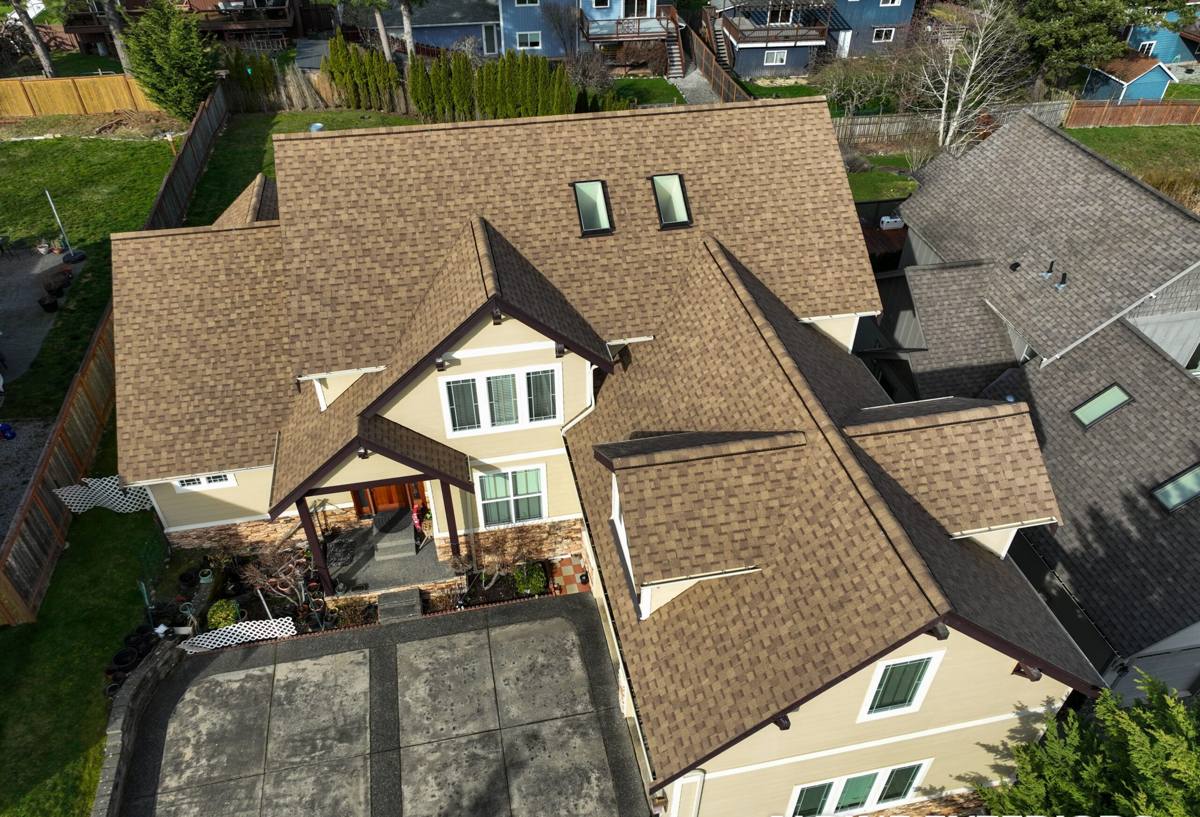
What Barkley's Climate Actually Does to a Roof
Salt Air and Corrosion
Even a few miles inland from the bay, salt air travels. Over years, it accelerates corrosion at cut edges, exposed screw heads, and any spot where the protective coating on a metal panel has been scratched, drilled through, or left unsealed during installation. This is why fastener choice and edge treatment matter more here than they would in a dry inland climate — a roof spec'd for the wrong environment will show rust streaks at fastener lines well before its expected lifespan is up.
Driving Rain and Wind-Driven Water
Bellingham doesn't just get rain — it gets rain pushed horizontally by wind coming off the water. That means water finds its way under laps, around penetrations, and into valleys that would stay dry in a calmer climate. A metal roof's water-shedding performance depends almost entirely on lap direction, fastener pattern, and underlayment quality at these vulnerable points. Skimping on any of them is where most "mystery leaks" in this area actually start.
Moss and Moisture Retention
Moss doesn't grow well on bare, sloped metal the way it does on shingles or shaded, low-slope sections — but it does take hold in valleys, at low-pitch transitions, and anywhere debris collects and holds moisture against the surface. Left unaddressed, trapped moisture accelerates coating breakdown and can work its way toward fasteners and seams over time.
What a Correct Metal Roof Job Involves
A metal roof is only as good as the details underneath and around it. In our experience working coastal Whatcom County homes, the jobs that hold up long-term all share the same non-negotiables:
- Full tear-off and deck inspection — metal should never go over a deck with hidden rot, soft spots, or old, saturated underlayment
- High-quality synthetic underlayment rated for the panel type, with ice-and-water-shield style protection at eaves, valleys, and penetrations
- Corrosion-resistant fasteners matched to the panel material — mismatched metals cause galvanic corrosion, which is a real and common failure point near saltwater
- Proper panel overlap and fastening pattern for our wind exposure, not a generic inland spec
- Closed or properly vented ridge details that keep wind-driven rain out while still allowing the attic to breathe
- Custom-formed flashing at every valley, chimney, skylight, and wall transition — not stock trim pieces forced to fit
- Attic ventilation checked and corrected if needed, since trapped moisture from below causes as much damage as water from above
Skip any one of these and the roof may look fine for a year or two before the climate finds the gap.
Choosing the Right Metal Roofing System for a Barkley Home
Not every metal roofing product performs the same way in a coastal, high-moisture climate. We steer homeowners toward systems that are proven for this environment rather than whatever is cheapest to source, because the trade-offs show up years later, not on installation day.
| Panel Type | Best For | Local Climate Trade-Offs |
|---|---|---|
| Standing seam steel | Most Barkley roof pitches and styles | Concealed fasteners reduce corrosion risk; higher upfront cost but strongest long-term performance in wind-driven rain |
| Exposed-fastener steel panels | Budget-conscious projects, outbuildings, some additions | Lower cost, but exposed fasteners require regular inspection and eventual re-torquing or resealing near salt air |
| Aluminum standing seam | Homes closest to the water | Naturally corrosion-resistant, doesn't rust; higher material cost, softer surface needs careful installation |
| Stone-coated steel | Homeowners wanting a shake or tile look | Good durability, but coating integrity at cut edges is critical in salt air — installation quality matters more than usual |
For most Barkley homes, standing seam steel with a quality baked-on coating hits the right balance of upfront cost and long-term performance. Homes with direct water exposure or a documented history of corrosion issues are often better served by aluminum, even at the higher price point — that's a conversation we have honestly during the estimate, not something we upsell blindly.
Our Process, Step by Step
1. On-Site Assessment
We walk the roof, check the deck condition from the attic side where accessible, look at ventilation, and note every valley, penetration, and transition that will need custom flashing. We also look at exposure — how much direct salt air and wind the roof actually takes given the home's position and tree cover, since that changes the spec.
2. Straight-Talk Estimate
We walk through panel options, realistic cost ranges, and what each choice means for maintenance and lifespan — no pressure toward the most expensive system if it isn't the right fit for the house.
3. Tear-Off and Deck Prep
Old roofing comes off, the deck gets inspected and repaired where needed, and any soft or water-damaged sheathing is replaced before anything new goes down. This step gets skipped by crews trying to save a day — it's the one that determines whether the new roof lasts.
4. Underlayment and Flashing
Synthetic underlayment goes down first, with reinforced protection at eaves, valleys, and every penetration. Flashing is custom-formed on site to fit the actual roof, not adapted from stock parts.
5. Panel Installation
Panels are installed with fastener spacing and lap direction set for our prevailing wind and rain patterns, using corrosion-appropriate fasteners throughout.
6. Final Walkthrough
We check every seam, penetration, and edge before calling the job done, and we walk the homeowner through what routine maintenance — if any — the system needs going forward.
Maintenance in a Moss-Prone Climate
A correctly installed metal roof needs far less maintenance than shingles, but "less" isn't "none" in Whatcom County. A short seasonal routine keeps a metal roof performing at its best:
- Clear debris from valleys and low-slope sections before the fall rains set in
- Check gutters and downspouts for moss and needle buildup that can back water up under eave flashing
- Trim back overhanging branches to reduce shade and debris drop, which slows moss and algae growth
- Do a visual check of fasteners and flashing every year or two, especially after a hard windstorm
- Address any scratched or exposed coating promptly — a small touch-up now prevents a corrosion point later
Why a Barkley-Familiar Crew Matters
A metal roofing crew that already works this area knows the wind exposure on a Barkley-area roof isn't the same as a sheltered inland lot, and specs the fastening and flashing accordingly. They know which valley and low-slope details tend to collect moss locally and detail those areas with extra care. They've seen what wind-driven rain does to a poorly lapped panel here, not just in a manual. That local pattern recognition is the difference between a roof that's technically installed and one that's actually built for where it sits — and it's the reason we treat every coastal Bellingham detail as non-negotiable, not optional.
Signs It's Time to Consider a Metal Roof
Homeowners in Barkley usually start looking into metal roofing for one of a few reasons:
- An existing shingle roof is approaching the end of its service life and showing granule loss or curling
- Recurring moss growth and moisture issues despite regular cleaning
- Interest in a longer-lasting, lower-maintenance option before the next major storm season
- Visible rust or coating failure on an older, poorly spec'd metal roof that needs to be replaced correctly
If any of that sounds familiar, it's worth a straightforward conversation about what your specific roof needs — not a generic sales pitch.
Get a Free, No-Pressure Estimate
If you're weighing a metal roof for a home in Barkley, we're happy to take a look, walk you through honest options for your specific roof and exposure, and give you a clear estimate — no pressure, no upsell. Use the form below to get started.