 Bellingham Siding
 Storm Damage Roof Repair for Ferndale Homes
Ferndale sits close enough to the water and the open flats north of Bellingham that its roofs take a different kind of beating than homes tucked into town. Wind off the Strait of Georgia and the bay picks up speed over open farmland and water before it hits a roofline, and it usually arrives together with driving rain. That combination is what causes most of the storm damage we see out here — not one dramatic event, but wind and water working on a roof at the same time, finding the one weak spot that a calm-weather inspection would have missed.
This page is specifically about storm damage roof repair for Ferndale properties — what actually counts as storm damage, how a correct repair is done, and why it matters to hire a crew that already works this area regularly rather than someone who showed up after the last windstorm and will be gone by the next one.
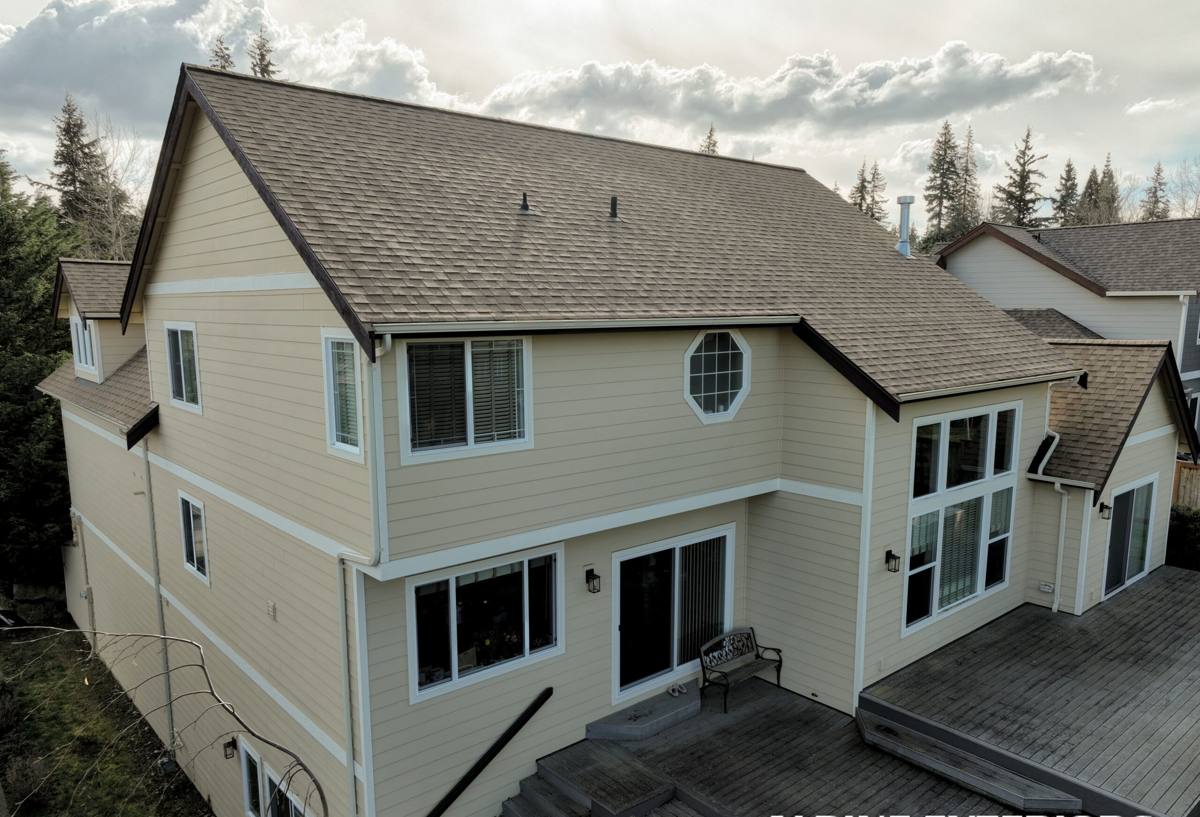
What Actually Counts as Storm Damage
Homeowners often picture storm damage as missing shingles scattered across the yard. That's part of it, but a lot of the damage that causes real problems later is much less obvious.
Wind Uplift and Lifted Edges
Sustained wind can lift shingle edges and break the seal strip underneath without tearing the shingle off completely. The roof looks intact from the ground, but the seal is broken, and the next rain gets underneath it. This is the most common type of damage we find in Ferndale after a windstorm, and it's the easiest to miss without getting up on the roof.
Wind-Driven Rain Intrusion
When rain comes in sideways instead of straight down, it can work its way under flashing, around vents, and into valleys that would shed a normal rain just fine. This is a bigger issue near Ferndale than in more sheltered parts of Bellingham, simply because there's less terrain to break up the wind before it reaches a roof.
Impact and Debris Damage
Fir and cedar trees are common throughout Whatcom County, and falling limbs — or whole trees in bad windstorms — cause punctures, cracked decking, and knocked-loose flashing. Even a glancing hit from a branch can crack a shingle or dent a vent boot in a way that isn't visible from the ground.
Granule Loss and Accelerated Wear
Hail is less common here than wind and rain, but heavy, sustained storms can still strip protective granules off asphalt shingles. A roof that loses granules doesn't leak immediately, but it ages faster and becomes more vulnerable in the next storm.
Why the Salt Air and Long Moss Season Change the Equation
Storm damage repair in Ferndale isn't just about patching what broke — it's about doing the repair in a way that holds up to what comes after. Two things make this area demanding on a roof year-round:
- Salt-laden air off the water accelerates corrosion on exposed fasteners, flashing, and metal vent caps. A repair that uses the wrong fastener or unprotected metal will start failing again well before a normal roof would.
- A long moss season, thanks to Whatcom County's damp, mild climate, means any repair that creates a spot where moisture and debris can collect becomes a moss magnet within a season or two. Moss holds water against the roof surface and works into seams that a storm has already weakened.
A repair that ignores either of these will look fine for a while and then fail again — often in the exact spot that was just fixed. That's the difference between a patch and a correct repair.
How We Handle a Storm Damage Call
Inspection and Documentation
We start with a full roof inspection, not just a look at the obvious damage. That means checking the field of the roof, all flashing points, valleys, vents, and edges — since wind and wind-driven rain rarely limit themselves to one spot. We document what we find with photos, both for your records and for any insurance claim you may file.
Temporary Protection
If there's an active leak or exposed decking, our first priority is stopping water intrusion — tarping, temporary flashing, or sealing exposed areas — before we ever talk about the permanent fix. In a region that gets rain again within days more often than not, this step isn't optional.
The Permanent Repair
Once the scope is clear, we repair to match the existing roof system correctly — proper underlayment at the repair area, correctly lapped and sealed flashing, matched shingles or roofing material, and fasteners rated for coastal exposure. We don't patch over a problem in a way that just moves it somewhere else on the roof.
Final Walkthrough
We walk the completed repair with you, explain exactly what was done and why, and point out anything else on the roof worth keeping an eye on. No pressure to buy more than the storm actually damaged.
Repair or Replace: How We Make That Call
Not every storm-damaged roof needs a full replacement, and not every roof can be responsibly patched. The right call depends on a few honest factors, not on which option is more profitable for us.
| Factor | Points Toward Repair | Points Toward Replacement |
|---|---|---|
| Roof age | Roof is well within its expected service life | Roof is already near the end of its expected life |
| Extent of damage | Damage is localized to one or two areas | Damage is spread across multiple slopes or the deck itself |
| Underlying condition | Decking and existing shingles are sound elsewhere | Widespread granule loss, soft decking, or prior moss damage found |
| Matching materials | Existing shingle line is still available and matchable | Discontinued product means visible patchwork on the roof |
| Insurance scope | Adjuster's scope supports a repair-level claim | Adjuster's scope or damage extent supports full replacement |
We'll tell you plainly which category your roof falls into, and why, rather than defaulting to whichever answer costs more.
Working with Your Insurance Claim
Most storm damage repairs in this area involve an insurance claim, and the process goes more smoothly when the documentation is solid from the start. We provide a written scope and photo documentation you can hand directly to your adjuster, and we're glad to be present for the adjuster's inspection if that's helpful. What we won't do is promise a specific claim outcome or inflate a scope to chase a bigger payout — that approach tends to backfire on the homeowner, not the contractor, when a claim gets flagged for review.
If you're not sure whether damage is significant enough to file a claim, an inspection with no obligation to file anything is a reasonable first step.
Materials and Methods Suited to Ferndale's Climate
A storm repair is only as good as the materials and technique behind it. For roofs in this area, that generally means:
- Synthetic underlayment or ice-and-water shield membrane at eaves, valleys, and repair perimeters, since felt alone doesn't hold up as well to prolonged damp exposure.
- Corrosion-resistant fasteners and flashing appropriate for coastal air, rather than standard-grade hardware that's fine further inland.
- Flashing details that shed water rather than trap it, since any low spot becomes a place for moss and debris to build up over a wet Whatcom County winter.
- Ventilation checked as part of the repair, since a roof that can't breathe holds moisture longer after any storm, which both accelerates moss growth and shortens shingle life.
None of this is upselling — it's simply what a repair needs to actually last in this climate rather than needing to be redone in a year or two.
Why a Local Bellingham Crew That Works Ferndale Matters
After a significant windstorm, it's common to see traveling crews going door to door in Whatcom County looking for storm damage work. Some of that work is fine. A lot of it isn't around to stand behind a year later when a repair starts to fail. We're based in Bellingham, we work Ferndale regularly as part of our normal service area, and we're still here — and reachable — long after the storm has passed.
Working this area consistently also means we're familiar with the roofing styles, common problem spots, and typical construction found on Ferndale homes, so an inspection isn't the first time we're learning what a roof out here tends to need.
After the Storm: What to Check Before We Arrive
If you've just been through a windstorm and are waiting on an inspection, a few careful, ground-level checks can help you describe the situation accurately when you call:
- Look for shingle pieces or granules in gutters, downspouts, or on the ground around the house.
- Check ceilings and upper closets for new water stains, especially after the next rain following the storm.
- Note any visibly bent, missing, or crooked flashing around chimneys, vents, or skylights, viewed safely from the ground.
- Watch for debris — branches or limbs — resting on the roof rather than assuming it simply rolled off.
- Avoid climbing onto the roof yourself after a storm; wet, wind-loosened shingles are not a safe place to walk.
If you see any of the above, it's worth getting an inspection before the next round of rain rather than waiting to see if a small leak gets worse.
Get a Free, No-Pressure Estimate
If your Ferndale home has taken storm damage, we're happy to come take a look, document what we find, and give you a straight answer on what it needs — repair or otherwise. There's no obligation and no pressure attached to the estimate. The form below will get you started.