 Bellingham Siding
 Roofing in Lynden Isn't the Same Job as Roofing Somewhere Dry
Lynden sits inland from Bellingham Bay in the farmland of the Nooksack Valley, but "inland" doesn't mean "sheltered." Whatcom County weather doesn't spare this side of the county. Homes here still deal with driving winter rain that comes in sideways off open fields, damp air that never fully clears through fall and spring, and long stretches of shade and moisture that let moss and algae colonies take hold on roofs that would stay clean almost anywhere else in the country. Add in the occasional salt-tinged air that rides inland off the Salish Sea during a west wind, and you've got a roofing environment that punishes shortcuts.
A roof installed for a drier climate — thin underlayment, minimal ventilation, no real flashing detail — will look fine for a year or two in Lynden and then start failing quietly: soft decking under a section of shingles, moss lifting tabs at the eaves, a slow leak that only shows up during the wettest week of January. New roof installation here has to be built for the specific way this climate attacks a roof, not just built to a generic code minimum.
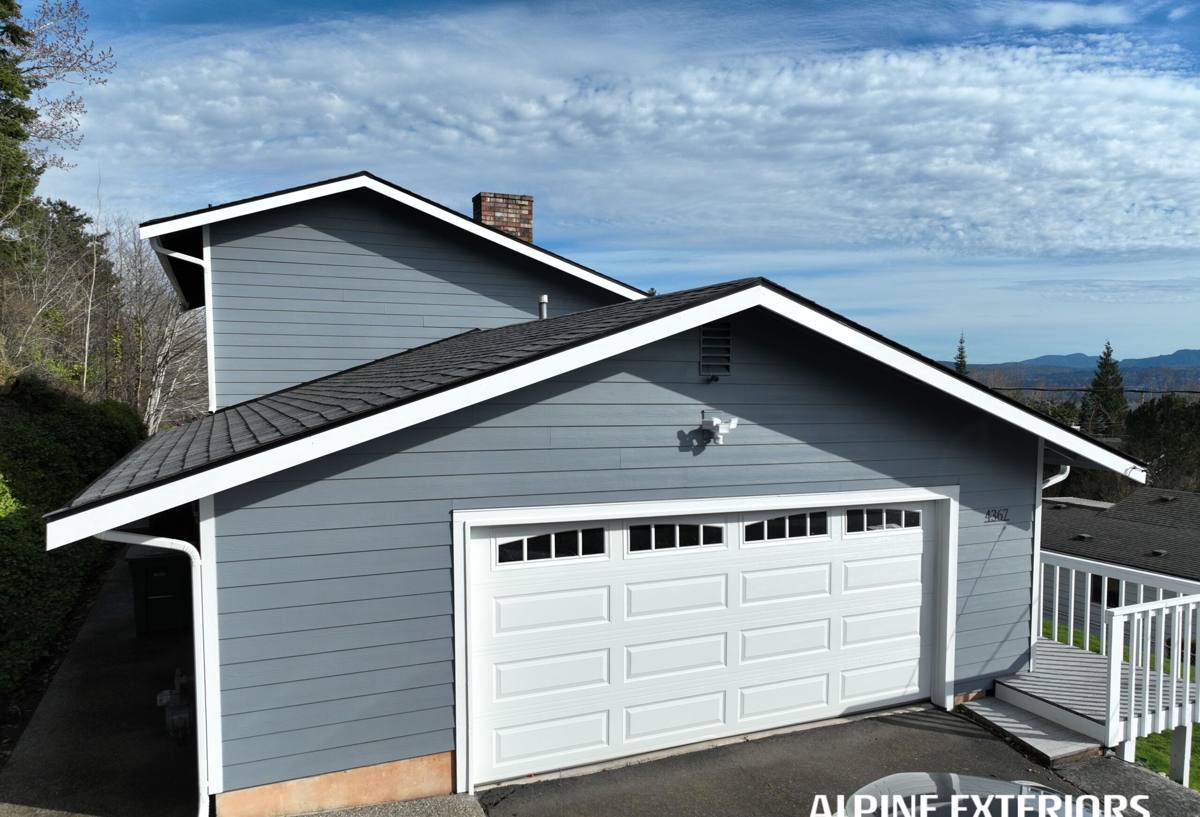
Signs a Lynden Home Needs a New Roof, Not Another Repair
Homeowners often call us for a repair and find out the roof has already aged past the point where patching makes sense. Some patterns we see regularly on Lynden homes:
- Granule loss heavy enough that you can see it collecting in gutters and downspouts every time it rains
- Shingles that are curling, cupping, or have gone brittle at the edges
- Moss and dark algae streaking that keeps coming back within months of cleaning
- Soft spots or visible sagging along roof planes, especially near valleys and low-slope sections
- Daylight visible through the attic decking, or damp insulation after a storm
- A roof that's already had multiple repair visits in the last few years for different leaks
Any one of these can sometimes be handled with a targeted repair. Several of them together, or a roof already past 20-25 years old, usually means the underlying materials are worn out across the board — and repeated patch jobs start costing more over time than one correctly done replacement.
What a Correct New Roof Installation Actually Involves
A new roof is more than shingles nailed to plywood. The parts nobody sees are the parts that determine whether the roof holds up through a decade of Whatcom County winters.
Tear-Off and Deck Inspection
We remove the old roofing down to the deck rather than layering over it. That's the only way to actually see the plywood or OSB underneath, check for rot or delamination from years of trapped moisture, and replace any sections that have gone soft before they're covered up and forgotten for another 20 years.
Underlayment
In a climate with this much sustained rain, underlayment is doing real work, not just serving as a formality between deck and shingle. We install synthetic underlayment across the field and self-adhering ice-and-water membrane at the eaves, valleys, and any low-slope transitions where wind-driven rain is most likely to work its way backward under shingles.
Flashing
Chimneys, skylights, sidewalls, and any roof-to-wall transition are where leaks actually start on most homes. Flashing has to be formed, stepped, and sealed correctly at every one of these points — not caulked over as a substitute for proper metal work.
Ventilation
Balanced intake and exhaust ventilation keeps the attic space from trapping moisture, which matters directly for moss growth, deck longevity, and shingle lifespan. We size and place vents based on the attic, not a one-size-fits-all guess.
Field Shingles or Roofing Material
The visible layer, installed to the manufacturer's nailing pattern and exposure specs — not "close enough." Fastener placement and pattern affect wind resistance and warranty validity both.
Material Choices That Make Sense for This Climate
There's no single "best" roofing material for every home — it depends on budget, roof pitch, and how much maintenance a homeowner wants to take on. Here's how the common options actually compare for Lynden's rain-and-moss conditions:
| Material | How It Handles Local Weather | Maintenance | Typical Lifespan |
|---|---|---|---|
| 3-tab asphalt shingle | Lower wind rating, more prone to moss taking hold in the shallower shingle profile | Regular moss/algae treatment needed | 15-20 years |
| Architectural (laminate) asphalt shingle | Heavier, better wind rating, many lines include algae-resistant granules | Occasional soft washing | 25-30 years |
| Metal roofing (standing seam or panel) | Sheds rain and moss buildup fastest of any common option; handles wind well | Minimal, mostly gutter and fastener checks | 40-50+ years |
| Synthetic/composite shingle | Good moisture resistance, mimics slate/shake look without the same moss retention | Low | 30-50 years depending on product |
We install a limited set of manufacturer systems rather than every product a homeowner might ask about. That's a deliberate professional standard, not a limitation we apologize for — sticking to systems with full matched accessory lines (starter strip, hip and ridge, flashing components) means every part of the roof is designed to work together, and the manufacturer's warranty actually applies as written instead of getting voided by mismatched parts.
Our Installation Process, Start to Finish
- On-site inspection and estimate — we walk the roof and attic, not just look from the ground, and give you a written scope before any work starts.
- Material selection — we go over the real trade-offs for your roof pitch, budget, and how much upkeep you want long-term.
- Scheduling around weather — in a climate this wet, timing the tear-off to avoid an open deck sitting exposed overnight matters, and we plan for it.
- Tear-off and deck repair — old material removed, deck inspected and any damaged sections replaced.
- Underlayment, flashing, and ventilation installed — the layers that determine long-term performance.
- Field material installed to manufacturer spec — correct exposure, fastening, and detailing at every valley, penetration, and edge.
- Final walkthrough and cleanup — magnetic sweep for stray nails, gutters checked, debris hauled off.
Ventilation, Moss, and the Long Wet Season
Whatcom County's moss season isn't a two-month nuisance — for a shaded or north-facing roof plane, it can be close to year-round. Moss holds moisture against the shingle surface, works its way under tabs as it grows, and eventually lifts them enough that wind-driven rain gets underneath. Zinc or copper strips near the ridge help slow regrowth on a new roof, and proper attic ventilation reduces the condensation that gives moss a head start from underneath. None of this replaces occasional gentle cleaning, but a correctly built roof needs far less intervention than one that was under-vented and under-flashed from day one.
What Actually Drives the Cost of a New Roof
We don't publish blanket prices because roof cost depends on real variables specific to your house. What we can do is lay out what those variables are so an estimate makes sense when you get one:
| Factor | Why It Matters |
|---|---|
| Roof size and number of planes | More material and more seams, valleys, and transitions to detail correctly |
| Pitch and accessibility | Steeper or harder-to-access roofs take longer and require more safety setup |
| Deck condition | Rotten or delaminated plywood found during tear-off adds material and labor |
| Material chosen | Asphalt, metal, and synthetic products vary significantly in material cost and labor time |
| Number of penetrations | Chimneys, skylights, and vent stacks each need individual flashing work |
| Tear-off layers | Removing two layers of old roofing costs more than removing one |
Before You Hire: A Practical Checklist
- Get a written, itemized estimate — not just a total number
- Confirm the contractor is licensed, bonded, and insured in Washington
- Ask specifically what underlayment and ice-and-water membrane will be used, and where
- Ask how deck repairs are priced if rot is found during tear-off
- Confirm who pulls the permit and handles the final inspection
- Ask about manufacturer warranty terms versus workmanship warranty terms — they're not the same thing
- Get a rough timeline and ask how weather delays are handled
Why Local Experience in Lynden Matters
A crew that works Whatcom County regularly already knows how this area's weather behaves — where moss builds up fastest, which roof orientations take the worst of the winter wind off open farmland, and how long a deck can realistically sit exposed during a tear-off before the forecast turns. That local pattern recognition doesn't show up on a spec sheet, but it shows up in how few callbacks a roof needs a few winters later. It also means faster response if something does come up, since we're not driving in from out of the area to take a look.
Permits and What Happens After Installation
Most new roof installations in Whatcom County require a building permit, and we handle that process and the final inspection as part of the job rather than leaving it to the homeowner. Once the roof is complete, we'll go over what to expect: normal shingle settling in the first few weeks, how to spot the difference between surface staining and an actual problem, and a simple maintenance rhythm — gutter checks, occasional gentle moss treatment — that keeps a correctly installed roof performing for its full expected life instead of needing early intervention.
If your Lynden roof is showing its age or you're just not sure whether it's a repair situation or a replacement situation, we're happy to take a look and give you a straight answer. The estimate is free, there's no pressure attached to it, and you can use the form below to get started.