 Bellingham Siding
 South Hill's Siding Has to Work Harder Than People Think
South Hill sits up above the flats of Bellingham, close enough to the bay to catch salt-laden air off the water and high enough to take the full brunt of whatever weather rolls in off the Strait. That combination — coastal moisture plus elevation exposure — is a harder test for exterior siding than most homeowners realize until something starts to fail. Add in Whatcom County's long, gray, wet season and the tree cover common on South Hill's older residential streets, and you've got a recipe for the three things that quietly wreck siding here: trapped moisture, salt corrosion on fasteners and finishes, and moss that never fully dries out.
A lot of siding sold in this region was never engineered for this specific mix of conditions. It was designed for a national market — dry summers in the Midwest, occasional storms in the Southeast — not for eight or nine months a year of damp, shaded, salt-touched air. When siding fails on a South Hill home, it's rarely one big event. It's cumulative: a few years of trapped moisture behind the cladding, moss holding water against a seam, a fastener corroding quietly until a panel lets go in a windstorm.
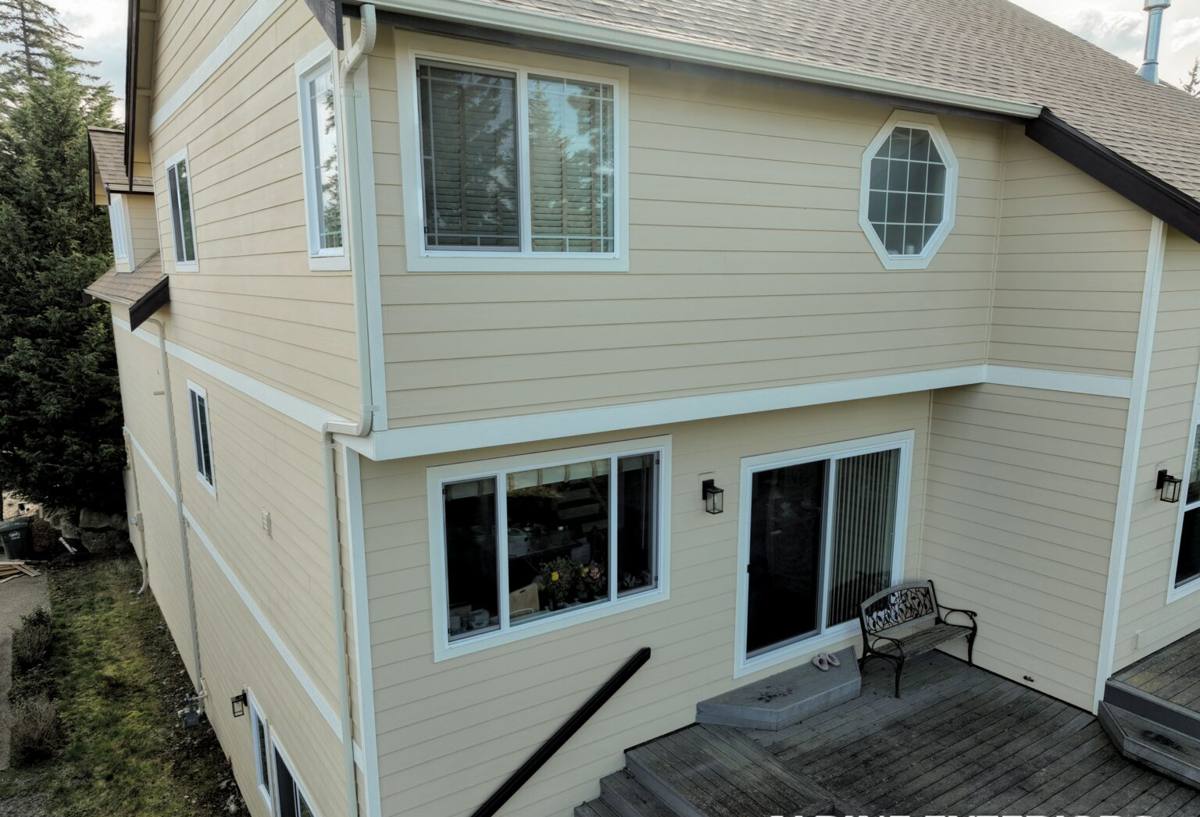
What Correct Siding Installation Actually Involves
Siding installation gets treated like a cosmetic job — pick a color, nail up some panels. That's not what protects a house. The siding itself is the least important part of the system. What actually keeps water out and lets a house breathe is everything underneath and behind it:
- A continuous, correctly lapped weather-resistive barrier (WRB) with no gaps at seams, corners, or penetrations
- Properly flashed windows, doors, and any roof-to-wall intersections, installed in the correct shingle-lap sequence so water always sheds outward and downward
- A rainscreen air gap behind the cladding on the sides of the home that take the worst weather, so moisture that does get past the siding can drain and dry instead of sitting against the sheathing
- Fasteners matched to the substrate and driven to manufacturer spec — not overdriven, not underdriven — at the correct field and edge distances
- Caulk and sealant used only where the manufacturer calls for it, never as a substitute for proper flashing
- Correct clearance at grade, decks, and patios so siding isn't sitting in contact with soil, mulch, or standing water
Skip any one of these and the siding on top can be the best product on the market and it still won't perform. This is the part of the job that separates a crew that understands Pacific Northwest wall assemblies from one that's just installing panels as fast as possible.
Why We Install James Hardie Fiber Cement — Only
We made a deliberate decision to install one product system: James Hardie fiber cement. Not vinyl, not LP SmartSide, not Cemplank or Allura, not primed wood or cedar. That's not a marketing angle — it's a standard we hold ourselves to because of what we've seen happen to other materials in exactly this climate.
Built for the Wet Side of the State
Hardie's HZ5 product line is engineered specifically for climates like ours — regions with prolonged moisture exposure, freeze-thaw cycling, and coastal humidity. It's fiber cement: sand, cement, and cellulose fiber, non-combustible, and dimensionally stable in a way that wood-based and vinyl products aren't. It doesn't swell and buckle in wet weather, and it doesn't soften or rot when moss and organic debris hold water against it longer than they should.
ColorPlus Factory Finish
Most siding failures we see aren't the substrate — they're the finish. Field-applied paint on any siding material starts breaking down years before the substrate does, especially somewhere as damp as South Hill. Hardie's ColorPlus finish is baked on in a controlled factory process, which gives it far better adhesion and UV resistance than paint applied on site, and it comes backed by its own finish warranty separate from the product warranty.
Salt Air and Fasteners
Salt-laden coastal air accelerates corrosion on anything metal — fasteners, trim flashing, hardware. Fiber cement itself doesn't corrode, and correct installation specifies fastener types rated for exterior and coastal exposure, which matters more on South Hill than it does further inland.
| Factor | Vinyl | Wood / LP SmartSide | James Hardie Fiber Cement |
|---|---|---|---|
| Moisture & moss tolerance | Can warp/gap; moss holds moisture against seams | Vulnerable to rot if moisture gets past finish | Dimensionally stable, resists moisture damage |
| Salt air exposure | Can become brittle over time | Finish and substrate both vulnerable | Non-combustible substrate, factory finish holds up |
| Fire resistance | Combustible | Combustible (engineered wood) | Non-combustible |
| Finish longevity | Color baked in but can fade/chalk | Field or factory paint, variable | ColorPlus factory finish, separate warranty |
| Long-term maintenance | Low but limited repairability | Higher — finish and caulk upkeep | Moderate — periodic caulk/paint checks per spec |
Every product on that list has legitimate uses somewhere. We simply don't think any of them hold up as well as Hardie does under South Hill's specific conditions, and we'd rather turn down work than install something we don't trust on a house we're putting our name on.
Our Installation Process on South Hill Homes
The process doesn't change dramatically house to house, but the sequencing and attention to detail on siding do, especially around tree-shaded lots and older wall assemblies common in this neighborhood.
- On-site assessment — we look at the existing wall assembly, any current moisture or rot damage, drainage at grade, and how much sun versus shade each elevation gets, since shaded, moss-prone walls sometimes need extra attention to the rainscreen detail
- Tear-off and sheathing inspection — old siding comes off and we inspect the sheathing underneath for hidden rot or moisture damage before anything new goes on; problems found here get repaired, not covered up
- Weather barrier installation — a new WRB is installed continuous and correctly lapped, with all penetrations sealed
- Flashing at every opening — windows, doors, and any roof intersections get properly sequenced flashing before the rainscreen and siding go on
- Rainscreen furring — a drainage gap is installed, particularly on north-facing and tree-shaded walls that stay damp longest
- Hardie panel or plank installation — installed to manufacturer fastening spec, with correct clearances at grade, decks, and trim
- Trim, caulking, and final finish check — sealant applied only where specified, and a final walk-through of every seam and penetration
Signs a South Hill Home Needs New Siding
Some of these show up gradually enough that homeowners assume it's cosmetic. It's usually not.
- Persistent moss or algae staining that comes back within a season of cleaning
- Soft spots or visible warping, especially near the bottom courses or around window trim
- Paint that's peeling or bubbling rather than just fading evenly
- Visible gaps at seams, corners, or trim that weren't there when the siding was new
- Rising energy bills that can't be explained by anything else — often a sign the wall assembly behind the siding is compromised
- Any soft or spongy feel when you press on the siding near grade or below windows
Cost Factors for Siding Installation in South Hill
| Factor | Why It Affects Cost |
|---|---|
| Existing wall condition | Rot or moisture damage found at tear-off requires sheathing repair before new siding goes on |
| Home size and complexity | Number of corners, gables, and trim details adds labor beyond straight square footage |
| Access and site conditions | Hillside lots, tree cover, and tight side yards on South Hill can slow staging and material handling |
| Product selection | Lap siding, panel siding, and shingle-style Hardie products carry different material and labor costs |
| Rainscreen and flashing scope | Full rainscreen assemblies and extensive flashing work add labor but are what actually protect the home long-term |
| Color and finish | Factory ColorPlus finishes cost more upfront than field-primed products but eliminate early repainting |
We don't quote from a distance. A number based on square footage alone, without seeing the actual wall condition, isn't a real estimate — it's a guess.
Why a Crew That Already Works South Hill Matters
Siding installation isn't identical from neighborhood to neighborhood, even within Bellingham. A crew that regularly works South Hill's tree-shaded, hillside lots already knows to plan around limited street access, to pay closer attention to rainscreen detail on the shadiest elevations, and to expect a longer moss season on north- and east-facing walls than they might see on more open, sun-exposed properties elsewhere in Whatcom County. That familiarity shows up in small decisions — where to add extra drainage capacity, which walls need the most attention at tear-off — that a crew unfamiliar with the area might not think to make.
It also matters for timing. Whatcom County's wet season runs long, and installation scheduling around dry windows is part of doing the job right rather than rushing panels onto damp sheathing.
After Installation: What Upkeep Looks Like
Correctly installed Hardie siding is low-maintenance, not zero-maintenance. Plan on an annual visual check — looking at caulking around trim and penetrations, checking for any moss buildup in shaded corners, and rinsing off accumulated grime or organic growth before it has a chance to hold moisture against the surface. That's a fraction of the upkeep other materials demand in this climate, but it's still worth doing.
If your South Hill home's siding is showing its age, or you're planning ahead rather than waiting for a failure, we're happy to take a look and give you a straight, no-pressure estimate — no obligation, just an honest read on where your home stands.