 Bellingham Siding
 Why Sunnyland Homes Need Siding Built for This Climate
Sunnyland sits close enough to Bellingham Bay and the surrounding waterways that homes here take on a specific combination of stress most inland neighborhoods don't deal with: salt-laden air, wind-driven rain that hits siding at an angle instead of falling straight down, and a long stretch of the year where shade, moisture, and cool temperatures line up perfectly for moss and algae growth. None of these factors are dramatic on their own, but stacked together over years they're exactly what wears out the wrong siding material and exposes sloppy installation work.
Salt air accelerates corrosion on fasteners and metal trim. Driving rain finds every gap in flashing and caulking that a calmer climate would never test. And moss doesn't just sit on a roof — given the right surface and enough shade, it colonizes siding too, holding moisture against the wall long after a storm has passed. Whatcom County's marine climate makes this a year-round condition, not a seasonal one.
Siding for a Sunnyland home isn't a cosmetic decision. It's the first line of defense for the sheathing, framing, and insulation behind it, and it needs to be selected and installed with this specific climate in mind — not a generic weather profile.
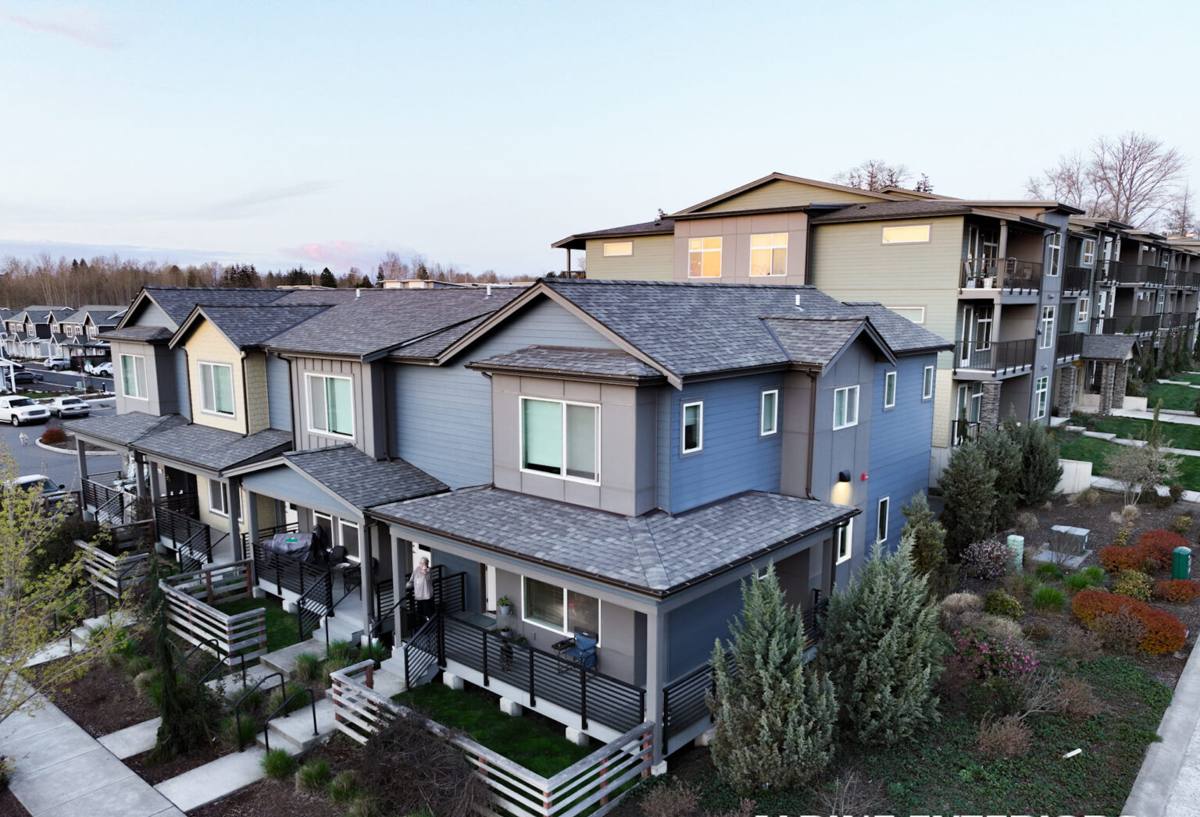
What Fiber Cement Actually Solves Here
Wood siding and trim absorb moisture, which is exactly what you don't want in a climate that stays damp for months at a stretch. Wood swells, cracks, and rots at joints and end grain, and it feeds the moss and mildew that already thrive in this environment. Vinyl sheds water fine on the surface, but it flexes and gaps at seams over time, softens under prolonged direct sun on south- and west-facing walls, and can't be repainted when it fades — you're stuck with whatever color it shipped with, forever.
Fiber cement is a different material entirely: sand, cement, and cellulose fiber, pressed and cured into a plank that doesn't absorb water the way wood does, doesn't expand and contract the way vinyl does, and doesn't burn. That combination matters in a climate that alternates between soaking rain and dry, sunny stretches — the siding needs to handle both without moving, cupping, or letting moisture in at the seams.
We install James Hardie fiber cement exclusively. We don't install LP SmartSide, vinyl, Cemplank, Allura, primed spruce, or cedar, and we're upfront with Sunnyland homeowners about why: those products each have real strengths, but they also carry maintenance burdens, moisture risks, or finish-durability trade-offs that we've decided we're not willing to put our name behind. James Hardie's ColorPlus factory-finished panels, non-combustible composition, and climate-specific HZ product engineering are what we've standardized on because they hold up to exactly the conditions Sunnyland sees — without asking the homeowner to repaint, recaulk, or patch rot every few years.
Product Line: Matching Hardie to a Marine Climate
James Hardie engineers its siding in HZ5 and HZ10 formulations calibrated to different climate zones across the country. Western Washington, including Bellingham and Whatcom County, falls into the HZ5 zone — engineered specifically for wet, moderate-temperature coastal and marine climates rather than freeze-thaw extremes or high-heat/high-UV regions. That's not a marketing distinction; it affects the moisture resistance and durability the product is built to deliver in this exact environment.
For Sunnyland's mostly single-family housing stock, we typically work with:
- HardiePlank lap siding — the standard horizontal siding for most homes, available in several exposure widths and textures (smooth or cedarmill) to match the look of the neighborhood.
- HardiePanel vertical siding — used for accent sections, gables, or a more modern look on additions and remodels.
- HardieTrim boards — for corners, window and door casing, and fascia, so the whole exterior envelope is fiber cement rather than mixing in wood trim that will rot faster than the siding around it.
- ColorPlus finishes — factory-baked color coats that resist fading and chipping far better than field-applied paint, which matters when you're trying to avoid a repaint cycle in a climate this wet.
What a Correct Installation Actually Involves
Fiber cement siding is only as good as its installation. The material itself resists moisture well, but a poorly installed job — wrong fastener pattern, missing flashing, caulked joints where there should be gaps — will fail regardless of what's nailed to the wall. In a climate that tests every seam with driving rain, installation quality matters more here than in drier parts of the state.
The details we don't skip
- Correct starter strip and minimum ground clearance so the bottom course never sits in splash-back moisture
- Manufacturer-specified fastener placement and spacing — over-driven or misplaced nails crack the board or void the warranty
- Proper weather-resistive barrier and rainscreen detailing behind the siding, so any moisture that does get past the surface can drain and dry rather than sit against the sheathing
- Flashing at every window, door, and horizontal trim transition — the single most common failure point on older homes we open up
- Joints treated per Hardie's specifications (some are caulked, some are designed to be left as controlled gaps) rather than caulking everything and trapping moisture
- Corner and trim details sealed correctly against wind-driven rain, which hits east- and south-facing walls in Sunnyland harder than most homeowners expect
This is also why we don't mix fiber cement with wood trim to save cost. A rotting trim board next to a Hardie panel undermines the whole system and creates a moisture path directly behind the siding.
Our Process for a Sunnyland Job
Every project starts with a walk-around of the existing siding and trim, not just a measurement for materials. We're looking for what's already failing — soft spots, moss buildup, gaps at trim, signs of past water intrusion — because that tells us where the sheathing needs attention before new siding goes up. Covering rot with new siding just hides a problem that gets worse.
- On-site assessment of existing siding, trim, flashing, and any moisture damage
- Removal of old siding and inspection of the sheathing and weather barrier underneath
- Repair of any damaged sheathing or framing found during removal
- Installation of weather-resistive barrier and rainscreen/drainage plane where called for
- Installation of HardiePlank, HardiePanel, and HardieTrim per manufacturer specification
- Final flashing, joint, and paint-line detailing, with a walk-through before we call it done
Cost Factors for Sunnyland Homes
Every fiber cement job prices differently based on the condition of what's underneath and the shape of the house, not just square footage. The table below covers the main factors that move a bid up or down.
| Factor | Why It Matters |
|---|---|
| Condition of existing sheathing | Rot or moisture damage found during removal adds repair work before new siding can go on |
| House height and stories | Multi-story homes need scaffolding or lift equipment, which adds labor time and cost |
| Trim and architectural detail | Homes with more corners, gables, and window trim take longer per square foot than a simple rectangular footprint |
| Siding profile and finish choice | Exposure width, texture, and ColorPlus color selection affect material cost |
| Full removal vs. tear-off complications | Multiple layers of old siding or hidden damage extend the removal phase |
| Access and site conditions | Tight lot lines, landscaping, or limited driveway access affect setup and material staging |
We give firm, itemized estimates after the on-site assessment rather than a phone quote — the condition behind the existing siding is the biggest variable, and that's not something you can price accurately without seeing it.
Why a Crew That Already Works Sunnyland Matters
A contractor who works this neighborhood regularly already understands the housing stock, the typical trim details, and the climate exposure specific to homes near the bay. That familiarity shows up in small but real ways: knowing which wall orientations take the worst of the driving rain, recognizing early moss growth as a moisture signal rather than just a cosmetic issue, and understanding how Whatcom County's permitting and inspection process works for exterior projects. It also means a crew that isn't learning fiber cement installation on your house — they've already handled the flashing and clearance details this climate demands, on homes like yours, in this same weather.
Maintaining Fiber Cement Siding in a Wet, Salt-Air Climate
Fiber cement is low-maintenance compared to wood, but "low-maintenance" doesn't mean zero-maintenance, especially this close to the water. A simple annual routine keeps it performing the way it's designed to:
- Rinse siding once or twice a year to clear salt residue, pollen, and organic buildup before it feeds moss or algae growth
- Keep gutters and downspouts clear so water isn't sheeting down the wall face during heavy rain
- Trim back shrubs and trees that hold shade and moisture against siding, which is where moss establishes first
- Check caulked joints around windows and trim yearly and touch up any that have separated
- Inspect the bottom courses near grade for splash-back staining or vegetation growing too close to the siding
- Address any impact damage or cracked boards promptly — a small gap is an easy fix, a neglected one becomes a moisture entry point
If you're planning a siding project in Sunnyland, we're happy to take a look and walk you through what your home actually needs — no pressure, no obligation. Use the form below to request a free estimate.